

Drawings and documents
National Archives restored drawings: drawing
John P. Ridings' Patent Drawing for a Machine for Thrashing Clover Seed

National Archives, Restored Patent Drawings (Record Group 241) · Full-size scan at the National Archives · Catalog record
Show the text on the drawing Hide (157 words)
Words on the drawing as machine-read by the National Archives; not checked. Useful mainly for searching.
Clover Hullers. / Entered Millitkulling / SI / 8912-+ / John LC Riding / Machine for thrashing blover Seed. / Patented: 19 Fune: 1835. / References. / Fig 1. Isometrical view of the machine (sides covering removed). / I Strap pulley. / 2. Separating screen with its supporter Spart of shoot boards. / h. Shelving or thrashing floor. / 3. showing the construction of the cylinder, without the iron sheathing. / i. Fellows for the shelving / a. Ferame / k. Loops with regulating screws / b. Feeding board or table. / Γ. Springs to force the shelving to cylinder / c. Feeder or feeding roller / m. Seperating screen. / d. bylinder / n. Supporter for the screen. / c. Cylinder / o. Shoot board for the seed. / f. bylinder- raild / p. / ditt for the hull on chaff / Figl. / Fig3 / be / OP / In / Fig2 / Patent Office April 2d. 1839. / Made under the direction of the Commipioner of Patents in / conformity with act: 3d March 1837. / francis Henne delt. / Commifriorer of Pate
USPTO scan
The patent as scanned by the USPTO
-
 Page 1
-
 Page 2
-
 Page 3


U.S. Patent and Trademark Office · Google Patents
Show the transcription Hide (502 words)
Machine transcription (LightOnOCR) of the pages as scanned by the USPTO, most of them the handwritten copies made when the records were restored after the 1836 fire. Not checked; it can misread handwriting, so compare it with the scan.
Page 1.
X 8,912
J.P. Riding, BEST AVAILABLE COPY
Clover Huller.
Patented June 19, 1835.
Fig. 3
Fig. 2
Fig. 1
A. PETER, PHOTO-LITHOGRAPHER, WASHINGTON, D.C.
Page 2.
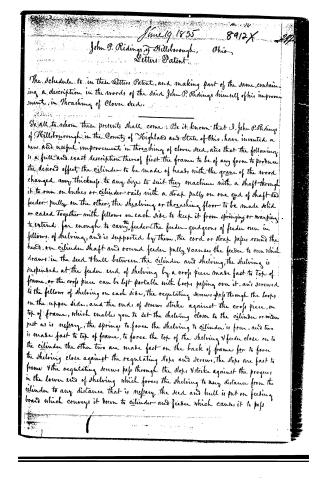
June 19, 1855 8912X 297
John P. Ridings, of Hillsborough, Ohio,
Letters Patent.
The Schedule to in this Letters Patent, and making part of the same, containing a description in the words of the said John P. Ridings himself of his improvement, in Thrashing of Clover Seed.
To all to whom these presents shall come: Be it known that I, John P. Ridings of Hillsborough, in the County of Highland and State of Ohio, have invented a new and useful improvement in thrashing of clover seed, and that the following is a full and exact description thereof: first the frame to be of any form to produce the desired effect, the cylinder to be made of heads with the grain of the wood changed every thickness to any size to suit they machine with a shaft through it to run on bushes or cylinder rails with a strap pully on one end of shaft and feeder pully on the other, the shelving or thrashing floor to be made solid or cased together with fellows on each side to keep it from springing or warping to extend far enough to carry the feeder—the feeder—gudgeons of feeder run in fellows of shelving, and is supported by them, the cord or strap passes round the head on cylinder shaft and round feeder pully & causes the feeder to run which draws in the seed & hull between the cylinder and shelving, the shelving is suspended at the feeder end of shelving by a cross piece made fast to top of frame, or the cross piece can be left portable with loops passing over it, and screwed to the fellows of shelving on each side, the regulating screws pass through the loops on the upper side, and the ends of screws strike against the cross piece, on top of frame, which enables you to set the shelving closer to the cylinder or wider just as is necessary, the springs to force the shelving to cylinder is four and two is made fast to top of frame, to force the top of the shelving & feeder close on to the cylinder the other two are made fast on the back of frame for to force the shelving close against the regulating stops and screws, the stops are fast to frame & the regulating screws pass through the stops & strike against the grooves in the lower end of shelving which forces the shelving to any distance from the cylinder to any distance that is necessary, the seed and hull is put on feeding board which conveys it down to cylinder and feeder which causes it to pass
Page 3.
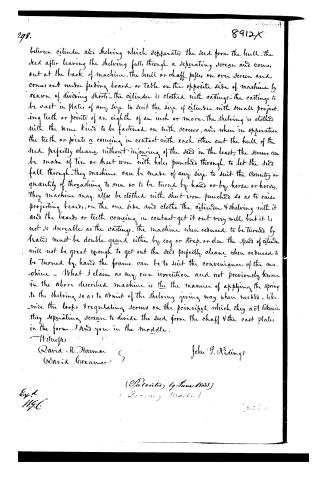
298. …
Published accounts: specification
Specification printed in the Journal of the Franklin Institute
Journal of the Franklin Institute, new ser., vol. 17 (1836), p. 59 · View the page
Text of the specification as printed in the Journal, from OCR; not proofread.
Specification of a Patent for an improvement in Riding Saddles. Granted to A. L. VAN HORN, City of Philadelphia, June 26th, 1835. To all whom it may concern, be it known, that I, A. L. Van Horn, of the City of Philadelphia, have invented an improvement in the manner of making Riding Saddles of all descriptions, and that the following is a full and exact description thereof. The saddle need not in its general construction be in any way altered from that now pursued by the manufacturers of that article. The saddle tree, the irons, the mode of covering, and in fact all the parts may be the same with those now employed by different workmen, my improvements consisting solely in the substituting webbing, or girth, of the kind denominated India Rubber Webbing, for that which is usually strained upon the saddle tree, and which forms the foundation for the seat. The India Rubber Webbing is a well known article, consisting in part of that substance interwoven with the ordinary materials of webbing, and communicating to it great elasticity, and that in a degree peculiarly adapting it to the new purpose to which I have applied it. In order to derive all the advantage possible from the use of this webbing, I take care in straining it to draw it as high upon the cantle as possible, as by this means it will have sufficient play without descending so low as to come in contact with the back of the horse, or with the saddle tree. A. L. VAN HORN.
Published accounts: journal notice
Notice in the monthly list of patents
Journal of the Franklin Institute, new ser., vol. 16 (1835), p. 143 · View the page
355. Hulling clover seed.-John P. Ridings, Hillsborough, Ohio,
Published accounts: journal notice
Notice in the monthly list of patents, with remarks
Journal of the Franklin Institute, new ser., vol. 17 (1836), p. 50 · View the page
A kind of instrument resembling a double wheeled plough is so constructed as that the wheels may straddle the cotton rows. One of the wheels has cogs on its inner face which take into a pinion, or trundle, on a horizontal shaft, revolving lengthwise of the machine, and carrying two hoes, or one, as may be desired, on the ends of arms, for thinning the cotton; a coulter and horse hoe are fixed on to each side rail, for siding up. Some directions are given respecting the use of the machine when the cotton may be unequal in thickness; but upon the whole its action is not rendered clear. The claim is to "the manner in which I have combined the operation of the wheels and hoes in the interior of the frame." 45. For a Machine for Thrashing Clover Seed; John P. Ridings, Hillsborough, Highland county, Ohio, June 19.
Remarks. In this hulling machine the seeds are to be rubbed between a cylinder and concave, and the fixing of the latter so as to be borne up by springs is all that is claimed. We apprehend that this claim has been before made, or the method of doing it described, at least ninety and nine times.
About this record
- Patentee
- DATAMP
- Date
- the Name and Date index of patents, DATAMP, USPTO records
- Invention
- DATAMP
- Listed in
- the Name and Date index of patents, DATAMP, USPTO records, Jim Shaw's X-patent list, the Journal of the Franklin Institute, Burke's List of Patents (1847)
- Burke's 1847 Patent Office list gives the same patent.