

Drawings and documents
National Archives restored drawings: drawing
Jordan Gatling's Patent Drawing for a Cotton Planter

National Archives, Restored Patent Drawings (Record Group 241) · Full-size scan at the National Archives · Catalog record
Show the text on the drawing Hide (88 words)
Words on the drawing as machine-read by the National Archives; not checked. Useful mainly for searching.
IIf SEEDERS & PLANTERS: / [133] Cotton. / Fintered / to : / CLASSE / 8920x / DI VII TOM / Tarling / Cordon Pacting / Parented 20. isss. / Collon Planter / A This lever is not mentroned in the specification. / References. / A.Plough beam B Handles C.Coverer. D. Coulter E Opener / Patent office april 24" 1838. / E Ecoppen a Shutter handle Hower hopper. / Made under direction of the commission of Patents / in conformity with the art of 3"March 133y / ML sumorth / Commissionery Patents
USPTO scan
The patent as scanned by the USPTO
-
 Page 1
-
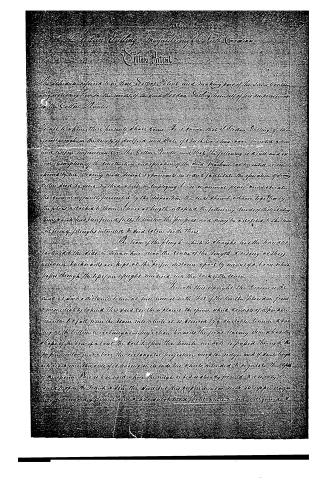 Page 2
-
 Page 3
-
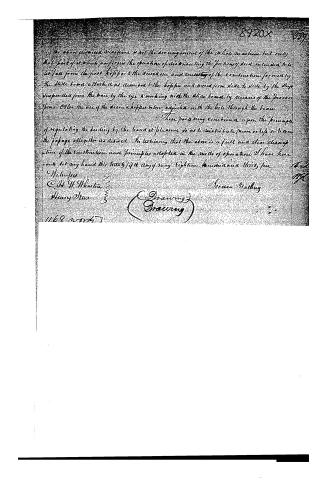 Page 4


U.S. Patent and Trademark Office · Google Patents
Show the transcription Hide (1,165 words)
Machine transcription (LightOnOCR) of the pages as scanned by the USPTO, most of them the handwritten copies made when the records were restored after the 1836 fire. Not checked; it can misread handwriting, so compare it with the scan.
Page 1.
8920X
J. Cating.
Cotton Planter.
No.
Patented Jan. 20, 1836.
Page 2.
June 27, 1835
Brown Gallery, Manchester, N.H.
Sales Patent
The following refers to the Sales Patent and making part of the same certain suggestions for the benefit of the said Brown Gallery himself and his successors in the Cotton Printer.
I will hereafter have present shall come. Be it known that I, William Gelling of Manchester, in the County of Hartford and State of New Hampshire, have invented and made improvements in the Cotton Printer, and that the following is a full and clear description of the construction and operation of the said Machine as invented and improved by me, having made several experiments in order to facilitate the operation of the Cotton Printer by some method which is employing to save a number of power, and to overcome the greatest difficulties presented by the disposition. The said Machine is shown together by the plates attached to these Sheets at length described, the following drawing particularly shows what I have found a fully to answer the purpose and may be described in the annexed figures intended to be used with this.
The base of the plough which is brought to the harness is attached to the side of the machine near the center of the length, and the harness is placed back and forth at the proper distance apart by means of a lever that passes through the top of an upright mounted into the back of the frame.
Beneath this upright the cross is placed and at such a distance below as will accord with that of the Guide Plate and is immediately behind the said Guide Plate and the space which consists of a paper under it, fell from the frame into which it is secured by a suitable means, showing at the bottom a rectangular projection to one of the front having a convex shape of the line of a boat, the bed to open the means, an eye is passed through the perpendicular just below the rectangular projection across the ridge and of such large as to reach in either side of it having such ends the wheel intended to regulate the edge of the paper. This is to be used when the ridge or bed is already formed, otherwise, it is used to form the trough when the said bed is perpendicular to such it approaches may be removed by means and a bed substituted for it when not required.
Page 3.
the handle opens there as usual. In order to distribute the seed I construct the following apparatus, consisting of a hopper or on top of a between the handles just behind the opener & which is here deemed to be the handle the shape which has adopted by using an elong following the length of the beam.
To the bottom of the four sides (which are gradually to approach each other as they descend) is attached a shutter or slide board, so as to close up the opening when desired either entirely (as when we turning or on spots not to be sown) or in part so as to let out but a given portion of seed such as may be requisite to the sowing. This motion to be given to this slide board is produced by the following arrangement; a broad piece of leather which I find to be numerous such as any thing else) is fastened to the bottom of the front side of the hopper so as to allow the board to shake from side to side, and on the opposite or back side of the hopper another piece of leather is attached to the under side of the slide board or a piece of pop or through it & the end of a long lever or handle consisting of a slender shaft sufficiently long to reach to the end of the plough handles so as to be grasped at the same time that with when desired. This shaft is supported beneath the beam, which keeps the handles apart by means of a staple or eye secured thereto and in which it plays from side to side.
Beneath this first hopper is located to contain the seed, is placed another enclosing the lower part of it & descending by a gradual diminution of its width so as to leave below the beam, where the sides approach the near as a long narrow opening of about two or three inches in length and about one in breadth through which the seed passes into the trough previously opened by the lever or opener & a corresponding hole made through the beam by shaking this shaft handle or moving it from side to side as the plough advances the staple forming the fulcrum regulates the distance to which the slide board can move from side to side, the pin through it and the end of the shaft serving as a pivot and the leather hinge being sufficient. This is a kind of the same motion. In this manner a long triangular opening is formed at each shake or movement of the shaft and slide board on say the left hand side (as being the most handy) during the progress of the plough and should it be desired to turning or on other occasions the opening may be effectively closed so as to prevent the passage of the seed by pressing the shaft to the plough handle of the opposite side & the triangular opening & retaining it there by the grasp of the hand comes both under the sowing to commence. That I claim as my invention and not previously known.
Page 4.
8920X 337
In the above described machine is not the arrangement of the whole machine but only that part of it which performs the operation of distributing the grains of rice intended to be fed from the first hopper to the second, and consisting of the construction formerly by the slide board attached as described to the hopper and moved from side to side by the stop suspended from the back by the eye & working with the slide board by means of the pressure spring. Also the use of the second hopper below, adjusted with the hole through the beam.
These parts being constructed upon the principle of regulating the feeding by the hand at pleasure, so as to distribute more or less or to cease the passage altogether as desired. In testimony that the above is a full and clear description of the construction and principles adopted in the mode of operation I have hereunto set my hand this twenty-fifth day of May, eighteen hundred and thirty-five.
Witnesses
C. H. W. Wharton 2
Henry Stone 3
(Signing)
(Signing)
1168 words
Filed
JUL
Published accounts: journal notice
Notice in the monthly list of patents
Journal of the Franklin Institute, new ser., vol. 16 (1835), p. 143 · View the page
366. Cotton planting.-Jordan Gatling, Murfreesborough, N. C.
Published accounts: journal notice
Notice in the monthly list of patents
Journal of the Franklin Institute, new ser., vol. 17 (1836), p. 50 · View the page
44. For thinning Cotton Plants; Jordan Gatling, Murfreesborough, Hertford county, North Carolina, June 19.
About this record
- Patentee
- DATAMP
- Date
- the Name and Date index of patents, DATAMP, USPTO records
- Invention
- DATAMP
- Listed in
- the Name and Date index of patents, DATAMP, USPTO records, Jim Shaw's X-patent list, the Journal of the Franklin Institute, Burke's List of Patents (1847)
- Burke's 1847 Patent Office list gives the same patent.