

Drawings and documents
National Archives restored drawings: drawing
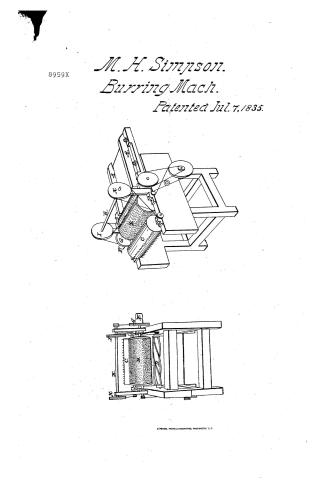
M.H. Simpson's Patent Drawing for a Butting Machine

National Archives, Restored Patent Drawings (Record Group 241) · Full-size scan at the National Archives · Catalog record
Show the text on the drawing Hide (35 words)
Words on the drawing as machine-read by the National Archives; not checked. Useful mainly for searching.
$2, / 19, CARDING. / x2. - / [28] Burring. / Wave / CLASSIFICATION / 8959x / M.H.SIMPSON o / DIVISION. / Bulling Machune. / Patented July 7th 1855 / Hi / ar
USPTO scan
The patent as scanned by the USPTO
-
 Page 1
-
 Page 2
-
 Page 3
-
 Page 4
-
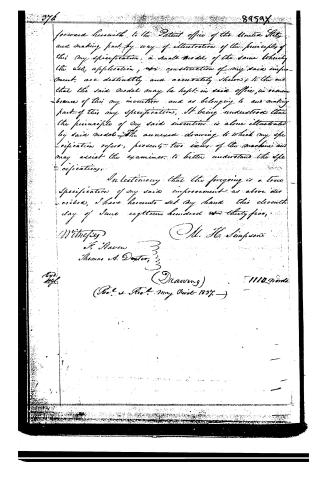 Page 5


U.S. Patent and Trademark Office · Google Patents
Show the transcription Hide (1,188 words)
Machine transcription (LightOnOCR) of the pages as scanned by the USPTO, most of them the handwritten copies made when the records were restored after the 1836 fire. Not checked; it can misread handwriting, so compare it with the scan.
Page 1.
8959X
M. H. Simpson.
Burring Mach.
Patented Jul. 7, 1835.

Page 2.
July 7, 1835
M. H. Simpson of Boston, Massachusetts
Letters Patent
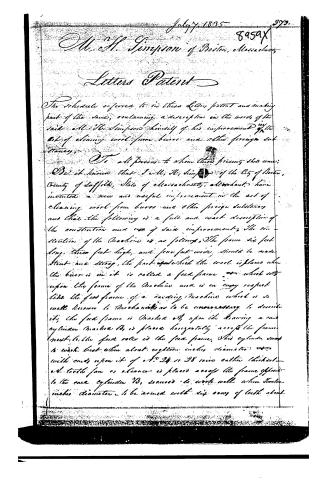
The schedule referred to in these Letters patent and making part of the same, containing a description in the words of the said M. H. Simpson himself of his improvement in the art of cleaning wool from burrs and other foreign substances.
To all persons to whom these presents shall come:
Be it known that I, M. H. Simpson of the City of Boston, County of Suffolk, State of Massachusetts, aforesaid, have invented a new and useful improvement in the art of cleaning wool from burrs and other foreign substances and that the following is a full and exact description of the construction and use of said improvement: The dimensions of the Machine is as follows: The frame six feet long, three feet high, and four feet wide, should be made stout and strong, the part upon which the wool is placed when the burr is in it is called a feed frame which rests upon the frame of the Machine and is in every respect like the feed frame of a carding Machine which is so well known to Mechanicians to be unnecessary to describe it; the feed frame is marked A, upon the drawing a card cylinder marked B, is placed horizontally across the frame next to the feed roller in the feed frame. This cylinder used to work best when about eighteen inches diameter and with ends upon it of 1/4, 2/4, or 2/8 size rather thicker and teeth for as cleaner is placed across the frame opposite to the card cylinder B, secured to work well when twelve inches diameter to be armed with six rows of teeth about
Page 3.
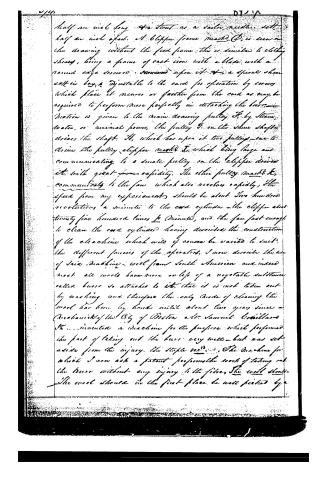
half an inch long, as stout as a sailor needle, set half an inch apart. A clipper frame marked C, is seen on the drawing without the feed frame. This is similar to clothing shears, being a frame of cast iron with a blade with a round edge screwed upon it, and a spindle shown set in box, adjustable to the card for operation by screw which place it nearer or farther from the card as may be required to perform more perfectly in detaching the burrs. Motion is given to the main drawing pulley H, by steam, water, or animal power, the pulley G, on the same shaft drives the shaft H, which has upon it two pulleys, one to drive the pulley clipper marked I, which being large and communicating to a small pulley on the clipper drives it with great rapidity. The other pulley marked K, communicates to the fan, which also revolves rapidly. The speed from my experiments should be about two hundred revolutions a minute to the card cylinder—the clipper about twenty-five hundred times a minute, and the fan fast enough to clean the card cylinder. Having described the construction of the machine which will of course be varied to suit the different species of the operators, I now describe the use of said machine. Wool from South America and indeed most all wools have more or less of a vegetable substance called burrs so attached to it, that it is not taken out by washing, and therefore the only mode of cleaning the wool has been by hand until about two years since a Mechanic of the City of Boston Mr. Samuel Cravilland Sr. invented a machine for the purpose which performed the part of taking out the burrs very well—but was set aside from the injury the staple received. The machine for which I now ask a patent performs the work of taking out the burrs without any injury to the fibre. The wool should—The wool should in the first place be well picked by a
Page 4.
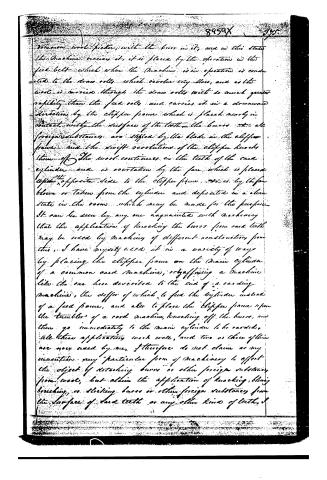
common wool picker, with the burrs in it, and in this state the machine receives it, it is placed by the operation of the feed belt which when the machine is in operation is connected to the draw rolls which revolve very slow, and as the wool is carried through the draw rolls with so much greater rapidity than the feed rolls and carries it in a downward direction by the clipper frame which is placed nearly in contact with the surface of the teeth, the burrs and all foreign substances are stopped by the blade in the clipper frame and the swift revolutions of the clipper knocks them off. The wool continues in the teeth of the card cylinder and is oscillated by the fan which is placed upon the opposite side to the clipper frame and is by the fan blown or taken from the cylinder and deposited in a clean state in the room which may be made for the purpose. It can be seen by any one acquainted with machinery that the application of knocking the burrs from card teeth may be used by machines of different construction from this. I have myself used it in a variety of ways by placing the clipper frame on the main cylinder of a common card machine, or affixing a machine like the one here described to the end of a carding machine, the doffer of which to feed the cylinder instead of a feed frame, and also to place the clipper frame upon the tumbler of a card machine, knocking off the burrs, and then go immediately to the main cylinder to be carded. All these applications work well, and two or three of them are now used by me. I therefore do not claim as my invention any particular form of machinery to effect the object of detaching burrs or other foreign substances from wool, but claim the application of knocking, blowing, brushing, or striking burrs or other foreign substances from the surface of card teeth or any other kind of teeth.
Page 5.
forward herewith to the Patent office of the United States and making part by way of illustration of the principles of this my specification, a small model of the same whereby the use, application, and construction of my said improvement are distinctly and accurately shown, to the end that the said model may be kept in said office, in remembrance of this my invention and as belonging to and making part of this my specification, it being understood that the principles of my said invention is alone illustrated by said model. The annexed drawing to which my specification refers, presents two views of the machine and may assist the examiner to better understand the specifications.
In testimony that the foregoing is a true specification of my said improvement as above described, I have hereunto set my hand this eleventh day of June eighteen hundred and thirty-five.
Witnesses
H. Haven
Thomas A. Dexter
M. H. Simpson
(Drawing)
(Rec'd. & Rec'd. May 2nd 1837.)
1112 words
Published accounts: journal notice
Notice in the monthly list of patents
Journal of the Franklin Institute, new ser., vol. 16 (1835), p. 215 · View the page
398. Wool, cleaning from burs, &c.-Michael H. Simpson, city of Boston,
Published accounts: journal notice
Notice in the monthly list of patents, with remarks
Journal of the Franklin Institute, new ser., vol. 17 (1836), p. 121 · View the page
14 4 10. For Cleaning Wool from Burrs, &c.; M. N. Simpson, Boston, Massachusetts, July 7.
Remarks. After giving a description of the machine intended to be used, the patentee observes that "wool from South America, and indeed almost all wools, have more or less of a vegetable substance, called burrs, so attached to it that it is not taken out by washing, and therefore the only mode of cleaning the wool has been by hand, until about two years since, a mechanic of the city of Boston, Mr. Lemuel Couillard, jr. invented a machine for the purpose, which performed the part of taking out the burr very well, but was set aside from the injury the staples received. The machine for which I now wish a patent performs the work of taking out the burr without any injury to the fibre. The wool should in the first place be well pinched by a common wool pincher, with the burr in it, and in this state the machine receives it; it is placed by the operation, on the feed belt, which when the machine is in operation is conducted to the draw rolls, which revolve very slow, and as the wool is carried through the draw rolls, the card cylinder takes it in small quantities in a thin state, as it revolves with so much greater rapidity than the feed rolls, and carries it in a continued direction by the clipper frame, which is placed nearly in contact with the surface of the teeth, the burrs and all foreign substances are stopped by the blade of the clipper frame, and the swift revolution of the clipper knocks them off. The wool continues in the teeth of the card cylinder, and is overtaken by the fan which is placed on the opposite side of the clipper frame, and is by the fan blown or taken from the cylinder and deposited in a clean state in the room which may be made for the purpose." It is stated that the machine may be much varied in form whilst the same effect will be produced, and the patentee says, "I do not therefore claim as my invention any particular form of machinery to effect the object of detaching burrs or other foreign substances from wool, but claim the application of knocking, blowing, brushing, or striking the burrs or other foreign substances from the surface of the card teeth, or any other kind of teeth." We think this claim may prove too broad, as it will be seen on turning to p. 187, vol. 13, that Mr. Couillard claimed, among other means, the "blowing or striking them off," when properly exposed; it may be, however that in the present machine the removal being effected from "the surface of the card teeth," may so far modify the thing as to prevent the one patent interfering with the other.
About this record
- Patentee
- DATAMP
- Date
- the Name and Date index of patents, DATAMP, USPTO records
- Invention
- DATAMP
- Listed in
- the Name and Date index of patents, DATAMP, USPTO records, Jim Shaw's X-patent list, the Journal of the Franklin Institute, Burke's List of Patents (1847)
- Burke's 1847 Patent Office list gives the same patent.