

Drawings and documents
USPTO scan
The patent as scanned by the USPTO
-
 Page 1
-
 Page 2
-
 Page 3
-
 Page 4
-
 Page 5


U.S. Patent and Trademark Office · Google Patents
Show the transcription Hide (1,326 words)
Machine transcription (LightOnOCR) of the pages as scanned by the USPTO, most of them the handwritten copies made when the records were restored after the 1836 fire. Not checked; it can misread handwriting, so compare it with the scan.
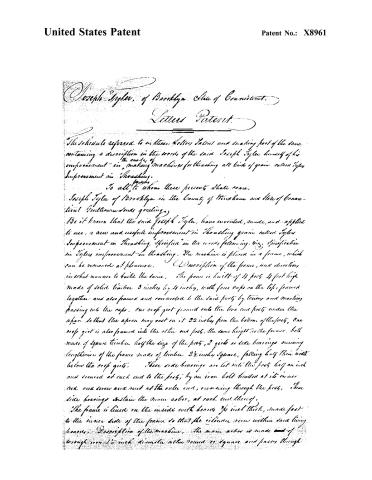
Page 2.
United States Patent
Patent No.: X8961
Joseph Tyler, of Brooklyn, State of Connecticut.
Letters Patent.
The schedule referred to in these Letters Patent and making part of the same containing a description in the words of the said Joseph Tyler himself of his improvement in the mode of making machines for threshing all kinds of grain called Tyler Improvement in Threshing.
To all to whom these presents shall come,
Joseph Tyler of Brooklyn in the County of Windham and State of Connecticut Greetings.
Be it known that the said Joseph Tyler, have invented, made, and applied to use, a new and useful improvement in Threshing grain called Tyler Improvement in Threshing specified in the words following, viz: Specification in Tyler improvement in threshing. The machine is placed in a frame, which can be removed at pleasure.
Description of the frame, and directions in what manner to build the same. The frame is built of 4 posts 4 feet high made of solid timber 3 inches by 4 inches, with four caps on the top, framed together and also framed and connected to the said posts by tenons and mortises passing into the caps. One cross girt framed into the two end posts under the apron so that the apron may rest on it 22 inches from the bottom of the posts. One cross girt is also framed into the other end posts, the same height as the former, both made of square timber half the size of the posts, 2 girts so side bearings running lengthwise of the frame made of timber 2½ inches square, falling half their width below the cross girts. These side bearings are let into the posts half an inch and secured at each end to the posts, by an iron bolt headed at its inner end and screw and nut at the outer end, running through the posts. These side bearings sustain the main axis, at each end thereof.
The frame is lined on the inside with boards ½ inch thick, made fast to the inner side of the frame so that the cylinder runs within said lining boards. Description of the machine. The main axis is made of wrought iron 1½ inch diameter either round or square and passes through
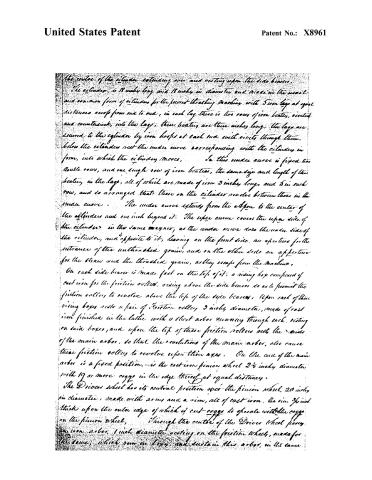
Page 3.
United States Patent
Patent No.: X8961
The center of the cylinder extending over and resting upon the side beater.
The cylinder is 18 inches long and 18 inches in diameter and made in the usual and common form of cylinders for the present threshing machines with 5 iron legs at equal distances across from end to end, in each leg there is two rows of iron beaters, riveted and countersunk, into the legs; these beaters are three inches long. The legs are secured to the cylinder by iron hoops at each end with rivets through them.
Below the cylinder rests the under curve corresponding with the cylinder in form, into which the cylinder moves. In this under curve is fixed two double rows, and one single row of iron beaters, the same size and length of the beaters in the legs, all of which are made of iron 3 inches long, and 5 in each row, and so arranged that those on the cylinder revolve between those in the under curve. The under curve extends from the abpon to the center of the cylinder and one inch beyond it. The upper curve covers the upper side of the cylinder in the same manner, as the under curve does the under side of the cylinder, and opposite to it, leaving on the front side, an aperture for the entrance of the unthreshed grain, and on the other side an aperture for the straw and the threshed grain, as they escape from the machine.
On each side bearer is made fast on the top of it, a rising box composed of cast iron for the friction rollers, rising above the side bearer so as to permit the friction rollers to revolve above the top of the side bearer. Upon each of these rising boxes rests a pair of friction rollers, 3 inches diameter, made of cast iron finished in the lathe with a short arbor running through each, resting on said boxes, and upon the top of these friction rollers acts the ends of the main arbor, so that the revolutions of the main arbor, also cause these friction rollers to revolve upon their axes. On the end of the main arbor is a fixed position, is the cast iron pinion wheel 2½ inches diameter with 19 or more cogs in the edge thereof at equal distances.
The Driver wheel has its central position over the pinion wheel, 20 inches in diameter, made with arms and a rim, all of cast iron. The rim ¾ inch thick upon the outer edge of which is cast cogs to operate with the cogs on the pinion wheel. Through the center of the Driver wheel passes an iron arbor 1 inch diameter resting on the friction wheels, made for the same, which run in boxes and sustain this arbor, in the same
Page 4.
United States Patent
Patent No.: X8961
manner as those above described for the arbor of the cylinder and to the end of this arbor is fixed the turning crank, with its handle composed of iron.
The arbor of the Driver wheel is secured by two iron clamps, passing over the arbor and made fast at each end by screws. The upper bearing is 3 inches through 2 inches thick secured to the posts by iron bolts at each end, with a nut and screw with a long mortise in the same, up and down of sufficient width for the Driver wheel to revolve, while the arbor of the arbor wheel rests on each side of said mortise that being the position of the friction rollers for said Driver wheel.
The balance wheels are made of cast iron weighing about 75 pounds each, one of which is placed on the main arbor at each end of the cylinder, having the lining board between the cylinder and the balance wheel — these balance wheels are made with a rim and arms 24 inches diameter, and so secured to the main arbor that the balance wheels revolve with the cylinder.
The apron is 20 inches wide, and 3 inches deep receiving the unthreshed grain, and conducts it to the beaters. The whole machine is propelled by hand power, and may be operated by one man, while the grain is fed by another or by any other power not exceeding the power of one man. The machine may stand on any floor, and removed at pleasure.
The several parts of said frame and machine, may be increased or diminished, from the above dimensions, preserving the same proportions.
The present claimant does not seek a patent for the cylinder, for the beaters, for the arbors, nor for the unthreshers, because those parts of this said machine have long been in use, and are no invention of the present claimant, but he does claim that the friction wheel, balance wheels, friction rollers, their size and proportions, and the mode of their application to this machine are entirely new, and are of the original invention of the present claimant, and also this claimant further claims as his invention the great reduction of power necessary to propel this machine and the great diminution of friction, which has heretofore retarded in a great measure the operation of machines of this description.
In testimony that the above is a true specification of my said improvement as above described I have hereunto set my hand the 1st day of April in the year of our Lord
Page 5.
United States Patent
Patent No.: X8961
one thousand eight hundred and forty five.
Miguel Andres F. Suen 1
Francis R. Suen 3
Joseph Tyler
1552 nts
Published accounts: journal notice
Notice in the monthly list of patents
Journal of the Franklin Institute, new ser., vol. 16 (1835), p. 215 · View the page
399. Thrashing machines. Joseph Tyler, Brooklyn, New York, Wat
Published accounts: journal notice
Notice in the monthly list of patents, with remarks
Journal of the Franklin Institute, new ser., vol. 17 (1836), p. 122 · View the page
11. For a Thrashing Machine; Joseph Tyler, Brooklyn, Windham county, Connecticut, July 7.
Remarks. It is no easy task to find the means of making a cylinder thrashing machine in which there shall be anything admitting a legitimate claim to novelty; and it is quite manifest that the present patentee has not accomplished it. He has placed his main shafts to run upon friction rollers, than which few things are more common in machinery; yet he makes this a main foundation of his claim. "The present claimant does not seek a patent for the cylinder, for the beaters, for the arbors, nor for the concave, because these parts of said machine have been long in use; but he does claim that the pinion wheel, balance wheels, the friction rollers, their size and proportions, and the modes of their application to this machine are entirely new, and are of the original invention of the present claimant. And also this claimant further claims as his invention, the great reduction of power necessary to propel this maAmerican Patents for July, with Remarks. chine, and the great diminution of friction which has heretofore retarded in a great measure, the operation of machines of this description." The latter part of the foregoing claim is merely to an effect produced, and it is a well established principle in law that a patent for a mere effect cannot be sustained. Any effect produced must result from certain means employed to produce it, and this latter is the only tangible object for a patent.
About this record
- Patentee
- DATAMP
- Date
- the Name and Date index of patents, DATAMP, USPTO records
- Invention
- DATAMP
- Listed in
- the Name and Date index of patents, DATAMP, USPTO records, Jim Shaw's X-patent list, the Journal of the Franklin Institute, Burke's List of Patents (1847)
- Burke's 1847 Patent Office list gives the same patent.