

Drawings and documents
National Archives restored drawings: drawing
Henry Lawson's Patent Drawing for Window Shade Machinery

National Archives, Restored Patent Drawings (Record Group 241) · Full-size scan at the National Archives · Catalog record
Show the text on the drawing Hide (129 words)
Words on the drawing as machine-read by the National Archives; not checked. Useful mainly for searching.
156, CURTAIN FIXTURES / Curtain Tassels. / >ls, / abbelo- / 150, of / THE NV TR. " III AWSON*S / ciA / 89.68-x / WINDOW SHADE MAHINERY. / DIVISION / Patented / Pig. / 1. / Fig. / 2. / Pig.3. / B. / Big 4. / D. / Pig 1 A section of the Ballance Pulley as used in the accompanying model; A, Cap, to cover - / B. the head, into which o. the sheerd is inserted. C & Dare elastic, to break the farce of / the Ballance, when striking againsty the glass. / Fig 2. The Ballance Pulley, complete / Fig 3. A section of the Roller A. on which the cloth is wound. B.&.C. Two flanches. / D. The barrel, on which the cord is wound El The axis. / Fig. 4. A perspective view of pin 3. / 613.
USPTO scan
The patent as scanned by the USPTO
-
 Page 1
-
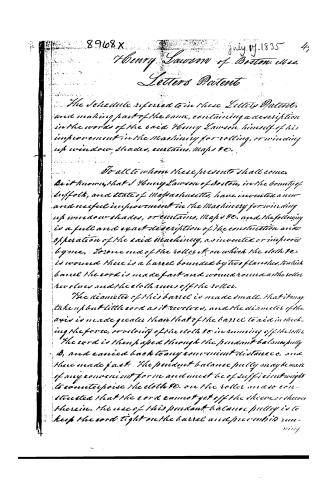 Page 2
-
 Page 3


U.S. Patent and Trademark Office · Google Patents
Show the transcription Hide (582 words)
Machine transcription (LightOnOCR) of the pages as scanned by the USPTO, most of them the handwritten copies made when the records were restored after the 1836 fire. Not checked; it can misread handwriting, so compare it with the scan.
Page 1.
No Printed Specification Available
8968X
H. Lawson,
Curtain Tassel,
Patented July 17, 1835.
Fig. 1
Fig. 2
Fig. 3
Fig. 4
M. PETERS, PHOTO-LITHOGRAPHER, WASHINGTON, D. C.
Page 2.
8968X
July 14, 1835
Henry Lawson of Boston, Mass.
Letters Patent
The Schedule referred to in these Letters Patent, and making part of the same, containing a description in the words of the said Henry Lawson, himself of his improvement in the Machinery for rolling, or winding up window shades, curtains, Maps &c.
To all to whom these presents shall come,
Be it known, that I Henry Lawson of Boston, in the county of Suffolk, and state of Massachusetts, have invented a new and useful improvement in the Machinery for winding up window shades, or curtains, Maps &c. and the following is a full and exact description of the construction and operation of the said machinery, as invented or improved by me.
To one end of the roller A, on which the cloth &c. is wound there is a barrel bounded by two flanges, to which barrel the cord is made fast and wound round as the roller revolves and the cloth runs off the roller.
The diameter of this barrel is made small, that it may take up but little cord as it revolves, and the diameter of the axis is made greater than that of the barrel to aid in checking the force, or velocity of the cloth &c. in running off the roller.
The cord is then passed through the pendant balance pully B, and carried back to any convenient distance, and there made fast. The pendant balance pully may be made of any convenient form and must be of sufficient weight to counterpoise the cloth &c. on the roller and so constructed that the cord cannot get off the sheaves or sheaves therein. The use of this pendant balance pully is to keep the cord tight on the barrel and prevent its running.
Page 3.
running over the flanches. To check the cloth so as it runs off the roller and to stop it when required also by the manner in which it is suspended to shorten the fall of the slack corn as it runs off the barrel and enable you to roll up the whole of the cloth to at one convenient hands pull. To serve as a handle, a gentle pull at which will wind the whole of the cloth on the roller, when it is required to roll up an excessive length of cloth say above 18 ft. long it will be necessary to have two sheaves in their balance making it a double pulley. My claim is, 1st for reducing the length of the draw (required to roll up this species of roller blind, shade, curtain, map &c. of any required length) to a convenient hands field that is by one easy move of the hand to cause the roller to revolve sufficiently to wind up any length of cloth &c. required for the above purposes) in the manner as above described. 2nd for the pulley balance pulley and the manner of applying it as above described. 3rd For the relative proportions of the barrel & axis as above described.
Witnesses
Wm. J. Myman
Patrick Riley
Henry Lawson
(Drawing)
500 2.87
Published accounts: journal notice
Notice in the monthly list of patents
Journal of the Franklin Institute, new ser., vol. 16 (1835), p. 215 · View the page
411. Rollers for curtains, &c. Henry Lawson, city of Boston,
Published accounts: journal notice
Notice in the monthly list of patents, with remarks
Journal of the Franklin Institute, new ser., vol. 17 (1836), p. 125 · View the page
23. For machinery for Rolling up Curtains, Maps, &c.; Henry Lawson, Boston, Massachusetts, July 17.
Remarks. The handle by which the curtain, &c., is to be rolled upon its roller, is made much in the form of the old fashioned bell pull, and has a small sheever, or pulley, at its upper end; a cord, one end of which is fastened to and winds round the end of the roller, passes through the pulley, and has its other end fastened to a pin, or other attachment, above; this whole arrangement, it will be seen, is exactly similar to the hanging the weight of a common eight day clock. "My claim is, 1st, for reducing the length of the draw required to roll up this species of roller blind, shade, curtain, map, &c., to a convenient hand's pull; that is, by one easy move of the hand, to cause the roller to revolve sufficiently to wind up any length of curtain, &c., required for the above purposes. "2nd. For the pendent balance pulley, and the manner of applying it, as above described. "3d. For the relative proportions of the barrel and axis, as above described." All that is said about relative proportions, is, that one part is made small, and another greater. Rather an indefinite thing to claim.
About this record
- Patentee
- DATAMP
- Date
- the Name and Date index of patents, DATAMP, USPTO records
- Invention
- DATAMP
- Listed in
- the Name and Date index of patents, DATAMP, USPTO records, Jim Shaw's X-patent list, the Journal of the Franklin Institute, Burke's List of Patents (1847)
- Burke's 1847 Patent Office list gives the same patent.