

Drawings and documents
National Archives restored drawings: drawing
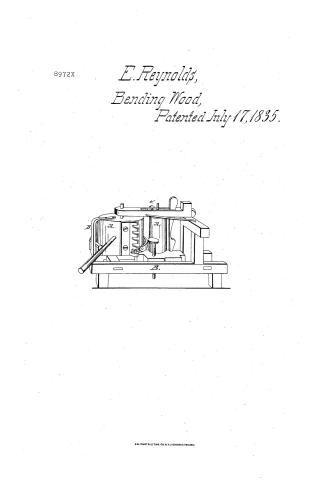
E. Reynolds' Patent Drawing for a Machine for Bending or Setting Felloes for the Wheels of Carriages and Wagons

National Archives, Restored Patent Drawings (Record Group 241) · Full-size scan at the National Archives · Catalog record
Show the text on the drawing Hide (80 words)
Words on the drawing as machine-read by the National Archives; not checked. Useful mainly for searching.
144. WOOD WORKING. / 3. SPECIAL WORK MACHINERY. / [176] Bending Wood. / 9.5% / C1 ASSIFITATION / 8972x / DIVISION. / E REYNOLDS / Bending or setting Felloes forttie Wheels of & Wascons / Patentions Yuly 1835. / A syllnders / B. Bench / Fixtented for 7. Years. / C. Regulating screw & Block. / D. clevis / Shicklund pet. / Patent office March 29th 1839- / leade under the direction of the commissioner of patents / in conformuty with act 3"March 1837- / Commissioner of patents
USPTO scan
The patent as scanned by the USPTO
-
 Page 1
-
 Page 2
-
 Page 3


U.S. Patent and Trademark Office · Google Patents
Show the transcription Hide (914 words)
Machine transcription (LightOnOCR) of the pages as scanned by the USPTO, most of them the handwritten copies made when the records were restored after the 1836 fire. Not checked; it can misread handwriting, so compare it with the scan.
Page 1.
8972X
E. Reynolds,
Bending Wood,
Patented July 17, 1835.

AN. PHOTO-LITHO. CO. N.Y. (OSBORNE'S PROCESS)
Page 2.
Granted for Seven years from 17th July 1835
Edward Reynolds of Haddonfield New Jersey
Letters Patent
The schedule referred to in these Letters Patent and making part of the same containing a description in the words of the said Edward Reynolds himself of his improvement in a machine for bending or setting felloes for the wheels of carriages and waggons.
To all whom it may concern,
Be it known that I Edward Reynolds of Haddonfield in the County of Gloucester, and State of New Jersey, have invented a new and useful machine for bending or setting felloes for the wheels of carriages and waggons of all description and that the following is a full and exact description thereof.
The felloes are to be semicircular, or nearly so, it being intended generally that two or three should form the rim of a wheel. The timber either sound or new is to be bent round cylindrical, which cylinder may be somewhat less in diameter say one fourth or one fifth, than that of the interior of the wheel. The bending machine is furnished with two such cylinders, one of them intended for the larger and the other for the smaller sized wheels. These I make of wood of such thickness for the lighter kind of wheels three may be bent thereon side by side, at the same time. These cylinders are placed horizontally upon a stout bench immovably fixed. Each of the cylinders revolves on a strong bolt forming its axis. One of these bolts is permanently fixed in the bench, the other passes at each end through a slot or mortise in the bench, and in a piece of timber placed above the cylinder to receive them. This is for the purpose of regulating the distance of the cylinders from each other, which distance in all cases be equal to that of the thickness of the timber to be bent. A regulating screw is made to operate upon each end of the sliding bolt, or rather against a sliding block, which receives the bolt. It will be found convenient to remove a part of each of the cylinders, say one fourth from the larger and one sixth from the smaller by cutting their circumference, by a vertical section in a straight line, a sufficient portion of the timber being left to effect the setting or bending. A hole is mortised in the middle of the straight part of each cylinder to receive a handspike by which to apply the regulating screw. When not in use the mortise need be made in the edge of the
Page 3.
8972x
cylinders. At one of the angles formed by the straight and curved part of each cylinder an iron clevis is to be fixed to receive under it and confine one of the ends of the stuff while the fillers are to be formed and holes are bored at suitable distances around the edges of the cylinders, to receive the bolts of a movable or shifting clevis which is used to confine the other end of the stuff after it has been set. The edges of the cylinders should be graduated or marked off in feet and inches, in order to determine (with facility) the exact place at which they must stand when the process of bending is commenced to raise the angle on the cylinders to one or two inches short of the end of the fillers) when bent in order to afford sufficient room for the opening of the shifting clevis. When the machine is to be used, the stuff to be bent is prepared by boiling or steaming in the usual manner. One of its ends is then placed under the stationary clevis together with a piece of hoop iron of proper length and width which, as the stuff is bent laps round its outer edge and prevents the formation of checks and splinters, the other ends of these iron straps I sometimes make to terminate in a screw furnished with a nut, which may be passed through an iron plate on the edge of the cylinder, the strap may then be drawn firmly around the fillers, as shown in the model and as more definitely in the Patent office.
What I claim as my invention and for what I ask a Patent is the machine or apparatus as herein described, and may be properly denominated revolving cylinders to be used for the bending of clevises, for carriages and wagons of all descriptions, ship runners, iron tires for wheels, loops, etc., hoops, vessels, mast-hoops, &c. In which machine two cylinders are employed operating together by means of certain accessory parts in the manner or upon the principles herein set forth, not intended however to limit myself in the formation of the accessory parts or to the specifics herein stated, but to vary them in any way and to apply them to any use not varying from the principle as I may find convenient whilst the machine continues substantially the same and a similar effect is produced by analogous means.
Witnesses
William Watson
John Colman
Edward Reynolds
Patented Feb 18, 1860
Published accounts: journal notice
Notice in the monthly list of patents
Journal of the Franklin Institute, new ser., vol. 16 (1835), p. 215 · View the page
409. Felloes, bending.-Edward Reynolds, Haddonfield, New Jersey,
Published accounts: journal notice
Notice in the monthly list of patents, with remarks
Journal of the Franklin Institute, new ser., vol. 17 (1836), p. 124 · View the page
21. For Bending or Setting Felloes for the Wheels of Carriages; Edward Reynolds, Haddonfield, Gloucester county, New Jersey, July 17.
Remarks. The patentee says, "What I claim as my invention, is the machine, or apparatus, as herein described, and may properly be denominated revolving cylinders, to be used for the bending of felloes for carriages and wagons of all descriptions; sleigh runners; iron tires for wheels; coopers' set hoops, vessels' mast hoops, &c. In which machine two cylinders are employed, operated together by means of certain accessary parts, in the manner, or upon the principle, herein set forth," We think the machine described well adapted to the bending of timber for rims for wheels. It consists of two wheels in a strong frame, the peripheries of the wheels being nearly in contact with each other; the timber, prepared by boiling, or steaming, is to be bent round one of them, by turnAmerican Patents for July, with Remarks. ing the other, which presses forcibly upon it. An iron band laps round the outside of the bent timber, to prevent its checking; and there are proper staples, and other appendages, for the management of the process.
DATAMP: illustration
Illustrations from DATAMP


DATAMP (Directory of American Tool and Machinery Patents), via the Internet Archive · Archived DATAMP page
About this record
- Patentee
- DATAMP
- Date
- the Name and Date index of patents, DATAMP, USPTO records
- Invention
- DATAMP
- Listed in
- the Name and Date index of patents, DATAMP, USPTO records, Jim Shaw's X-patent list, the Journal of the Franklin Institute, Burke's List of Patents (1847)
- Burke's 1847 Patent Office list gives the same patent.