

Drawings and documents
USPTO scan
The patent as scanned by the USPTO
-
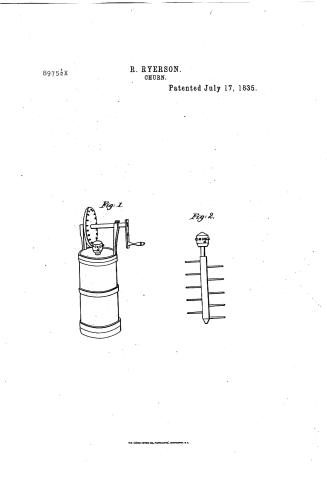 Page 1
-
 Page 2
-
 Page 3


U.S. Patent and Trademark Office · Google Patents
Show the transcription Hide (601 words)
Machine transcription (LightOnOCR) of the pages as scanned by the USPTO, most of them the handwritten copies made when the records were restored after the 1836 fire. Not checked; it can misread handwriting, so compare it with the scan.
Page 1.
8975½X
R. RYERSON.
CHURN.
Patented July 17, 1835.
Fig. 1.
Fig. 2.
THE HARRIS PETERS CO., PHOTO-LITHO., WASHINGTON, D. C.
Page 2.
July 17, 1835 8975 Y2X 313
Reading Ryerson, Oxford Co. Maine
Letters Patent
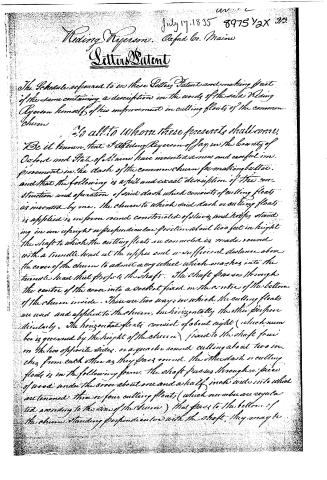
The Schedule referred to in these Letters Patent and making part of the same containing a description in the words of the said Reading Ryerson himself of his improvement in cutting floats of the common churn.
To all to whom these presents shall come.
Be it known, that I, Reading Ryerson of Jay in the County of Oxford and State of Maine have invented a new and useful improvement in the dash of the common churn for making butter, and that the following is a full and exact description of the construction and operation of said dash which consists of cutting floats as invented by me. The churn to which said dash or cutting floats is applied is in form round constructed of staves and hoops standing in an upright or perpendicular position about two feet in height. The shaft to which the cutting floats are connected is made round with a funnel head at the upper end in sufficient distance above the cone of the churn to admit a cog wheel which meshes into the funnel head that projects the shaft. The shaft passes through the centre of the cone into a socket fixed in the centre of the bottom of the churn inside. There are two ways in which the cutting floats are used and applied to the churn, one horizontally the other perpendicularly. The horizontal floats consist of about eight (which number is governed by the height of the churn) fixed to the shaft four on the two opposite sides, or a quarter round cutting about two inches from each other as they pass round. The other dash or cutting floats is in the following form. The shaft passes through a piece of wood under the cone about one and a half inch wide into which are tenoned three or four cutting floats (which number are regulated according to the size of the churn) that pass to the bottom of the churn standing perpendicular with the shaft, they may be
Page 3.
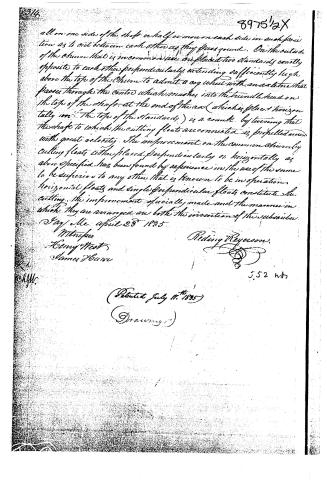
all on one side of the shaft or half or more on each side in each position as to cut between each other as they pass round. On the outside of the churn that is in common use are placed two standards exactly opposite to each other perpendicularly extending sufficiently high above the top of the churn to admit a cog wheel with an axle that passes through the center which meshes into the trundle head on the top of the shaft at the end of the ax (which is placed horizontally on the top of the standards) is a crank. By turning that the shaft to which the cutting floats are connected is propelled round with great velocity. The improvement on the common churnly cutting floats either placed perpendicularly or horizontally as above specified has been found by experience in the use of the same to be superior to any other that is known to be in operation. Horizontal floats and single perpendicular floats constitute the cutting. The improvement specially made and the manner in which they are arranged are both the invention of the subscriber.
Signed this April 23, 1835.
Witnesses:
Henry West
James Howe
Redding Meyerson.
552 wts
(Patented July 17, 1835)
(Drawing)
Published accounts: journal notice
Notice in the monthly list of patents
Journal of the Franklin Institute, new ser., vol. 16 (1835), p. 215 · View the page
420. Churn floats. Reding Ryerson, Jay, Oxford county, Maine,
Published accounts: journal notice
Notice in the monthly list of patents, with remarks
Journal of the Franklin Institute, new ser., vol. 17 (1836), p. 127 · View the page
32. For a Churn; Reding Ryerson, Jay, Oxford county, Maine, July 17.
Remarks. The tub of this churn is to be upright, and in the usual form. A shaft passes through the lid, and its lower end is received in a step on the bottom of the churn. The shaft is to be turned by a face wheel and wallower, in the manner of bevil gear, and upon the shaft there are floats, or dashers, some of which are horizontal, and others vertical; the floats are called "cutting floats," and it is to these that the goodness of the churn is attributed, but in what particular they differ from others, so as to obtain their name and value, we are not informed.
About this record
- Patentee
- the Journal of the Franklin Institute, Journal
- Date
- the Name and Date index of patents, USPTO records, Jim Shaw's X-patent list
- Invention
- the Name and Date index of patents
- Listed in
- the Name and Date index of patents, USPTO records, Jim Shaw's X-patent list, the Journal of the Franklin Institute, Burke's List of Patents (1847)
- The Name and Date index has a note on this number.
- The patentee's full name comes from the Franklin Institute's journal.
- Burke's 1847 Patent Office list gives the same patent.