

Drawings and documents
National Archives restored drawings: drawing
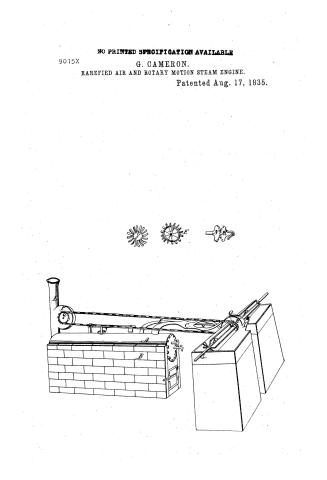
Cameron's Patent Drawing for a Rarefied Air and Rotary Motion Steam Engine

National Archives, Restored Patent Drawings (Record Group 241) · Full-size scan at the National Archives · Catalog record
Show the text on the drawing Hide (65 words)
Words on the drawing as machine-read by the National Archives; not checked. Useful mainly for searching.
1:1 / PESTEAR LENGINES / Roiary Impreto, CAMERON'S / C1 AFSIFICATION / Rarefied Air and Rotary molion Steam Engine / outsat / DIV ISION. / Palented 17, 18.35 / 5.21. p.55. / References / Boiler / Wissian and Wheite / Steam of the / for the escape of the superfluon / Forced Pump / cogs cogs attached on the leaver to the Swam / tog pulleys / retured case
USPTO scan
The patent as scanned by the USPTO
-
 Page 1
-
 Page 2
-
 Page 3
-
 Page 4


U.S. Patent and Trademark Office · Google Patents
Show the transcription Hide (1,015 words)
Machine transcription (LightOnOCR) of the pages as scanned by the USPTO, most of them the handwritten copies made when the records were restored after the 1836 fire. Not checked; it can misread handwriting, so compare it with the scan.
Page 1.
NO PRINTED SPECIFICATION AVAILABLE
9015X
G. CAMERON.
RAREFIED AIR AND ROTARY MOTION STEAM ENGINE.
Patented Aug. 17, 1835.
Page 2.
George Cameron
Aug 17, 1835
The schedule referred to in the Letter Patent and making part of the same, containing a description in the words of the said George Cameron himself of his improvement in a specific air and rotary motion Steam Engine.
Be it known that I, George Cameron of the City of Washington and district of Columbia have made an improvement in the useful arts, being a specific air and rotary motion Steam Engine. This machine consists of the following principal parts viz. a cylindrical boiler and a furnace of the ordinary form and construction, a forked or double steam pipe attached to the boiler in the usual manner, which connects the steam from the boiler to the steam wheel through the steam wheel case, both of which (that is the steam wheel & the steam wheel case) are made of sheet iron or of sheet copper, sustained or supported by bandy hoops or circular bands made of wrought iron each differing from the other in diameter extending in different circles at short distances from each other, from near the centre to near the extremity or outer edge of both the wheel and case, the whole, both the wheel and the case respectively, secured by means of rivets or screws. The steam wheel having a rim of proportionate width and thickness in which is attached buckets of any convenient size, shape or number, made of the same material and secured in the same manner as above stated, both wheel and case to be perfectly true and fitting each other so closely that whilst the former revolves upon its axis within the latter freely and without touching, they are still sufficiently close together to require no packing of any kind to prevent the steam from escaping down the sides of the ring to any injurious degree. The steam is used by the buckets on the steam wheel from the steam pipes, through the steam wheel case, to which they are attached in a strong and close manner, one for a page.
Page 3.
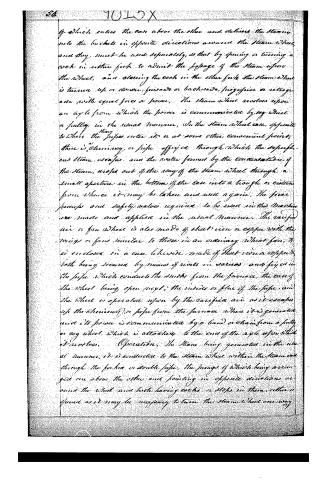
of which enters the case above the other and delivers the steam into the buckets in opposite directions around the steam wheel, and they must be used separately, so that by opening or turning a cock in either fork to admit the passage of the steam upon the wheel, and closing the cock in the other fork the steam wheel is turned up or down, forwards or backwards, progressive or retrograde with equal force or power. The steam wheel revolves upon an axle from which the power is communicated by cog wheel or pulley in the usual manner. In the steam wheel case, opposite to where the steam pipes enter it, or at some other convenient point, there is a chimney or pipe opening through which the superfluous steam escapes, and the water formed by the condensation of the steam, drops out of the way of the steam wheel through a small aperture in the bottom of the case into a trough or cistern from whence it may be taken and used again. The force pumps and safety valves required to be used in this machine are made and applied in the usual manner. The carfield air or fan wheel is also made of sheet iron or copper with the wings or fans similar to those in an ordinary wheat fan, and is enclosed in a case likewise made of sheet iron or copper, both being secured by means of rivets or screws and fixed in the pipe which conducts the smoke from the furnace, the case of the wheel being open next the inside or face of the pipe, and the wheel is operated upon by the carfield air as it escapes up the chimney or pipe from the furnace where it is generated and its power is communicated by a band or chain from a pulley or cog wheel, which is attached to the end of the axle upon which it revolves.
Operation. The steam being generated in the usual manner, it is conducted to the steam wheel within the steam case through the forked or double pipe, the prongs of which being arranged one above the other and pointing in opposite directions around the wheel and both having cocks or stops in them, either is opened as it may be necessary to turn the steam wheel one way
Page 4.
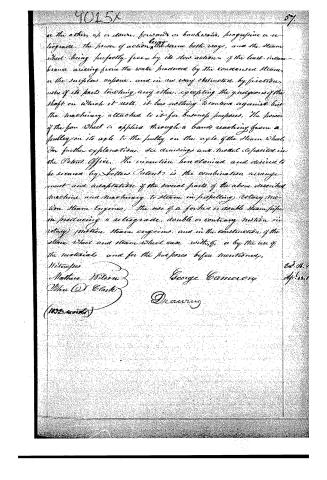
or the other, up or down, forward or backward, progressive or retrograde, the power of action being the same both ways, and the steam wheel being perfectly free by its slow action—of the least inconvenience arising from the water produced by the condensed steam, or the surplus vapour, and in no way obstructed by friction, none of its parts touching any other, excepting the guideways of the shaft on which it rests, it has nothing to contend against but the machinery attached to it for business purposes. The power of the fan wheel is applied through a band reaching from a pulley on its axle to the pulley on the axle of the steam wheel. For further explanation, see drawings and model deposited in the Patent Office. The invention here claimed and desired to be secured by Letters Patent is the combination arrangement and adaptation of the several parts of the above described machine and machinery to steam in propelling rotary motion steam engines, the use of a forced or double steam pipe in producing a retrograde, double or contrary motion in rotary motion steam engines, and in the construction of the steam wheel and steam wheel axle, with, or by the use of the materials, and for the purposes before mentioned.
Witnesses
Matthew Wilson
John O. Clark
(1022 words)
George Cameron
Drawing
Ed. H. 9
Apr. 22
Published accounts: journal notice
Notice in the monthly list of patents
Journal of the Franklin Institute, new ser., vol. 16 (1835), p. 287 · View the page
490. Rotary steam and air engine. George Cameron, Washington, D. C.
Published accounts: journal notice
Notice in the monthly list of patents, with remarks
Journal of the Franklin Institute, new ser., vol. 17 (1836), p. 207 · View the page
48. For a Rarefied Air and Rotary Motion Steam Engine; George Cameron, Washington city, August 17.
Remarks. This is one of the oldest and worst species of engines ever made, as its power is to be derived from blowing the steam on to the buckets of a wheel. Much stress is laid upon the using of a forked pipe, leading to opposite sides of the wheel, and furnished with stop cocks, to reverse the motion. The rarefied air part consists of a similar wheel, on to which the rarefied air from the furnace chimney is to be directed. We would propose as a motto for this, "de pis en pis."
About this record
- Patentee
- DATAMP
- Date
- DATAMP, USPTO records
- Invention
- DATAMP
- Listed in
- the Name and Date index of patents, DATAMP, USPTO records, Jim Shaw's X-patent list, the Journal of the Franklin Institute, Burke's List of Patents (1847)
- The sources give different dates; the date shown is the one most of them agree on.
- The Franklin Institute's journal confirms the date shown.
- Burke's 1847 Patent Office list gives the same patent.