

Drawings and documents
National Archives restored drawings: drawing
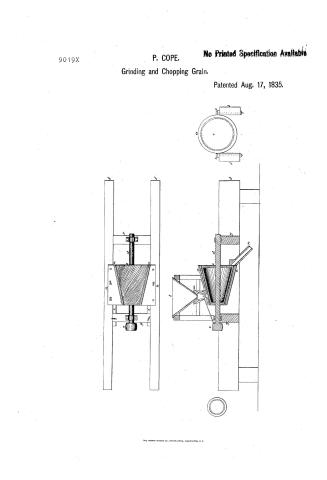
P. Cope's Patent Drawing for a Machine for the Grinding and Chipping of Grain

National Archives, Restored Patent Drawings (Record Group 241) · Full-size scan at the National Archives · Catalog record
Show the text on the drawing Hide (97 words)
Words on the drawing as machine-read by the National Archives; not checked. Useful mainly for searching.
Bo. MILLS, / Grinding Mills / Cone and / Shell / P.ODE / Old / 21. Page 519 / DIV / 33 / 159 as / 1835 / to / Conerthell. / Grinding C-Chring grain / plan with ten of cylinder Removed / a. Cylender or concare / b. Inletterective Grain / C. Runner / d. Axic / e. Pulley / f Finance / g. Crosslinners / h Wrngs of Cylinders / i Ironbotor slide / K. Tempering screws / l. / escation / in Shoe / 72 shout to dischargeyment / tind of concakes Runne / Patent office 1844 / Made under the direction ghe commition y / Patent in comformets with / Meny Sumorth / Courseporous of aa / the
USPTO scan
The patent as scanned by the USPTO
-
 Page 1
-
 Page 2
-
 Page 3


U.S. Patent and Trademark Office · Google Patents
Show the transcription Hide (876 words)
Machine transcription (LightOnOCR) of the pages as scanned by the USPTO, most of them the handwritten copies made when the records were restored after the 1836 fire. Not checked; it can misread handwriting, so compare it with the scan.
Page 1.
9019X
P. COPE.
Grinding and Chopping Grain.
Patented Aug. 17, 1835.
No Printed Specification Available
THE NORRIS PETERS CO., PHOTO-LITHO., WASHINGTON, D. C.
Page 2.
Aug. 17, 1855
9019X
579
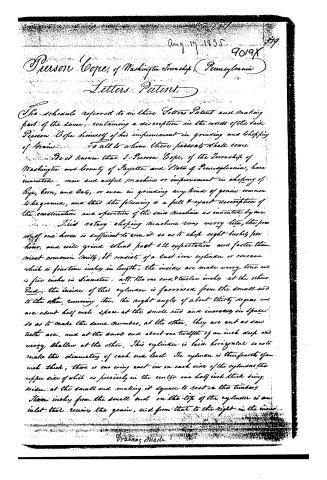
P. Person Cope, of Washington Township, (Pennsylvania)
Letters Patent.
The schedule referred to in these Letters Patent and making part of the same, containing a description in the words of the said Person Cope himself of his improvement in grinding and chopping of grain.
To all to whom these presents shall come.
Be it known that I, Person Cope, of the Township of Washington and County of Fayette and State of Pennsylvania, have invented a new and useful machine or improvement in chopping of Rye, Corn, and Oats, or even in grinding any kind of grain common to be ground, and that the following is a full & exact description of the construction and operation of the said machine as invented by me.
This rotary chopping machine runs very lite, the power of one horse is sufficient to run it so as to chop eight bushels per hour, and will grind wheat past all expectation and faster than most common mills. It consists of a cast iron cylinder or concave which is fourteen inches in length, the insides are made very true and is five inches in diameter, at the one end twelve inches at the other. End, the inside of this cylinder is narrowed from the small end to the other, running from the right angle of about thirty degrees and are about half inch space at the small end and increasing in space so as to make the same number, at the other, they are cut as saw teeth are, and at the small end about one twelfth of an inch deep and very shallow at the other. This cylinder is laid horizontal so as to make the diameter of each end level. The cylinder is three fourths of an inch thick, there is one wing cast in on each side of the cylinder, the upper side of which is precisely in the center one half inch thick being wider at the small end making it square to rest on the timbers. Three inches from the small end on the top of the cylinder is an inlet that receives the grain, and from that to the right in the inner
Drawing Made
Page 3.
part of the cylinder is wider one fourth round that it may feed freely,
The runner is made to fit the concave on the inside of the cylinder.
This runner is furrowed as is stated above, the spaces agreeing only that they incline to the left so as when they pass each other they will grind and clean themselves most beautifully, it being cast iron with each end cast solid except a two inch square mortise in each end, to receive an iron axle which extends ten inches at each end past the casting one end turned so as to fit a cast iron seat, the other end where the grain feeds in, is a neck turned having three inches at the side for a pulley or cog so as to suit convenience, The before mentioned part is a particular part of the invention, it is small and portable the advantage of attaching it to the horse power of a threshing machine so as to suit farmers, or still less the case may be, The form of the frame is of hewn or cased timber seven by three inches, the side timbers is six feet long, the width just so as to suit casting or the wings of the casting, so that it will lay one inch and half on each side of the frame the cross timbers just so wide as will suit the seat, of the axle to run in, on the side timbers when the wings of the cylinder rests there is an iron bar one on each side with shoulders to keep it permanent they run back the cross timbers where there is a screw that descends in the cross timber to set the grinding finer or coarser, The height of the frame may be to suit convenience the cylinder fastens down with iron bolts through the side beam with bars to slacken when tempering the grinding,
On the frame above the cylinder, there is a small frame suitable for the hopper and shoe to rest on it is similar to other mills the shoe is put in motion by an iron from it to the pulley, There is a curb at the large end of cylinder where the meal discharges through a spout below,
What I claim as my own invention and not previously known in the above described machine, is the plan of the casting the plan of the furrows that they may grind fast with little power and discharge freely through to the opposite end and the tempering screws with the iron sliders and putting it together for convenience
Res. Mitney, Thomas Shepherd, Mary G. Hearn, James Fuller
Person Hope [960 wts]
Published accounts: journal notice
Notice in the monthly list of patents
Journal of the Franklin Institute, new ser., vol. 16 (1835), p. 287 · View the page
474. Grain, grinding and chopping.-Pierson Cope, Fayette county, Pa.
Published accounts: journal notice
Notice in the monthly list of patents, with remarks
Journal of the Franklin Institute, new ser., vol. 17 (1836), p. 202 · View the page
32. For Grinding and Chopping Grain; Pierson Cope, Washington township, Fayette county, Pennsylvania, August 17.
Remarks. This is merely a mill with a conical nut and box, the axis of which is placed horizontally, the feeding being effected through an opening in the shell at the small end. The claim is to "the plan of the castings; the plan of the furrows that they may grind fast with little power, and discharge freely through the opposite end, and the plan of tempering screws with the iron slides, and putting it together for convenience;" each of which plans has about an equal claim to novelty.
About this record
- Patentee
- DATAMP
- Date
- DATAMP, USPTO records
- Invention
- DATAMP
- Listed in
- the Name and Date index of patents, DATAMP, USPTO records, Jim Shaw's X-patent list, the Journal of the Franklin Institute, Burke's List of Patents (1847)
- The sources give different dates; the date shown is the one most of them agree on.
- The Franklin Institute's journal confirms the date shown.
- Burke's 1847 Patent Office list gives the same patent.