

Drawings and documents
USPTO scan
The patent as scanned by the USPTO
-
 Page 1
-
 Page 2
-
 Page 3
-
 Page 4


U.S. Patent and Trademark Office · Google Patents
Show the transcription Hide (1,200 words)
Machine transcription (LightOnOCR) of the pages as scanned by the USPTO, most of them the handwritten copies made when the records were restored after the 1836 fire. Not checked; it can misread handwriting, so compare it with the scan.
Page 1.
9036 $\frac{1}{2}$ X
A. Stone.
Take-Up Motion.
Patented Aug. 17, 1835.

Page 2.
Aug. 17th 1835 77. 90365/X
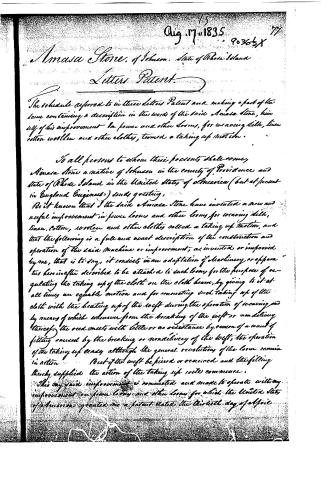
Amasa Stone, of Johnson, State of Rhode Island
Letters Patent.
The schedule referred to in these Letters Patent and making a part of the same containing a description in the words of the said Amasa Stone, him self of his improvement in power and other Looms, for weaving silk, linen cotton woollen and other clothes, termed a taking up motion.
To all persons to whom these presents shall come,
Amasa Stone a native of Johnson in the county of Providence and state of Rhode Island in the United States of America (but at present in England Engineer) sends greeting,
Be it known that I the said Amasa Stone have invented a new and useful improvement in power looms and other looms for weaving silk, linen, cotton, woollen and other clothes called a taking up motion, and that the following is a full and exact description of the construction and operation of the said machine or improvement, as invented or improved by me, that is to say, it consists in an adaptation of machinery, or apparatus herein after described to be attached to such looms for the purpose of regulating the taking up of the cloth on the cloth beam, by giving to it at all times an equal motion and for connecting such taking up of the cloth with the beating up of the woof during the operation of weaving and by means of which whenever from the breaking of the woof or non delivery thereof the reed meets with little or no assistance by reason of a want of filling caused by the breaking or non delivery of the woof, the operation of the taking up ceases although the general revolution of the loom remain in action. But if the woof be fixed or renewed and the filling thereby supplied the action of the taking up will commence.
This my said improvement is connected and made to operate with any improvement on power loom and other looms for which the United States of America granted me a patent dated the thirtieth day of April
Page 3.
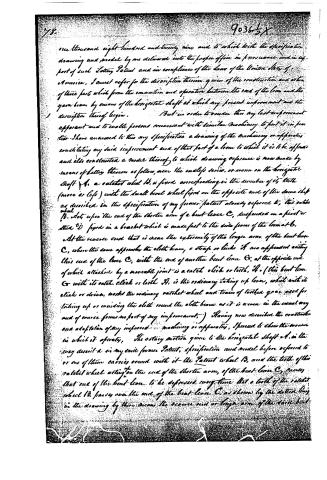
one thousand eight hundred and twenty nine and to which with the specification drawing and model by me delivered into the proper office in pursuance and in support of such Letters Patent and in compliance of the laws of the United States of America, I must refer for the description therein given of the construction and action of those parts which form the connection and operation between the end of the loom and the yarn beam by means of the horizontal shaft at which my present improvement and the description thereof begin.
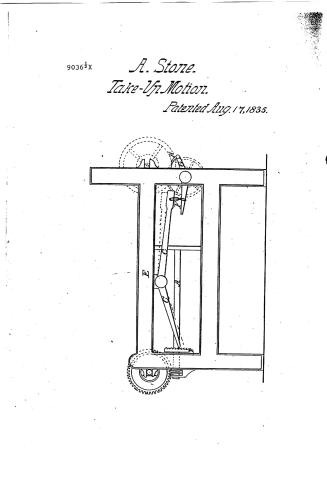
But in order to render them any less unimportant apparent and to enable persons conversant with similar machinery to put it in practice I have annexed to this my specification a drawing of the machinery or apparatus constituting my said improvement and of that part of a loom to which it is to be applied and also constructed a model thereof to which drawing reference is now made by means of letting thereon as follow, near the endless series, or room on the horizontal shaft A, a ratchet wheel B, is fixed corresponding in the number of its teeth (more or less) with the small bevel wheel fixed on the opposite end of the same shaft as described in the specification of my former patent already referred to, this ratchet wheel B, acts upon the end of the shorter arm of a bent lever C, suspended on a pivot or stud D fixed in a bracket which is made fast to the side frame of the loom at G.
At the reverse end that is near the extremity of the longer arm of the bent lever C, where the same approaches the cloth beam, a strap or links H are appended uniting this end of the lever C, with the end of another bent lever G, at the opposite end of which attached by a movable joint is a catch click or tooth, H, of this bent lever G with its catch click or tooth H, is the ordinary taking up lever, which with its click or clack, works the ordinary ratchet wheel and train of toothed gear used for taking up or winding the cloth round the cloth beam as it is woven in the usual way and of course forms no part of my improvement.) Having now described the construction and adaptation of my improved machinery or apparatus, I proceed to show the manner in which it operates. The rotary motion given to the horizontal shaft A in the way described in my said former Patent, specification and model before referred to or one of them carries round with it the Patent wheel B, and the teeth of this ratchet wheel acting on the end of the shorter arm, of the bent lever C, causes that end of the bent lever to be depressed every time that a tooth of the ratchet wheel B, passes over the end of the bent lever C, as shown by the dotted line in the drawing by this means, the reverse end or longer arm of the said bent
Page 4.
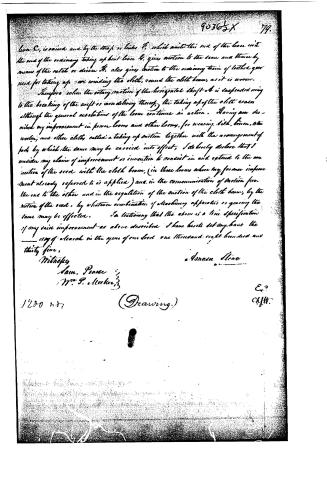
loom C, is raised and by the strap or links H, which unite this end of the loom with the end of the ordinary taking up belt-loose H, gives motion to the same and thence by means of the catch or driver K, also gives motion to the ordinary train of loom gear used for taking up or winding the cloth, round the cloth beam, as it is woven.
Therefore when the rotary motion of the horizontal shaft A is suspended owing to the breaking of the weft or yarn delivery thereof, the taking up of the cloth ceases although the general operations of the loom continue in action. Having now described my improvement in power looms and other looms, for weaving silk, linen, cotton, woolen, and other cloths called a taking up motion together with the arrangement of parts by which the same may be carried into effect, I solemnly declare that I consider my claim of improvement or invention to consist in and extend to the connection of the seed with the cloth beam, (in those looms where my former improvement already referred to is applied) and in the communication of motion from the one to the other and in the regulation of the motion of the cloth beam, by the motion of the seed, by whatever combination of machinery apparatus or gearing the same may be effected. In testimony that the above is a true specification of my said improvement as above described I have hereunto set my hand the day of March in the year of our Lord one thousand eight hundred and thirty four.
Witnesses
Sam. Pease
Wm. P. Meeker
(Drawing.)
1280 n.d.
E. 3
C. 14.
Published accounts: journal notice
Notice in the monthly list of patents
Journal of the Franklin Institute, new ser., vol. 16 (1835), p. 287 · View the page
467. Power loom.-Amasa Stone, Providence county, Rhode Island,
Published accounts: journal notice
Notice in the monthly list of patents, with remarks
Journal of the Franklin Institute, new ser., vol. 17 (1836), p. 201 · View the page
26. For an improvement in Power, and other, Looms; Amasa Stone, of Rhode Island, but now residing in England, August 17.
Remarks. In the specification of this patent particular reference is made to one formerly obtained by Mr. Stone, and dated the 13th of April, 1829, and upon which the present plan is to be considered as an improvement. After explaining the construction of his apparatus, by reference to drawings, the patentee says that, "having now described my improvement in power looms, and other looms for weaving silk, linen, cotton, woollen, and other cloths, called a taking up motion, together with the arrangement of parts by which the same may be carried into effect, I do hereby declare that I consider my claim of improvement or invention to consist in and extend to the connection of the reel with the cloth beam (in those looms where my former improvement already referred to is applied) and in the communication of motion from one to the other, and in the regulation of the motion of the cloth beam by the motion of the reed, by whatever combination of machinery, apparatus, or gearing, the same may be effected."
About this record
- Patentee
- the Journal of the Franklin Institute, Journal
- Date
- USPTO records, Jim Shaw's X-patent list, Burke's List of Patents (1847)
- Invention
- the Name and Date index of patents
- Listed in
- the Name and Date index of patents, USPTO records, Jim Shaw's X-patent list, the Journal of the Franklin Institute, Burke's List of Patents (1847)
- The sources give different dates; the date shown is the one most of them agree on.
- The patentee's full name comes from the Franklin Institute's journal.
- The Franklin Institute's journal confirms the date shown.
- Burke's 1847 Patent Office list gives the same patent.