

Drawings and documents
National Archives restored drawings: drawing
Peter Clark's Patent Drawing for a Corn Harrow and Grain Cultivator

National Archives, Restored Patent Drawings (Record Group 241) · Full-size scan at the National Archives · Catalog record
Show the text on the drawing Hide (79 words)
Words on the drawing as machine-read by the National Archives; not checked. Useful mainly for searching.
PLOWS, / (Entered) / [43] Cultivator / $150 / CLASSIFICATICN / Peter Clark / 9047.t / DIVISION. / Cam Harrow and Grain Culturetor / Patented any no. 1835 / OR / Intent office aug 10th 2844 / Inferences. a. central bar. b.b. side bars. / Inadi under the direction of the Commitiona / C.C transverse ironplates d.d regulating arms. / of Patent in conformity with act of's march / e.e. handles. of frontview of a share.g sideview. / 1037
USPTO scan
The patent as scanned by the USPTO
-
 Page 1
-
 Page 2
-
 Page 3


U.S. Patent and Trademark Office · Google Patents
Show the transcription Hide (682 words)
Machine transcription (LightOnOCR) of the pages as scanned by the USPTO, most of them the handwritten copies made when the records were restored after the 1836 fire. Not checked; it can misread handwriting, so compare it with the scan.
Page 1.
9042X
P. CLARK.
Cultivator-Teeth.
Patented Aug 20, 1835.

A.M. PHOTO-LITHO. CO. N.Y. (OSSORNE'S PROCESS)
Page 2.
Aug 20 1835
Peter Clark, Amherst N.Y.
Letters Patent
The subject referred to in these Letters Patent and making part of the same containing a description in the words of the said Peter Clark himself of his improvement in the Corn Harrow and grain Cultivator.
In all to whom these presents shall come, Be it known that Peter Clark of Amherst, One County and State of New York have invented a new and useful improvement in the Cultivator for agricultural purposes and that the following is a full and exact description of the construction and operation of the said machine as invented or improved by me.
The frame of the Cultivator consists of three bars of wood of suitable dimensions the centre one projecting from one of the side bars and having firmly riveted to its opposite sides two bars made plates of iron about about twelve inches from its fore end which extends laterally far enough to receive the ends of the side bars which are secured by bolts in such manner as to permit them to turn upon them as the Cultivator is expanded or contracted. The expansion of the Cultivator is regulated by two iron or iron bars which turn at their outer ends upon bolts passing through Circular Holes cut into the side bars near their three quarters into which the iron bars are inserted and the iron ends being hinged together fly in a groove in a moulded cast horizontally through the centre bar and are fastened at different points along the bar by means of an iron pin. The iron handles are fastened at the fore end by bolts passing down through their transverse plates of iron and extending backwards and upwards are sustained by means of a chain resting on the centre bars. The teeth are made of iron and have a front view the cutting portion on each of them with a sharp edge along the centre. The two adjacent sides of them are nearly right angular to each other and extend laterally the teeth are broken gradually widening from the joint towards the shoulder.
On the back side it is next by a deep straight long iron groove to which the handles are attached to cutting the
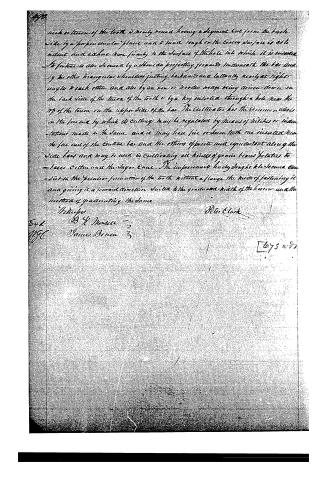
Page 3.
such a turn of the tooth is nearly round having a depression cut from the back side by a perpendicular plane and a more rough on the lower surface so as to adhere and adhere more firmly to the surface of the hole into which it is inserted. The friction is also increased by another projecting forward underneath the bar and by the other triangular shoulders projecting backward and laterally nearly at right angles to each other and also by an iron or wooden wedge being driven down on the back side of the turn of the tooth and by a key inserted through a hole near the top of the turn on the upper side of the bar. The cultivator has the common claws in the forward by which its cutting may be regulated by means of notches or indentations made in the same, and it may have five or seven teeth one inserted near the fore end of the cultivator bar and the others opposite and equidistant along the side bars and may be used in cultivating all kinds of grain, beans, potatoes, tobacco, cotton, and the sugar cane. The improvement is lucky thought to be a good one suited to the peculiar formation of the tooth without a flange the means of fastening it and giving it a forward direction suited to the grain and width of the harrow and the method of graduating the same.
Witnesses
B. H. Morse
James Brown
Pete Clark
[675 u 90]
Published accounts: journal notice
Notice in the monthly list of patents
Journal of the Franklin Institute, new ser., vol. 16 (1835), p. 287 · View the page
503. Cultivator and harrow. -Peter Clark, Aurora, New York,
Published accounts: journal notice
Notice in the monthly list of patents, with remarks
Journal of the Franklin Institute, new ser., vol. 17 (1836), p. 210 · View the page
61. For an improvement in the Harrow and Cultivator; Peter Clark, Aurora, Erie county, New York, August 20.
Remarks. This cultivator is so constructed that its two sides, which form a V, as usual, may be expanded, or contracted; there is also some variation in the manner of forming the teeth, but the change in this part does not appear to be very definite, or important. The claim is to "the peculiar formation of the tooth, without a flanch; the mode of fastening it, and giving it a forward direction suited to the graduated width of the harrow, and to the method of graduating the same."
About this record
- Patentee
- the Journal of the Franklin Institute, Journal
- Date
- USPTO records, Jim Shaw's X-patent list
- Invention
- the Name and Date index of patents
- Listed in
- the Name and Date index of patents, USPTO records, Jim Shaw's X-patent list, the Journal of the Franklin Institute
- The sources give different dates; the date shown is the one most of them agree on.
- The patentee's full name comes from the Franklin Institute's journal.
- The residence comes from the Franklin Institute's journal.
- The Franklin Institute's journal confirms the date shown.