

Drawings and documents
USPTO scan
The patent as scanned by the USPTO
-
 Page 1
-
 Page 2
-
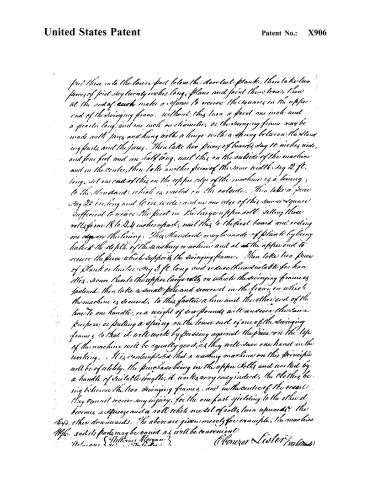 Page 3


U.S. Patent and Trademark Office · Google Patents
Show the transcription Hide (890 words)
Machine transcription (LightOnOCR) of the pages as scanned by the USPTO, most of them the handwritten copies made when the records were restored after the 1836 fire. Not checked; it can misread handwriting, so compare it with the scan.
Page 2.
United States Patent
Patent No.: X906
O. Honeger & Sister
LESSON PATENT
Issued July 12, 1843.
The Schedule referred to in these Letters Patent and making part of the same containing a description in the words of the said O. Honeger & Sister himself of his Washing Machine.
Take two pieces of Board say 5 feet long and 18 inches wide; plane them perfectly smooth, then joint both edges straight, then with a sweep say 4 feet long sweep the under edge of each side piece beginning 9 inches from the center of each which will leave the bottom about 18 in. flat. Then take a number of pieces of boards for the bottom, plane them smooth and groove them together, jointing each joint; then take a strip of cloth and secure on the lower edge of the two side pieces and then nail the bottom on, then take two pieces, say 15 in. wide & 18 in. long, or as long as the machine is wide for the end pieces, make them perfectly smooth and nail them on so that they may be perfectly tight, and the vessel which holds the water is completed. It is to be observed that the ends are to be level from two to ten inches, and that a piece of board of six or eight inches in width is to be securely fixed on the top of the machine and join with the ends. Then take two pieces of two inch plank 8 ft. long, and two of 20 in. long and six wide, plane & joint them smooth and frame them together for the Washing machine to be secured on. Or take two pieces of Plank 22 in. long and 6 in. wide; saw a piece out of one edge of each leaving 1½ inch at each end of each to receive the machine. Then with a piece of board dovetail these together about 2 ft. from each other, then take 4 strips of plank say 4 feet long & 8 inches wide, plane and joint them smooth & true; then in the upper end of each make a hole of 1½ inch square; then bore four or five holes in the lower end of each piece say 3 inches apart above this cut a groove to receive a piece of plank with a dovetail; then take four or five Rolls of suitable length say 14 inches long, and from 1½ to 2 inches diameter.
Page 3.
United States Patent
Patent No.: X906
put these into the lower part below the door tail plank, then take two pieces of pine say twenty inches long, plane and joint them true, then at the end of each make a square to receive the squares in the upper end of the swinging frame; without this turn a pivot one inch and a quarter long, and one inch in diameter, or the swinging frame may be made with jaws and hung with a hinge with a spring between the standing parts and the jaws. Then take two pieces of boards say 10 inches wide, and four feet and an half long, nail this on the outside of the machine and in the center; then take another piece of the same width say 2 ft. long, set one end of this on the upper edge of the machine as a lining, to the Standard, which is nailed on the outside. Then take a piece say 20 in. long and 6 in. wide, and on one edge of this turn a square sufficient to receive the pivot in the large upper roll. Setting these rolls from 18 to 24 inches apart, nail this to the first board and setting one edge on the lining. This Standard may be made of plank by being halved the depth of the washing machine and at the upper end to receive the piece which supports the swinging frame. Then take two pieces of plank or timber say 3 ft. long and make them suitable for handles. Secure these to the upper large rolls on which the swinging frames fastened. Then take a small pole and secure it in the frame on which the machine is secured, to this fasten a line and the other end of the line to one handle, or a weight of six pounds will answer the same purpose, or putting a spring on the lower end of one of the swinging frames so that it will work by pressing against the piece on the top of the machine will be equally good, as they will save one hand in the working. It is contemplated that a washing machine on this principle will be of utility, the pieces being in the upper rolls and worked by a handle of suitable length, it works very easy indeed, the clothes being between the two swinging frames, and in the center of the vessel they cannot receive any injury, for the one fast yielding to the other becomes a spring and a roll while one set of rolls turn upwards the tops other downwards. The above are given merely for example, the machine may and its parts may be varied as will be convenient.
William S. Williams Morgan
(Proper & Lister)
(Proper & Lister)
About this record
- Patentee
- DATAMP
- Date
- the Name and Date index of patents, DATAMP, USPTO records
- Invention
- DATAMP
- Listed in
- the Name and Date index of patents, DATAMP, USPTO records, Jim Shaw's X-patent list, S. A. Elliot's printed list of patents, Burke's List of Patents (1847)
- The sources give the patentee's name differently; the name shown follows DATAMP and Shaw.
- S. A. Elliot's printed list of patents gives the same name and date.
- Burke's 1847 Patent Office list gives the same patent.