

Drawings and documents
National Archives restored drawings: drawing
P.W.A. Needham's Patent Drawing for a Saw Mill Gauge

National Archives, Restored Patent Drawings (Record Group 241) · Full-size scan at the National Archives · Catalog record
Show the text on the drawing Hide (37 words)
Words on the drawing as machine-read by the National Archives; not checked. Useful mainly for searching.
110. SAWS. / 143, / [130] Head Blocks. / Saw Set / Mill WOOR SAWING. Works. / 50 / ONA Needhams / CLASSIFICATIOX / 9081.X / faw Mill Gwage. / DIVISIO NT. / Patented Sep! 9th 1835
USPTO scan
The patent as scanned by the USPTO
-
 Page 1
-
 Page 2
-
 Page 3


U.S. Patent and Trademark Office · Google Patents
Show the transcription Hide (469 words)
Machine transcription (LightOnOCR) of the pages as scanned by the USPTO, most of them the handwritten copies made when the records were restored after the 1836 fire. Not checked; it can misread handwriting, so compare it with the scan.
Page 1.
9081X
W. A. Needham,
Sarr-Mill Head-Block.
Patented Sep. 9, 1835.

AM. PHOTO-LITHO. CO. N.Y. (OSBORNE'S PROCESS)
Page 2.
Sept 9 1835
William A. Needham, of Bunfield, Massachusetts.
Letters Patent.
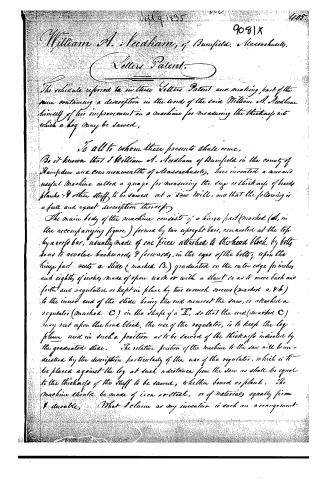
The schedule referred to in these Letters Patent and making part of the same containing a description in the words of the said William A. Needham himself of his improvement in a machine for measuring the thickness into which a log may be sawed,
To all to whom these presents shall come,
Be it known that I William A. Needham of Bunfield in the county of Hampshire and commonwealth of Massachusetts, have invented a new and useful machine called a gauge for measuring the size or thickness of boards planks & other stuff to be sawed at a saw mill, and that the following is a full and exact description thereof.
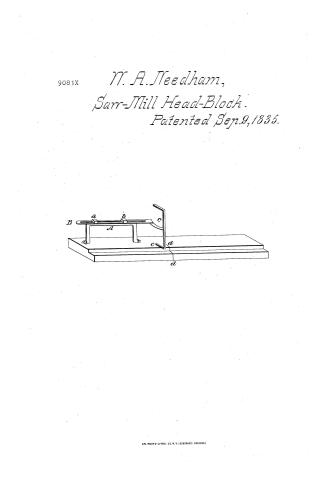
The main body of this machine consists of a hinge part (marked A, in the accompanying figure) formed by two upright bars, connected at the top by a cross bar, usually made of one piece attached to the head block by bolts so as to revolve backwards & forwards, in the eyes of the bolts, upon the hinge part. rests a slide (marked B.) graduated on the outer edge for inches and eighths of inches made of open work or with a slant so as to move back and forth and regulated or kept in place by two wrench screws (marked a & b) to the inner end of the slide being the end nearest the saw, is attached a regulator (marked C) in the shape of a T, so that the end (marked C) may rest upon the head block, the use of the regulator, is to keep the log plumb and in such a position as to be sawed of the thickness indicated by the graduated slide. The relative position of the machine to the saw will be understood by the description particularly of the use of the regulator, which is to be placed against the log at such a distance from the saw as shall be equal to the thickness of the stuff to be sawed, whether board or plank. The machine should be made of iron or steel, or of materials equally firm & durable. What I claim as my invention is such an arrangement
Page 3.
9081X
If the parts described as will according to the description cause a log to be lowered into any required thickness, marked upon the graduated edge of the line—
Witness
Wm. B. Calkins
Jno. H. Polkwood
Wm. A. Necham
465
(Drawing)
Published accounts: journal notice
Notice in the monthly list of patents, with remarks
Journal of the Franklin Institute, new ser., vol. 17 (1836), p. 258 · View the page
24. For a Saw Mill Gauge; William A. Needham, Brimfield, Hampden county, Massachusetts, September 9.
Remarks. This appears to be a very imperfect affair, when compared with many other devices for setting or gauging saw logs. A bar of iron is to be bent twice at right angles, thus, joints to the head block; its ends being attached by hinge upon the top bar there is to be a slide, which may be secured by screws, and which is to be graduated into inches and parts. The end of this bar towards the log has a piece attached to it, thus, which piece is to bear against the log, and to keep it upright.
About this record
- Patentee
- the Journal of the Franklin Institute, Journal
- Date
- the Name and Date index of patents, USPTO records, Jim Shaw's X-patent list
- Invention
- the Name and Date index of patents
- Listed in
- the Name and Date index of patents, USPTO records, Jim Shaw's X-patent list, the Journal of the Franklin Institute, Burke's List of Patents (1847)
- The patentee's full name comes from the Franklin Institute's journal.
- Burke's 1847 Patent Office list gives the same patent.