

Drawings and documents
National Archives restored drawings: drawing
John Tustin's Patent Drawing for a Rail Road Revolving Platform

National Archives, Restored Patent Drawings (Record Group 241) · Full-size scan at the National Archives · Catalog record
Show the text on the drawing Hide (54 words)
Words on the drawing as machine-read by the National Archives; not checked. Useful mainly for searching.
RAILWAYS. / 1. The Way. / 120 Turn Tables. / JOHN TUSTIN'S. / 100 / of / RAIL ROAD REVOLVIVG. / Patented 9 Sept 1835 / PL.ATFOR.M. / 9090. / DIVISION / 1) / O, / Circular channel for the balls. / The / P. / The zower portion of the platform. / The upper portion of the platform.
USPTO scan
The patent as scanned by the USPTO
-
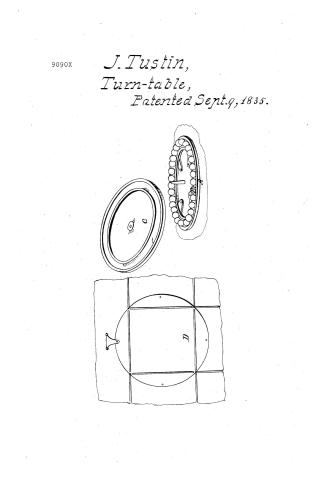 Page 1
-
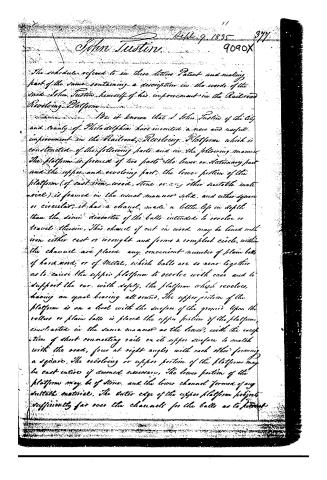 Page 2
-
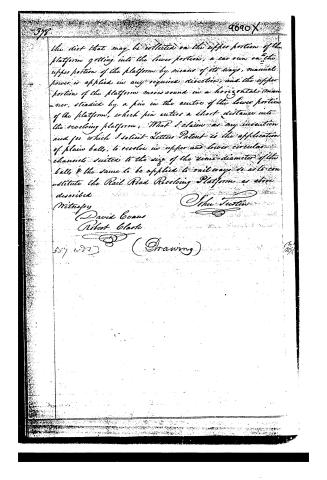 Page 3


U.S. Patent and Trademark Office · Google Patents
Show the transcription Hide (522 words)
Machine transcription (LightOnOCR) of the pages as scanned by the USPTO, most of them the handwritten copies made when the records were restored after the 1836 fire. Not checked; it can misread handwriting, so compare it with the scan.
Page 1.
9090X
J. Tustin,
Turn-table,
Patented Sept. 9, 1835.

Page 2.
John Justin.
The schedule referred to in these letters Patent and making part of the same containing a description in the words of the said John Justin himself of his improvement in the Railroad Revolving Platform.
Be it known that I John Justin of the City and County of Philadelphia have invented a new and useful improvement in the Railroad, Revolving Platform which is constructed of the following parts and in the following manner. The platform is formed of two parts the lower or stationary part and the upper and revolving part; the lower portion of the platform (of cast iron, wood, stone or any other suitable material) is framed in the usual manner solid, and either square or circular; it has a channel made a little less in depth than the semi diameter of the balls intended to revolve or travel therein. This channel if cut in wood may be lined with iron either cast or wrought and forms a complete circle, within the channel are placed any convenient number of plain balls of hard wood, or of metal, which balls are so near together as to cause the upper platform to revolve with ease and to support the car with safety, the platform which revolves, having an equal bearing all around. The upper portion of the platform is on a level with the surface of the ground upon the rollers or plain balls is placed the upper portion of the platform, constructed in the same manner as the lower, with the exception of short connecting rails on its upper surface to match with the road, four at right angles with each other forming a square. The revolving or upper portion of the platform may be cast entire if deemed necessary. The lower portion of the platform may be of stone, and the lower channel formed of any suitable material. The outer edge of the upper platform projects sufficiently far over the channels for the balls as to prevent
Page 3.
the dirt that may be collected on the upper portion of the platform getting into the lower portion, a car run on the upper portion of the platform by means of its ways, manual power is applied in any required direction, and the upper portion of the platform moves round in a horizontal manner, steadied by a pin in the centre of the lower portion of the platform, which pin enters a short distance into the revolving platform. What I claim as my invention and for which I solicit Letter Patent is the application of plain balls, to revolve in upper and lower circular channels suited to the size of the semi-diameter of the balls & the same to be applied to railways so as to constitute the Rail Road Revolving Platform as above described.
Witnesses
David Evans
Robert Clark
(Signature)
(Drawing)
Published accounts: journal notice
Notice in the monthly list of patents
Journal of the Franklin Institute, new ser., vol. 16 (1835), p. 358 · View the page
525. Platform for rail-roads. John Tustin, Philadelphia,
Published accounts: journal notice
Notice in the monthly list of patents, with remarks
Journal of the Franklin Institute, new ser., vol. 17 (1836), p. 252 · View the page
5. For a Revolving Platform for Rail Road; John Tustin, city of Philadelphia, September 9.
Remarks. We believe that the mode of construction here proposed has not been made the subject of a patent, but recollect its being proposed, and an opinion given, that the plan would not be approved in practice. A circular channel is to be made in the bed upon which the platform is to rest, which channel is to be adapted to the reception of round balls, like cannon balls. The revolving platform is to be similarly grooved on its lower side, and placed upon the bed with a sufficient number of balls to be nearly in contact with each other; as a safeguard, there is to be a centre pin. With a heavy weight upon such a platform there will be much friction, the balls as they revolve passing over very unequal spaces on their touching parts; they will also be apt to overtake each each other, and thus increase the evil.
About this record
- Patentee
- the Journal of the Franklin Institute, Journal
- Date
- the Name and Date index of patents, USPTO records, Jim Shaw's X-patent list
- Invention
- the Name and Date index of patents
- Listed in
- the Name and Date index of patents, USPTO records, Jim Shaw's X-patent list, the Journal of the Franklin Institute, Burke's List of Patents (1847)
- The patentee's full name comes from the Franklin Institute's journal.
- Burke's 1847 Patent Office list gives the same patent.