

Drawings and documents
National Archives restored drawings: drawing
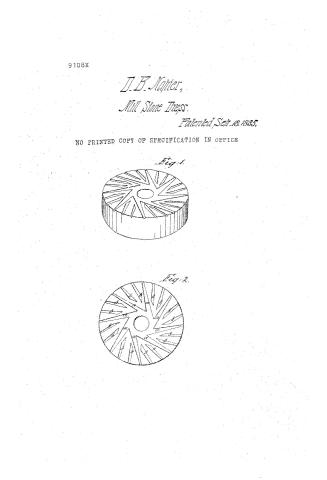
David B. Napier's Patent Drawing for a Method of Dressing Mill Stones

National Archives, Restored Patent Drawings (Record Group 241) · Full-size scan at the National Archives · Catalog record
Show the text on the drawing Hide (99 words)
Words on the drawing as machine-read by the National Archives; not checked. Useful mainly for searching.
83. MILLS. / [57] Mill Stone Dress. / Vol 22. hg.44g. / 9108- X / Daniel B Elgan / Protoun Not 2 / DIVISION. / During Mill.com / Gatental tept isth 1835. / 1. / truft with !" to the foot / furnum ent process" / of semmeter / the farrous should be cut round) / Preferences. / Sig.t. Perspection View / Pig.2 SopiView. a.a.a.e.come leading furrows / 6.6.6.6.1.e short furrows. / Sig.2. / Intent office the 25 Gannaz 18ho / administer / Mari under the direction of the Commissions of / Patents ,in conformity with betof 3d march 183% / Meny Liusworth / of / Eatent / EM.9.
USPTO scan
The patent as scanned by the USPTO
-
 Page 1
-
 Page 2
-
 Page 3


U.S. Patent and Trademark Office · Google Patents
Show the transcription Hide (542 words)
Machine transcription (LightOnOCR) of the pages as scanned by the USPTO, most of them the handwritten copies made when the records were restored after the 1836 fire. Not checked; it can misread handwriting, so compare it with the scan.
Page 1.
9108X
J. B. Maher,
Mill Stone Dress.
Patented, Sept. 18, 1835.
NO PRINTED COPY OF SPECIFICATION IN OFFICE
Fig. 1.
Fig. 2.
Page 2.
Sept. 18, 1835
David B. Napier of the County of Casey, Kentucky,
Letters Patent.
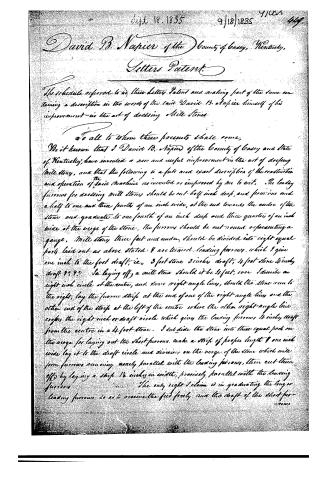
The schedule referred to in these Letters Patent and making part of the same containing a description in the words of the said David B. Napier himself of his improvement in the art of dressing Mill Stones.
To all to whom these presents shall come,
Be it known that I David B. Napier of the County of Casey and State of Kentucky, have invented a new and useful improvement in the art of dressing Mill stone, and that the following is a full and exact description of the construction and operation of said machine as invented or improved by me to wit. The leading furrows for dressing mill stones should be cut half inch deep, and from one and a half to one and three fourths of an inch wide, at the end towards the centre of the stone and graduate to one fourth of an inch deep and three quarters of an inch wide at the verge of the stone. The furrows should be cut round representing a gauge. Mill stone three feet and under, should be divided into eight equal parts laid out as above stated & are termed leading furrows, which I give one inch to the foot draft, i.e., 3 foot stone 3 inches draft, 4 foot stone 4 inches draft &c. In laying off a mill stone should it be 4 feet, over I describe an eight inch circle at the centre, and draw right angle lines, should the stone run to the right, lay the furrow strip at the end of one of the right angle lines and the other end of the strip at the left of the centre where the other right angle line crosses the eight inch or draft circle which gives the leading furrows 4 inches draft from the centre in a 4 foot stone. I subdivide the stone into three equal parts on the verge for laying out the short furrows. Make a strip of proper length & one inch wide lay it to the draft circle and divisions on the verge of the stone which will form furrows running nearly parallel with the leading furrows, then cut them off by laying a strip 1½ inches in width, precisely parallel with the leading furrows. The only right I claim is in graduating the long or leading furrows so as to receive the feed freely and the draft of the short fur-
Page 3.
so as to make them pass one each other at an angle of about 25 or 30 degrees. Each Mills stone should be faced true from the centre to the verge, i.e., Bed stone and Runner, they then commence grinding at or near the centre (and will grind faster than any other plan of dressing in my knowledge) 28th July 1835.
D. B. Napier.
Witness: J. W. Lowney & G. W. Coffey
(Drawing)
528 ndr.
Ex: C.W.
Published accounts: journal notice
Notice in the monthly list of patents, with remarks
Journal of the Franklin Institute, new ser., vol. 17 (1836), p. 264 · View the page
43. For an improvement in the manner of Dressing Mill Stones; David B. Napier, Casey county, Kentucky, September 18.
Remarks. In a stone four feet in diameter, a circle of eight inches is to be described at the centre, and eight leading furrows are laid off, each of which forms a tangent to said circle, which gives the leading furrows four inches draught. Two short furrows are laid out between each of the leading furrows, the strip being still laid to the periphery of the draught circle; these latter terminate 14 inch before they reach the leading furrows. The leading furrows are to be half an inch deep, and from one to one and threefourths of an inch wide. The short furrows are one inch wide. "The only right I claim is in graduating the long or leading furrows so as to receive the feed freely; and the draught of the short furrows so as to make them pass over each other at an angle of about 25 or 30 degrees."
About this record
- Patentee
- DATAMP
- Date
- the Name and Date index of patents, DATAMP, USPTO records
- Invention
- DATAMP
- Listed in
- the Name and Date index of patents, DATAMP, USPTO records, Jim Shaw's X-patent list, the Journal of the Franklin Institute, Burke's List of Patents (1847)
- Burke's 1847 Patent Office list gives the same patent.