

Drawings and documents
National Archives restored drawings: drawing
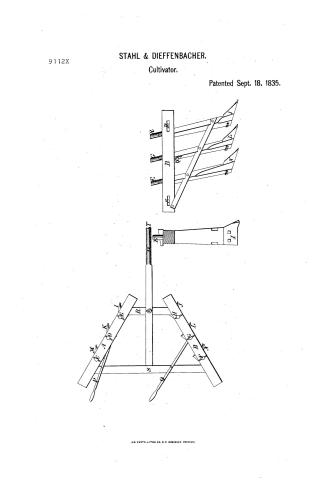
Peter Stahl and Ino Duffenbachers' Patent Drawing for a Cultivating Plough

National Archives, Restored Patent Drawings (Record Group 241) · Full-size scan at the National Archives · Catalog record
Show the text on the drawing Hide (59 words)
Words on the drawing as machine-read by the National Archives; not checked. Useful mainly for searching.
Entered / 97. PLOWS. / [43] Cultivators. / CLASSIFICATION 9112X Straddle ROW. / 9172-X / Cultivating Plough . / Patented. throughout / References. / AB The beams / CDEFGI Standards / IJ Fore mould or shears. / KI middle oltto / MN Hind / dust / o Tongue / current / PQ Handles / RS Forc & bind crols bars. / C.LEEcischmann Engineer
USPTO scan
The patent as scanned by the USPTO
-
 Page 1
-
 Page 2
-
 Page 3
-
 Page 4


U.S. Patent and Trademark Office · Google Patents
Show the transcription Hide (1,070 words)
Machine transcription (LightOnOCR) of the pages as scanned by the USPTO, most of them the handwritten copies made when the records were restored after the 1836 fire. Not checked; it can misread handwriting, so compare it with the scan.
Page 1.
9112X
STAHL & DIEFFENBACHER.
Cultivator.
Patented Sept. 18, 1835.

A.M. PHOTO-LITHO. CO. N.Y. (OSBORNE'S PROCESS)
Page 2.
Sept. 16, 1825
Peter Stahl & John Diefenbacher of Turbot Township, Penn.,
Letters Patent.
The schedule referred to in these Letters Patent and making part of the same, containing a description in the words of the said Peter Stahl & John Diefenbacher themselves of their improvement in the Plough.
To all to whom these presents shall come,
Be it known that we Peter Stahl & John Diefenbacher both of Turbot township in the county of Northumberland and state of Pennsylvania have invented a new and useful improvement in the Plough and that the following is a full and exact description of the construction and operation of the said Machine as invented or improved by us. The Plough is for the purpose of cultivating Corn and Potatoes, and consists of two beams A, B, fastened together in a triangular manner into each of which are fastened securely three standing B, D, E, F, G, H, on the lower end of each of which an iron shear or mould-board is securely fastened, and the whole placed in such a manner in relation to each other, that when the plough is drawn along over the row of corn or potatoes there will be three of the above-mentioned shears or mould-boards, on each side of the said row, the two first or foremost ones, I, J, throwing the earth up against the corn; the two second or next K, L, throwing the earth which is before them into the furrows caused by the two first and the last or third shears M, N, throwing the earth which is before them into the furrows caused by the two second.
On the top of the Plough a tongue O is securely fastened extending beyond the plough a sufficient length to allow of two horses being attached thereto, one on each side for the purpose of drawing and guiding the same; and also on the hinder part of the Plough two handles P, Q, are placed for the convenience of the ploughman in regulating and using the same for the purpose assigned.
Each of the beams should be made about three feet three inches
Page 3.
in length, about three by four inches thick, and framed together by two bars, one at each end of the plough, the foremost one R, being about three inches wide and two and a half inches thick, and of such a length as to bring the heels of the two foremost shears or mould boards about fourteen inches apart, and the hindmost bar S being of the same thickness as the fore one, and of such a length as to bring the heels of the two hindmost shears or mould boards about three feet apart. The Standards C.D, E.F, G.H, should each extend about twenty one inches from the bottom of the beam, and be framed into the latter as to slant forwards at the bottom about two and a half inches from a perpendicular line to the beam; and should be about one and three quarters of an inch thick and about six inches wide. The iron shears or mould boards should be about eight inches long and about five inches deep, fastened on to the standards by two screws passing through each, and of such a shape, and placed in such a manner upon the four sides of the lower ends of the standards, as that when the plough is drawn by the horses in a line, with, and over the row of corn or potatoes, the earth, before each, will be thrown towards the said rows. For a particular idea of the shape & relative situation of the shears and standards reference can be had to the model. The inclination of the face of each of the standards should be at an angle of about fifteen degrees to the outside of the beam, or in other words at an angle of about eighty degrees in relation to each other on the two sides of the plough. The tongue O, is fastened to the centre of each of the end bars R, & S, and should be about ten and a half feet in the whole length, and about three inches square at the hindmost end and about two and a half inches in diameter at the fore end. It should be placed nearly horizontal, but raised or lowered as occasion may require, by means of a small block, which can be placed either under or in the upper side of the tongue and secured in either situation by means of a draw bolt, which
Page 4.
passes through the same and secures them to the centre of the pole or R, each handle should be fastened to the hindmost bar and to the middle standard of each beam both inclining to left side of the plough the left handle being about two and a half feet and the right one about three feet in length. The horses should be attached to the plough by means of a double tree fastened in the lower side of the tongue at 3/4.
What we claim as our own invention and not previously known in the above described machine, are first the sheers or mould boards (which are each cast in one piece and forming a continuous sheer & mould board) second, the high standards C, D, E, F, G, H, which carry the plough beams so far above the corn or potatoes as not to break it down so long as it needs cultivating. And third the placing them in such a manner as to plough or cultivate both sides of a row of corn or potatoes at one and the same time if going over the same, we do not restrict the number of sheers or mould boards and standards to three on each side of the plough as their number must be increased or diminished as the distance between the rows of corn or potatoes is increased or diminished.
Witnesse
Ja. Bourn
Robt. Bennet
972 wd
(Drawing)
Peter Stahl
John Dieffoulbacker
Ex. 2
Ch. 11
Published accounts: journal notice
Notice in the monthly list of patents, with remarks
Journal of the Franklin Institute, new ser., vol. 17 (1836), p. 260 · View the page
How many patents for the application of spiral springs we have seen recorded, we cannot tell, but they are not few. We, however, recollect one from the same county with the foregoing, dated August 25th, 1831, and noticed at p. 128, vol. ix., which, uninviting as we thought it, appeared to offer more comfort than the one under consideration. 33. For a Plough for Cultivating Corn and Potatoes; Peter Stahl, and John Diffenbacher, Turbut township, Northumberland county, Pennsylvania, September 18.
Remarks. This instrument is made in the form of what is commonly called a cultivator, and is furnished with six shares, affixed to standards twenty inches in length, for the purpose of mounting the beams high up above the ground. For the particular form of the shares, the model is, incorrectly, referred to. The following is the claim. "The shares, or mould-boards, which are each cast in one piece, and forming a coulter, share, and mould-board. The high standards, which carry the plough beams so far above the corn, or potatoes, as not to break it down so long as it needs cultivating. The placing these in such a manner as to plough, or cultivate, both sides of a single row of corn, or potatoes, at one and the same time of going over the same."
About this record
- Patentee
- the Journal of the Franklin Institute, Journal
- Date
- the Name and Date index of patents, USPTO records, Jim Shaw's X-patent list
- Invention
- the Name and Date index of patents
- Listed in
- the Name and Date index of patents, USPTO records, Jim Shaw's X-patent list, the Journal of the Franklin Institute, Burke's List of Patents (1847)
- The patentee's full name comes from the Franklin Institute's journal.
- Burke's 1847 Patent Office list gives the same patent.