

Drawings and documents
USPTO scan
The patent as scanned by the USPTO
-
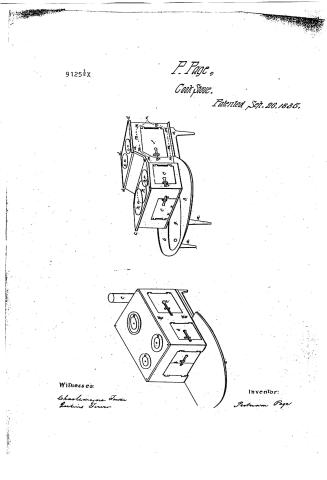 Page 1
-
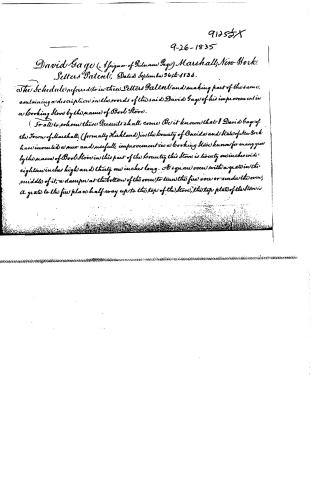 Page 2
-
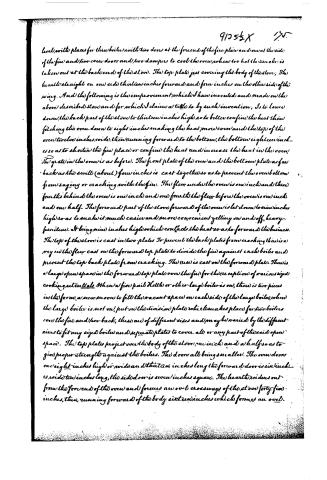 Page 3
-
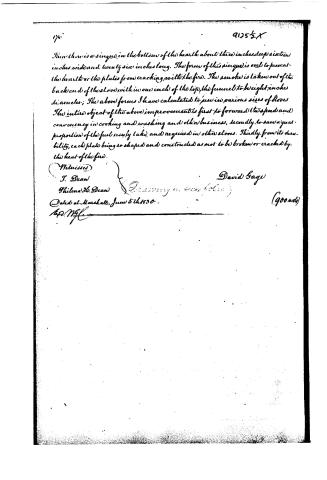 Page 4


U.S. Patent and Trademark Office · Google Patents
Show the transcription Hide (955 words)
Machine transcription (LightOnOCR) of the pages as scanned by the USPTO, most of them the handwritten copies made when the records were restored after the 1836 fire. Not checked; it can misread handwriting, so compare it with the scan.
Page 1.
9125½x
F. Page,
Cook Stove.
Patented Sept. 20, 1835.
Witnesses:
Charlemagne J. T.
Lutius T.
Inventor:
F. Page
Page 2.
91255X
9-26-1835
David Gage (Signer of Pulman Page) Marshall, New York.
Letters Patent, Dated September 26th 1835.
The Schedule referred to in these Letters Patent and making part of the same, containing a description in the words of the said David Gage of his improvement in a cooking stove by the name of Boob Stove.
(To all to whom these Presents shall come: Be it known that I David Gage of the Town of Marshall, (formerly Kirkland) in the County of Oneida and State of New York have invented a new and useful improvement in a cooking stove known for many years by the name of Boob Stove in this part of the country this stove is twenty one inches wide, eighteen inches high and thirty one inches long. A square oven with a grate in the middle of it, a damper at the bottom of the oven to turn the fire over or under the oven, a grate to the fire place half way up to the top of the stove, the top plate of the stove is
Page 3.
91255X 175
level, with places for three boilers, with two doors at the fore end of the fire place and one at the side of the fire and two oven doors and two dampers to cool the oven, when too hot the smoke is taken out at the back end of the stove. The top plate just covering the body of the stove; The hearth straight on one side thirteen inches forward and four inches on the other side of the wing. And the following is the improvement which I have invented and made on the above described stove and for which I claim a title to by such invention; Is to lower down the back part of the stove to thirteen inches high so to better confine the heat then fetching the oven down to eight inches making the heat more even and the top of the oven twelve inches wide, then running forward to the bottom, the bottom eighteen inches so as to shorten the fire place or confine the heat and increase the heat in the oven. The grate in the oven is as before. The front plate of the oven and the bottom plate as far back as the scull (about) four inches is cast together so as to prevent the oven bottom from sagging or cracking with the fire. The floor under the oven is one inch and three fourths behind the oven is one inch and one fourth the floor before the oven is one inch and one half. The forward part of the stove forward of the oven is let down to nine inches high so as to make it much easier and more convenient getting on and off, heavy furniture. It being nine inches high which contact the heat so as to forward the business. The top of the stove is cast in two plates to prevent the back plates from cracking there is a key in the floor cast on the forward top plate to divide the fire against each boiler and prevent the top back plate from cracking. The case is cast on the forward plate. There is a large open space in the forward top plate over the fire for the reception of various sized cooking utensils. When a five pail kettle or other large boiler is on, there is two pieces in the form, a new moon to fill the vacant space on each side of the large boiler, when the large boiler is not on, put on the division plate which makes place for two boilers on the fire and two back, these are of different sizes and may be varied by the different sizes to fit any sized boiler and separate plates to cover all or any part of the said open space. The top plates project over the body of the stove, one inch and a half so as to give proper strength against the boilers. The doors all being smaller. The oven doors one eight inches high or wide and thirteen inches long the forward door is six inches wide ten inches long, the side door is seven inches square. The hearth widens out from the fore end of the oven and forms an over crossways of the stove forty five inches, then running forward of the body sixteen inches which forms an over.
Page 4.
170
Then there is a singue in the bottom of the hearth about three inches deep sixteen inches wide and twenty six inches long. The form of this singue is soel to prevent the hearth or the plates from cracking so it to the fire. The smoke is taken out of the back end of the stove within one inch of the top, the funnel to be eight inches diameter; The above forms I have calculated to use in various sizes of Stoves. The entire object of the above improvement is first to forward the speed and convenience in cooking and washing and other business, secondly to save a great proportion of the fuel usually taken and required in other stoves. Thirdly from its durability, each plate being so shaped and constructed as not to be broken or cracked by the heat of the fire.
Witnesses
J. Dean
Philena H. Dean
David Gage
Dated at Marshall's, June 5th 1830.
(900 wds)
Published accounts: journal notice
Notice in the monthly list of patents, with remarks
Journal of the Franklin Institute, new ser., vol. 17 (1836), p. 266 · View the page
50. For a Cooking Stove; Putnam Page, Sangerfield, Oneida county, New York, (assignee of D. Gage,) September 26.
Remarks. It is stated in the specification that this patent is obtained for an improvement on what is called the Bool stove; and the said improvement consists mainly, if not entirely, in changing the dimensions of the fireplace, the oven, and certain other parts. There is not any thing which can properly be called a claim, but we are told that "the entire object of the improvement is, first, to forward the speed and conveniency in cooking and washing, and other business; secondly, to save a great proportion of the fuel usually taken and required in other stoves; thirdly, its durability, each piece being so shaped and constructed as not to be broken or cracked by the use of the fire."
About this record
- Patentee
- Jim Shaw's X-patent list
- Date
- the Name and Date index of patents, USPTO records, Burke's List of Patents (1847)
- Invention
- the Name and Date index of patents
- Listed in
- the Name and Date index of patents, USPTO records, Jim Shaw's X-patent list, the Journal of the Franklin Institute, Burke's List of Patents (1847)
- The sources give different dates; the date shown is the one most of them agree on.
- The index's second listing was used.
- The Franklin Institute's journal confirms the date shown.
- Burke's 1847 Patent Office list gives the same patent.