

Drawings and documents
USPTO scan
The patent as scanned by the USPTO
-
 Page 1
-
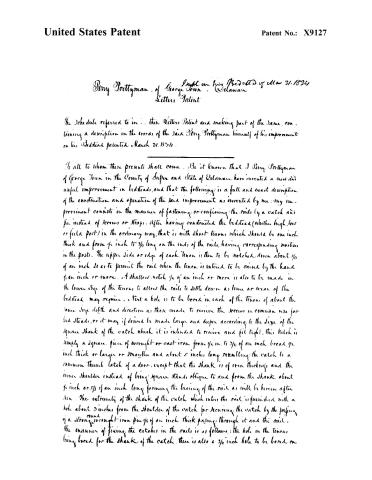 Page 2
-
 Page 3
-
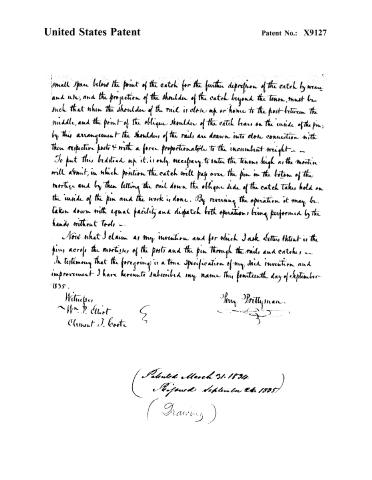 Page 4


U.S. Patent and Trademark Office · Google Patents
Show the transcription Hide (1,366 words)
Machine transcription (LightOnOCR) of the pages as scanned by the USPTO, most of them the handwritten copies made when the records were restored after the 1836 fire. Not checked; it can misread handwriting, so compare it with the scan.
Page 2.
United States Patent
Patent No.: X9127
Billy Prettyman, of George Town, Delaware
Filed on his Petition of Mar 31, 1854
The Schedule referred to in . . . their Letters Patent and making part of the same, containing a description in the words of the said Billy Prettyman himself of his improvement on his Bedstead patented March 31, 1854.
To all to whom these presents shall come: Be it known that I Billy Prettyman of George Town in the County of Sussex and State of Delaware have invented a new and useful improvement in bedsteads, and that the following is a full and exact description of the construction and operation of the said improvement as invented by me: My improvement consists in the manner of fastening or confining the rails by a catch and pin instead of screws or straps. After having constructed the bedstead (whether high, low or field post) in the ordinary way, that is with short tenons, which should be one inch thick and from ¼ inch to ⅜ inch long on the ends of the rails, having corresponding mortises in the posts. The upper side or edge of each tenon is then to be notched down about ⅜ of an inch so as to permit the rail when the tenon is entered to be raised by the hand ¼ an inch or more. A shallow notch ¼ of an inch or more is also to be made in the lower edge of the tenons to allow the rails to settle down as time or wear of the bedstead may require. Next a hole is to be bored in each of the tenons of about the same size depth and direction as those made to receive the screws in common use for bedsteads, or it may if desired be made larger and deeper according to the size of the square shank of the catch which it is intended to receive and fit tight; this hole is simply a square piece of wrought or cast iron from ¼ in. to ⅜ of an inch broad, ½ inch thick or larger or smaller and about 5 inches long resembling the catch to a common thumb latch of a door; except that the shank is of even thickness and the inner shoulder instead of being square stands oblique to and from the shank about ¼ inch or ⅜ of an inch long forming the bearing of the rail as will be hereinafter seen. The extremity of the shank of the catch which enters the rail is furnished with a hole about 3 inches from the shoulder of the catch for securing the catch by the passing of a strong wrought iron pin ⅜ of an inch thick passing through it and the rail. The manner of fixing the catches in the rails is as follows: the hole in the tenons being bored for the shank of the catch, there is also a ⅜ inch hole to be bored on
Page 3.
United States Patent
Patent No.: X9127
the outside of the rail two inches from the shoulder of the rail to the centre of the hole, to reach the hole when the shank is to be driven in the shank of the catch is now to be driven in with the catch down and within a short distance of their oblique shoulder, the hole in the shank now being seen in the hole on the outside of the rail, a boring bit starting the hole in the shank is to be passed through the shank and through the rail, the large hole first made on the outside of the rail is then to be firmly closed by a solid wooden pin and a hole bored through it with the bit last used from the reverse side of the rail, after which the iron pin is driven through from the outside of the rail - and the catch is secured; there may be other methods used to bore these holes but that here described will enable expert workmen to perform the operation quickly and correctly. The mortices of the posts are made three inches 4 3/8 long and gaged 7/8 of an inch from the outside of the post, and one inch wide, the mortice is cut 3/4 of an inch deep the part that is inch wide, then in the center of the inch mortice is to be a half inch mortice or larger if required cut so as to receive the head of the catch nearly one inch deep, next there is to be a 3/8 inch hole bored from the inside of the post across the mortice, within a quarter of an inch of the outside of the post one inch from the edge of the post to the centre of the hole and one inch and 3/8 from the bottom or lower edge of said mortice, then there is to be a 3/8 round wrought iron pin from two 3/4 to two 7/8 inches long or longer if required which is simply a piece of 3/8 chain rod cut off to be driven in the hole across the mortice to within about a 1/4 of an inch of the outside of the post, then a wooden pin is to be driven in the hole on the iron pin to prevent it from moving and this makes a firm fastening for the catch when the tenon is put in the mortice; for large high post bedsteads the best method is to put in two catches in the side rails, one even with the top edge of the tenon and the other near the bottom edge of the tenon; that is let the point of the catch come even with the bottom edge of the tenon, and put two iron pins across the mortices instead of one; one is simply sufficient for low posts and field posts; but it is best to have two for high posts; but one will do very well to put two pins across the mortices; they are to be put the same distance from the inside of the post as before described and one is to be put in 1/2 inch from the lower edge of the mortice to the centre of the hole, and the other is to be put in one inch and 1/4 from the top edge of the mortice to the centre of the hole, the wood behind the pin being sufficiently removed before the pin is driven in to permit the catch to enter over the pin and take hold and to allow a
Page 4.
United States Patent
Patent No.: X9127
small space below the point of the catch for the further depression of the catch by wear and use, and the projection of the shoulder of the catch beyond the tenon, must be such that when the shoulder of the rail is close up or home to the post between the middle, and the point of the oblique shoulder of the catch bears on the inside of the pin; by this arrangement the shoulders of the rails are drawn into close connection with their respective posts & with a force proportional to the incumbent weight —
To put this bristled up it is only necessary to enter the tenons high as the mortise will admit, in which position the catch will pay over the pin in the bottom of the mortise and by then letting the rail down the oblique side of the catch takes hold on the inside of the pin and the work is done. By reversing the operation it may be taken down with equal facility and dispatch both operations being performed by the hands without tools —
Now what I claim as my invention and for which I ask Letters Patent is the pins across the mortises of the posts and the pin through the rails and catches —
In testimony that the foregoing is a true specification of my said invention and improvement I have hereunto subscribed my name this fourteenth day of September 1835.
Witnesses,
Wm. P. Elliot
Clement J. Coote
Henry Prettyman
(Patented March 31, 1834
Reissued September 26, 1835)
(Drawing)
Published accounts: journal notice
Notice in the monthly list of patents, with remarks
Journal of the Franklin Institute, new ser., vol. 17 (1836), p. 270 · View the page
66. For an improvement on his Bedstead, patented March 31st, 1834; Perry Prettyman, Georgetown, Sussex county, Delaware, September 26.
Remarks. Our notice of the patent above alluded to will be found at p. 261, Vol. 14. The difference now made is but small, and as we fully described the original plan, we shall now give the claim only from the new patent, which is to "the pins across the mortises of the posts, and the pins through the rails and catches."
About this record
- Patentee
- the Journal of the Franklin Institute, Journal
- Date
- the Name and Date index of patents, USPTO records, Jim Shaw's X-patent list
- Invention
- the Name and Date index of patents
- Listed in
- the Name and Date index of patents, USPTO records, Jim Shaw's X-patent list, the Journal of the Franklin Institute, Burke's List of Patents (1847)
- The patentee's full name comes from the Franklin Institute's journal.
- The residence comes from the Franklin Institute's journal.
- Burke's 1847 Patent Office list gives the same patent.