

Drawings and documents
National Archives restored drawings: drawing
Seth W. Watson and Cloud Robinson's Patent Drawing for Improvements in Forgers

National Archives, Restored Patent Drawings (Record Group 241) · Full-size scan at the National Archives · Catalog record
Show the text on the drawing Hide (76 words)
Words on the drawing as machine-read by the National Archives; not checked. Useful mainly for searching.
62 / 75. / Furnaces, Forge. / Jeth W.Watson &lond Robinson / CLASSIFICATION / 9130.X / Improvements in Torges ge: / DIVISION. / tol.22 ps 341 / Patented Septem 1835. X / DE / Section of / the / out / 20 / References. / custiron boxes. / ctube to recieve / d caps or / Intent office aug so 1842 / tubes. / he / Marli under the direction offer / lenn with pioner of fatents. in conformity / act of 3 march 183y / ML elementh / him m
USPTO scan
The patent as scanned by the USPTO
-
 Page 1
-
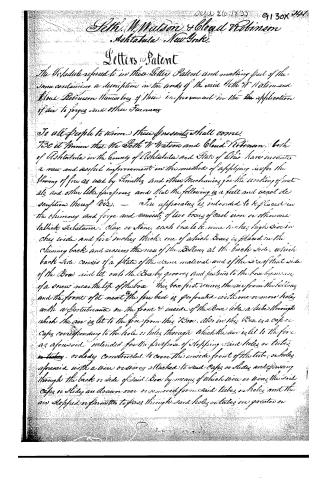 Page 2
-
 Page 3


U.S. Patent and Trademark Office · Google Patents
Show the transcription Hide (756 words)
Machine transcription (LightOnOCR) of the pages as scanned by the USPTO, most of them the handwritten copies made when the records were restored after the 1836 fire. Not checked; it can misread handwriting, so compare it with the scan.
Page 1.
9130X
PATENTED SEPT. 26, 1835.
S. W. WATSON & C. ROBINSON.
FORGE.

Page 2.
Sept 26 1855 9130X 341
Seth W. Watson & Cloud Robinson
Ashtabula, New York.
Letters of Patent
The Schedule referred to in these Letters Patent and making part of the same containing a description in the words of the said Seth W. Watson and Cloud Robinson themselves of their improvement in the application of air to forges and other Furnaces.
To all people to whom these presents shall come.
Be it known that We Seth W. Watson and Cloud Robinson, both of Ashtabula in the County of Ashtabula and State of Ohio have invented a new and useful improvement in the method of applying air for the blowing of fire as used by Smiths and other Mechanics for the working of iron, etc., and other like purposes and that the following is a full and exact description thereof viz. — The apparatus is intended to be placed in the chimney and forge and consists of two boxes of cast iron or other metallic substance, clay, or stone, each box to be nine inches high, six inches wide and five inches thick, one of which boxes is placed in the chimney back and across the nose of the Bellows at the back side, which back side consists of a plate of the same material and of the size of that side of the Box and let onto the Box by grooves and fastens to the box by means of a screw near the top of the box. This box first receives the air from the bellows and the front of it next the fire bed is perforated with one or more holes with a perforation on the front & inside of the Box like a tube through which the air is let to the fire from this Box. Also in this Box is a copper caps corresponding to the hole or holes through which the air is let to the fire as aforesaid intended for the purpose of stopping said holes or tubes or tubes, or slides constructed to cover the inside front of the tube or holes opened with a wire or wires attached to said caps or slides and passing through the back or side of said Box by means of which wire or wires the said caps or slides are drawn over or removed from said tubes or holes and the air stopped or permitted to pass through said holes or tubes in greater or
[Signature]
Page 3.
9130X
smaller quantities. On the front side of the Box and nearly at the bottom is a hole or opening communicating with the inside of the Box of diameter sufficient to receive the tube hereinbefore mentioned as connecting the two boxes. The other box is placed in front of the Box just described and ten or twelve inches or other convenient distance therefrom and is the same in construction with the other Box (first described) except that it has no opening at its back for the reception of air from the Bellows, but having the same hole, or tube for letting the air to the fire in front and the same opening at its front side for the reception of the tube herein mentioned. Between these boxes and below the fire bed passes a tube of the same material with the Boxes of one inch and one half or other convenient diameter (but larger than the tubes or holes through which the air passes to the fire) connecting and passing into each of said Boxes through which the air passes from the first to the second described Box. The boxes are also connected by bars or rods of iron passing from back to back of each Box near the bottom and fastened at one end by a screw the boxes and tubes to be air tight. What we claim as our own invention and not previously known in the above described improvement is the principle and mode of conveying the air to the Box secondly above described from the Box first above described so as to let the air to the fire in counter currents and in appropriate directions from the same Bellows.
Signed in Presence of
Horace Wilder
Cli. J. Wilder
Leth W. Matson
Cloud Robinson
750 n. 67
Published accounts: journal notice
Notice in the monthly list of patents, with remarks
Journal of the Franklin Institute, new ser., vol. 17 (1836), p. 268 · View the page
58. For Supplying Air to Forges; Seth W. Watson, and Cloud Robinson, Ashtabula, Ashtabula county, Ohio, September 26.
Remarks. This contrivance is in part like that described at No. 51; that is the tuyeres are to be supplied with stoppers in the same way; but instead of one box only, there are to be two, connected by a tube, so that the air blown into one may pass freely into the other; the fire is to be between these two boxes, each having its blow pipe, or tuyere. The claim is to "the carrying the air to the second from the first box, so as to let the air to the fire in counter currents, and in opposite directions, from the same bellows."
About this record
- Patentee
- the Journal of the Franklin Institute, Journal
- Date
- the Name and Date index of patents, USPTO records, Jim Shaw's X-patent list
- Invention
- the Name and Date index of patents
- Listed in
- the Name and Date index of patents, USPTO records, Jim Shaw's X-patent list, the Journal of the Franklin Institute, Burke's List of Patents (1847)
- The patentee's full name comes from the Franklin Institute's journal.
- Burke's 1847 Patent Office list gives the same patent.