

Drawings and documents
USPTO scan
The patent as scanned by the USPTO
-
 Page 1
-
 Page 2
-
 Page 3
-
 Page 4


U.S. Patent and Trademark Office · Google Patents
Show the transcription Hide (1,103 words)
Machine transcription (LightOnOCR) of the pages as scanned by the USPTO, most of them the handwritten copies made when the records were restored after the 1836 fire. Not checked; it can misread handwriting, so compare it with the scan.
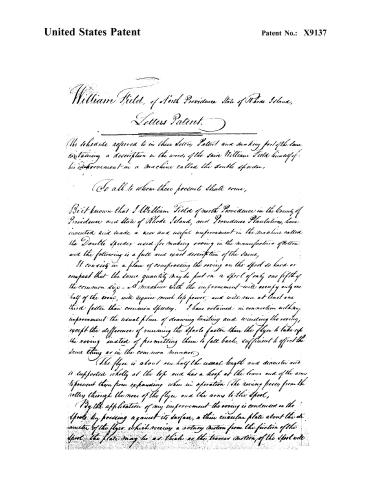
Page 2.
United States Patent
Patent No.: X9137
William Field, of North Providence State of Rhode Island,
Letters Patent.
The schedule referred to in these Letters Patent and making part of the same containing a description in the words of the said William Field himself of his improvement in a machine called the double speeder.
To all to whom these presents shall come,
Be it known that I William Field of North Providence in the County of Providence and State of Rhode Island, and Providence Plantations, have invented and made a new and useful improvement in the machine called the Double Speeder used for making roving in the manufacture of cotton and the following is a full and exact description of the same.
It consists in a plan of compressing the roving on the spool so hard or compact that the same quantity may be put on a spool of only one fifth of the common size. A machine with the improvement will occupy only one half of the room, will require much less power, and will run at least one third faster than common speed. I have retained in connection with my improvement the usual plan of drawing, twisting and winding the roving, except the difference of running the spools faster than the flyer to take up the roving instead of permitting them to fall back, sufficient to effect the same thing as in the common manner.
The flyer is about one half the usual length and diameter and is supported wholly at the top and has a hook at the lower end of the arms to prevent them from expanding when in operation. The roving passes from the nelly through the nose of the flyer and the arms to the spool.
By the application of my improvement the roving is conducted on the spool by pressing against its surface, a thin circular plate about the diameter of the flyer which receives a rotary motion from the friction of the spool. The plate may be as thick as the travers motion of the spool will
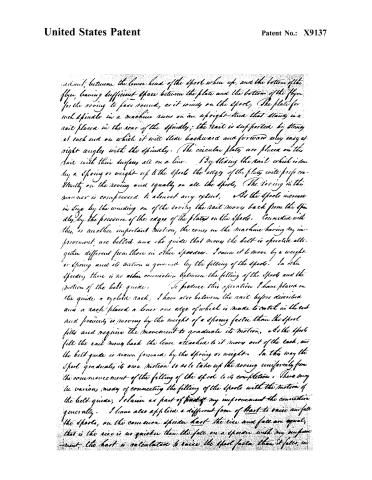
Page 3.
United States Patent
Patent No.: X9137
...between the lower head of the spool when up, and the bottom of the fly, leaving sufficient space between the plate and the bottom of the fly for the roving to pass round, as it winds on the spool. The plate for each spindle in a machine runs on an upright stud that stands in a rail placed in the rear of the spindle; the rail is supported by stays at each end on which it will slide backward and forward any easy at right angles with the spindle. The circular plates are placed on the rail with their surfaces all on a line. By sliding the rail which is done by a spring or weight up to the spool the edges of the plates will press constantly on the roving and equally on all the spools. The roving in this manner is compressed to almost any extent. As the spools increase in size by the winding on of the roving the rail moves back from the spindle, by the pressure of the edges of the plates on the spools. Connected with this, is another important motion, the cones in the machine having my improvement, are belted and the guide that moves the belt is operated altogether different from those in other spindles. I cause it to move by a weight or spring and its motion is governed by the filling of the spools. In other spindles there is no other connection between the filling of the spools and the motion of the belt guide. To produce this operation I have placed on the guide a cycloidal rack, I have also between the rail before described and a rack placed a lever one edge of which is made to catch in the rack and prevents it moving by the weight of a spring faster than the spool fills and requires the movement to graduate its motion. As the spools fill the rail moves back the lever attached to it moves out of the rack, and the belt guide is drawn forward by the spring or weight. In this way the spool graduates its own motion so as to take up the roving uniformly from the commencement of the filling of the spool to its completion. There may be various modes of connecting the filling of the spools with the motion of the belt guide, I claim as part of my improvement the connection generally. I have also applied a different form of Hart to raise and fall the spools, on the common spindle Hart the rise and fall are equal, that is the rise is no quicker than the fall on a spindle with my improvement, the Hart is calculated to raise the spool faster than it falls in
Page 4.
United States Patent
Patent No.: X9137
order that a less quantity of roving may be deposited when the spool is rising it being necessary on account of the circular plates not acting directly on the course which the spool receives when rising, but acting on both courses when the spool is falling.
1st. what I claim as my improvement and not previously known is the plan of compressing roving on spools by circular plates, and having a rotary motion acquired by their pressure on the spools, the edges of which act on the roving as it is received from the flyers, and thereby condense it so that a much greater quantity can be deposited on spools of the same size: 2nd. The sliding rail in the rear of the spools on which the circular plates are placed and the connection between the increasing size of the spools, and the transverse motion of the belt guide so that the spools may cause the variation of speed which their constantly increasing size requires. 3rd. The application of a heart, for transverse the spool to formed as to cause them to rise with a greater velocity than they fall, so that a less quantity of roving may be deposited on the spools when rising than when falling.
North Providence, August 27, 1835.
William Field
N.B. The Model accompanying this Specification is not intended to represent an entire machine but those parts only which are generally connected with my improvement
Witnesses
E. S. Wilkinson
David Lefavour
William Field
Published accounts: journal notice
Notice in the monthly list of patents
Journal of the Franklin Institute, new ser., vol. 17 (1836), p. 70 · View the page
589. Double Speeder. - William Field, North Providence, Rhode Island,
Published accounts: journal notice
Notice in the monthly list of patents, with remarks
Journal of the Franklin Institute, new ser., vol. 17 (1836), p. 325 · View the page
1. For an improvement in the Double Speeder; William Field, North Providence, Providence county, Rhode Island, October 6.
Remarks. This improvement "consists in a plan of compressing the roving on the spool so hard, or compact, that the same quantity may be put on a spool of only one-fifth of the common size. A machine with this improvement will occupy only one-half of the room, will require much less power, and will run at least one-third faster than common speeders." The usual plans for drawing, twisting, and winding, the roving, are followed; but the spools are run faster than the flyers, to take up the roving, instead of permitting them to fall back, in the common manner. The flyers are supported wholly above and independent of the spindles, are about one-half the usual length and diameter, and have a hoop at their lower ends to prevent their expanding. The condensation of the roving is effected by the pressure of a thin, circular, plate against it, as it is wound on the spool; the plate being about the same diameter as the spool. VOL. XVII. No. 5.-MAY, 1836. 31 The claims are to "the plan of compressing roving on spools by circular plates, having a rotary motion, acquired by their pressure on the spools, the edges of which act on the roving as it is received from the flyers, and thereby condense it, so that a much greater quantity can be deposited on spools of the same size. The sliding rail in the rear of the spools, on which the circular plates are placed, and the connection between the increasing size of the spools, and the traverse motion of the belt guide, so that the spools may cause the variation of speed which their constantly increasing size requires. The application of a heart motion for traversing the spools, so formed as to cause them to rise with greater velocity than they fall, so that a less quantity of roving may be deposited on the spools when rising than when falling."
Published accounts: journal notice
Notice in the monthly list of patents, with remarks
Journal of the Franklin Institute, new ser., vol. 17 (1836), p. 328 · View the page
12. For Distilling Alcohol from Apples; Anson Walcott, Bloomfield, Ontario county, New York, October 6.
Remarks. The pommage is to be put into a steam-tight tub, into which steam is to be admitted through a tube, which descends nearly to the bottom of it; a series of vessels, similarly connected by tubes, and perfectly resembling Woulfe's apparatus, is terminated by a condensing worm. The three last vessels, as represented, are to be hollow globes of metal, placed within open tubs, the water in which is to be sufficiently warm to keep the alcohol in the state of vapour, as, otherwise, it would condense in the hollow globes. The claim is to "the application of steam in extracting alcohol from apple pommage, without first making it into cider, and the globular metallic condensers."
About this record
- Patentee
- the Journal of the Franklin Institute, Journal
- Date
- the Name and Date index of patents, USPTO records, Jim Shaw's X-patent list
- Invention
- the Name and Date index of patents
- Listed in
- the Name and Date index of patents, USPTO records, Jim Shaw's X-patent list, the Journal of the Franklin Institute, Burke's List of Patents (1847)
- The patentee's full name comes from the Franklin Institute's journal.
- Burke's 1847 Patent Office list gives the same patent.