

Drawings and documents
National Archives restored drawings: drawing
Elnathan Samson's Patent Drawing for a Stove

National Archives, Restored Patent Drawings (Record Group 241) · Full-size scan at the National Archives · Catalog record
Show the text on the drawing Hide (115 words)
Words on the drawing as machine-read by the National Archives; not checked. Useful mainly for searching.
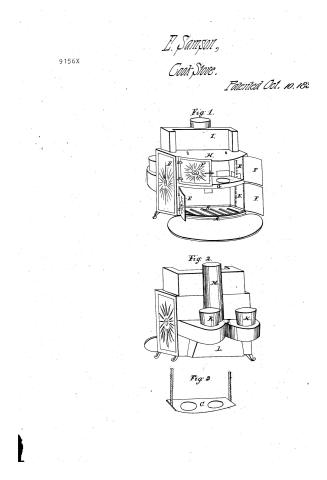
1: / P25 (54) Reservon Cooking Stove. / 06, STOVES is / Calmities - Cooking Stores / A VITY HA N S A / The / CLAZSIFICATION / TOVE. / 9156.x / DIVISTON. / Patented 10th Oct." 1835. / Fig. 1. / V,23 15 / Boiler Mate above, and biloth / grate basedby packtainion worked by Grank outside / Fig 2. / over a unde grate B / m flues around over / Slide under grate lets ashes down into verence / Josplate H is his ged it has a in catching / the doors / Ends are double to let th fire pass source / Iis a case enclosing 5 the Racks + the fire / Heres around rear birters / Tin baker may be put / /Vo Claims / 01 / Fig 3. / bb
USPTO scan
The patent as scanned by the USPTO
-
 Page 1
-
 Page 2
-
 Page 3
-
 Page 4


U.S. Patent and Trademark Office · Google Patents
Show the transcription Hide (1,049 words)
Machine transcription (LightOnOCR) of the pages as scanned by the USPTO, most of them the handwritten copies made when the records were restored after the 1836 fire. Not checked; it can misread handwriting, so compare it with the scan.
Page 1.
9156X
E. Sampson,
Cook Stove.
Patented Oct. 10, 1883
Fig. 1.

Fig. 2.

Fig. 3.

Page 2.
Oct. 10, 1835. 9156X
Jonathan Sampson of Pierpoint State of New York.
Letters Patent.
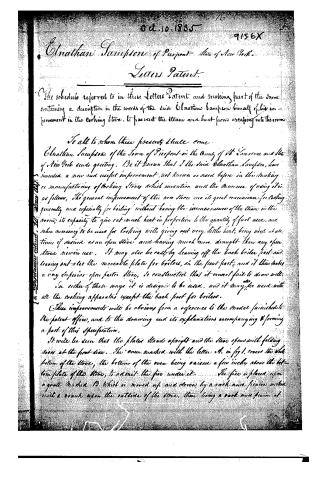
The schedule referred to in these Letters Patent and making part of the same containing a description in the words of the said Jonathan Sampson himself of his improvement in the cooking stove, to prevent the steam and heat from escaping into the room.
To all to whom these presents shall come.
Jonathan Sampson, of the Town of Pierpoint in the County of St Lawrence and State of New York sends greeting. Be it known that I the said Jonathan Sampson, have invented a new and useful improvement not known or used before in the making or manufacturing of cooking stoves which invention and the manner of using it is as follows, The general improvement of this new stove are its great convenience for cooking generally and especially for boiling without having the inconvenience of the steam in the room; its capacity to give out much heat in proportion to the quantity of fuel used, and when necessary to be used for cooking with giving out very little heat, being used at all times if desired as an open stove and having much more draught than any open stove now in use. It may also be easily by leaving off the back boiler part and leaving out also the moveable plate for boilers, in the front part, and it then makes a very superior open part stove, so constructed that it cannot fail to draw well. In either of these ways it is designed to be used, and it may also be used with all the cooking apparatus except the back part for boilers.
These improvements will be obvious from a reference to the model furnished to the patent office, and to the drawing and its explanations accompanying & forming a part of this specification.
It will be seen that the plates stand upright and the stove opens with folding doors at the front side. The oven marked with the letter A, in fig 1, covers the whole bottom of the stove, the bottom of the oven being raised a few inches above the bottom plate of the stove, to admit the fire under it. The fire is placed upon a grate marked B which is moved up and down by a rack and pinion within with a crank upon the outside of the stove, there being a rack and pinion at
Page 3.
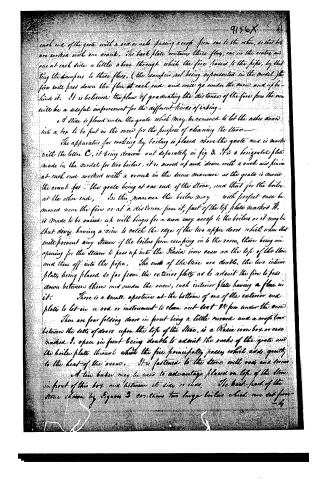
each end of the grate with a rod or axle passing through from one to the other, so that both are worked with one crank. The back plate contains three flues, one in the center and one at each side a little above through which the fire passes to the pipes, by that tying the dampers to these flues. (The dampers not being represented in the model.) The fire will pass down the flue at each end and will go under the oven and up behind it. It is believed the plan of graduating the distance of the fire from the oven will be a useful improvement for the different kinds of baking.
A slide is placed under the grate which may be removed to let the ashes down into a box to be put in the oven for the purpose of cleaning the stove.
The apparatus for cooking by boiling is placed above the grate and is marked with the letter C, it being drawn out separately in fig. 3. It is a horizontal plate made in the model for two boilers, it is moved up and down with a crank and pinion at each end worked with a crank in the same manner as the grate is moved. The crank for the grate being at one end of the stove, and that for the boiler at the other end. In this manner the boiler may with perfect ease be moved near the fire or at a distance from it, part of the top plate marked H. is made to be raised up with hinges for a more easy access to the boilers or it may be shut down, having a rim to catch the edge of the two upper doors which when shut will prevent any steam of the boilers from escaping into the room, there being an opening for the steam to pass up into the Russia iron case on the top of the stove and then off into the pipes. The ends of the stove are double, the two interior plates being placed so far from the exterior plates as to admit the fire to pass down between them and under the oven, each interior plate having a flue in it.
There is a small aperture at the bottom of one of the exterior end plates to let in a rod or instrument to clean out soot &c from under the oven.
There are four folding doors in front being a little curved and a cross bar between the sets of doors upon the top of the stove, is a Russia iron box or case marked I, open in front being double to admit the sacks of the grate and the boiler plate through which the fire principally passes which adds greatly to the heat of the room. It is fastened to the stove with rods and screws.
A tin baker may be used to advantage placed on top of the stove in front of this box and between its sides or ends. The back part of the stove shown by figures 2 contains two large boilers which are set from—
Page 4.
in the bottom plate of that part of the stove guarded against any injury from the wood the fire passing from the front part through flues around the boiler up into the pipe. In witness whereof I have hereunto set my hand this 20th day of August 1833.
C. Nathan, Lauphan
Witness: B. G. Baldwin
Wm. A. Dart
(Drawing)
1040 ndr
Ex. 4
ChfW
Published accounts: journal notice
Notice in the monthly list of patents
Journal of the Franklin Institute, new ser., vol. 17 (1836), p. 70 · View the page
607. Cooking Stove.-Elnathan Samson, St. Lawrence County, New York,
Published accounts: journal notice
Notice in the monthly list of patents, with remarks
Journal of the Franklin Institute, new ser., vol. 17 (1836), p. 330 · View the page
19. For a Cooking Stove; Elnathan Samson, Pierpont, St. Lawrence county, New York, October 10.
Remarks. This stove is to be used as an open stove, when desired; but, like many others, it has doors in front, by which it may be closed. The oven, boilers, &c., are clearly described, and well represented, but there is an entire absence of every thing like a claim. We are told, however, that the improvements will be obvious from the description, and to the patentee this may be the case; he has erred, however, in not enlightening others, by designating these improvements, as the law requires he should do; obvious as they are said to be, we cannot point them out.
About this record
- Patentee
- the Journal of the Franklin Institute, Journal
- Date
- the Name and Date index of patents, USPTO records, Jim Shaw's X-patent list
- Invention
- the Name and Date index of patents
- Listed in
- the Name and Date index of patents, USPTO records, Jim Shaw's X-patent list, the Journal of the Franklin Institute, Burke's List of Patents (1847)
- The patentee's full name comes from the Franklin Institute's journal.
- Burke's 1847 Patent Office list gives the same patent.