

Drawings and documents
National Archives restored drawings: drawing
Henry Ault's Patent Drawing for a Washing Machine

National Archives, Restored Patent Drawings (Record Group 241) · Full-size scan at the National Archives · Catalog record
Show the text on the drawing Hide (109 words)
Words on the drawing as machine-read by the National Archives; not checked. Useful mainly for searching.
t.c. / [91] vas. ane Mrch's / HENRY AULT / ROLLER&BED, / $2 / 9158.X / Patrated / DI V LOION / ealine of Box / cylinder of stats / pressure Boliers / of a eczcle ir Rollers / cranks / Sprency will Herisepmen / of Sliving e7 ver moveable supports / as / Lever waring clown upon the Pivolt of the / =Tuller / injurights allacted to Lever / I. Steving 10100 unrights supporting the / firewing Rollers / coupleng Bars / LV. Treadres / U. Linesia treadles / 7. / cross bas to which Treadles constraction / NO / patented line 1838 / Gen / Made der the direction f Commitional of / Patenlish informity with acts March ing / Commitionar of Patents
USPTO scan
The patent as scanned by the USPTO
-
 Page 1
-
 Page 2
-
 Page 3
-
 Page 4


U.S. Patent and Trademark Office · Google Patents
Show the transcription Hide (830 words)
Machine transcription (LightOnOCR) of the pages as scanned by the USPTO, most of them the handwritten copies made when the records were restored after the 1836 fire. Not checked; it can misread handwriting, so compare it with the scan.
Page 1.
No Printed Specification Available
9158X
H. Ault,
Washing Machine,
Patented Oct. 14, 1835.

Page 2.
Oct. 14, 1835 Av. 11 21.
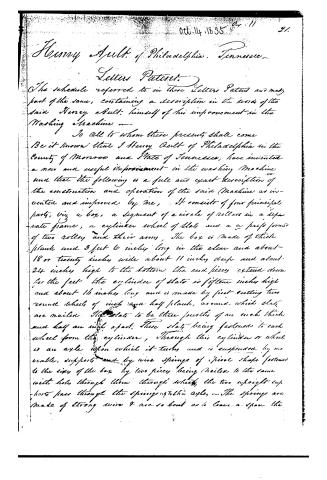
Henry Ault. of Philadelphia, Tennessee.
Letters Patent.
The schedule referred to in these Letters Patent and may part of the same, containing a description in the words of the said Henry Ault, himself of his improvement in the Washing Machine —
To all to whom these presents shall come
Be it known that I Henry Ault of Philadelphia in the County of Monroe and State of Tennessee, have invented a new and useful improvement in the washing Machine and that the following is a full and exact description of the construction and operation of the said Machine as invented and improved by me. It consists of four principal parts, viz a box, a segment of a circle of rollers in a separate frame, a cylinder wheel of slats and a a pair of forms of two rollers and their arms. The box is made of thick plank and 3 feet 6 inches long in the clear and about 18 or twenty inches wide about 11 inches deep and about 24 inches high to the bottom the end pieces extend down for the feet the cylinder of slats is fifteen inches high and about 16 inches long and is made by first cutting two round wheels of inch and half plank, around which slats are nailed. The slats to be three fourths of an inch thick and half an inch apart. These slats being fastened to each wheel from the cylinder, Through this cylinder or wheel is an axle upon which it turns and is suspended by movable, supports and by wire springs of spiral shape fastened to the sides of the box by two pieces being nailed to the same with holes through them through which the two upright supports pass through the springs up to the axle. The springs are made of strong wire & are so bent as to leave a space the
Page 3.
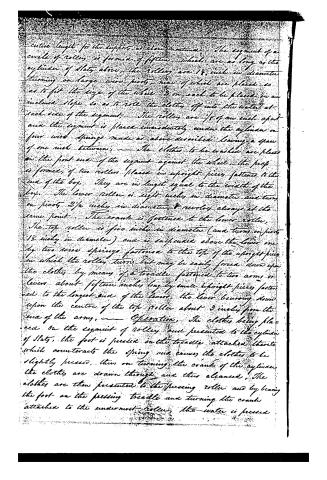
entire length for the support is about mentioned. The segment of a circle of rollers is formed of fifteen, which are as long as the cylinder of slats above, the rollers are 18 inches in diameter turning on large iron pivots, nine of which are placed so as to fit the size of the wheel. 3 on each to be placed in an inclined slope so as to roll the clothes off into the water at each side of the segment. The rollers are 1/8 of an inch apart and the segment is placed immediately under the cylinder on four wire springs made as above described, leaving a space of one inch between. The clothes to be washed are placed on the front end of the segment against the wheel, the prep is formed of two rollers placed in upright pieces fastened to the end of the box. They are in length equal to the width of the box. The lower roller is eight inches in diameter and turns on pivots 2 1/2 inches in diameter & revolves always at the same point. The crank is fastened to the lower roller. The top roller is five inches in diameter (and turns on pivots 1 1/2 inches in diameter) and is suspended above the lower one by two wire springs fastened to the top of the upright pieces in which the rollers turn but may be easily forced down upon the clothes by means of a treadle fastened to two arms or levers about fifteen inches long by small upright pieces fastened to the longest side of the levers, the lever bearing down upon the centre of the top roller about 3 inches from the end of the arm.
Operation. The clothes being placed on the segment of rollers and presented to the cylinder of slats, the foot is pressed on the treadle attached thereto which counteracts the spring and causes the clothes to be slightly pressed, then on turning the crank of the cylinder the clothes are drawn through and thus cleaned. The clothes are then presented to the pressing roller and by bearing the foot on the pressing treadle and turning the crank attached to the undermost roller, the water is pressed
Page 4.
out of the clothes as they pop off from the machine on to a table or bench fastened to the machine to receive them.
What I claim as my invention and for which I solicit Letters Patent, is the application of the springs under the shoulders of the movable supports, the cylinder of slats, the supports themselves, the treadle and coupling bar for depressing the cylinder on the clothes on the segment of roller and the treadle, lever or arms of the pressing cylinder which operate downwards.
Witnesses:
Edward Badlaw
Norman Sheldene
Henry Mull
1000
Patented October 14, 1895.
(Drawing)
Spec 900 words
Published accounts: journal notice
Notice in the monthly list of patents, with remarks
Journal of the Franklin Institute, new ser., vol. 17 (1836), p. 335 · View the page
37. For a Washing Machine; Henry Ault, Philadelphia, Monroe county, Tennessee, October 14.
Remarks. A fluted cylinder is to revolve in a trough, and between this and rollers below it, the clothes are to be passed, by turning the cylinder, the gudgeons of the latter resting upon springs, and being drawn down by placing the foot upon a treadle. After they are cleaned, the clothes are to be pressed by passing them between rollers, the uppermost of which, also, may be borne down by means of a treadle.
About this record
- Patentee
- Jim Shaw's X-patent list
- Date
- the Name and Date index of patents, USPTO records, Jim Shaw's X-patent list
- Invention
- the Name and Date index of patents
- Listed in
- the Name and Date index of patents, USPTO records, Jim Shaw's X-patent list, the Journal of the Franklin Institute, Burke's List of Patents (1847)
- Burke's 1847 Patent Office list gives the same patent.