

Drawings and documents
USPTO scan
The patent as scanned by the USPTO
-
 Page 1
-
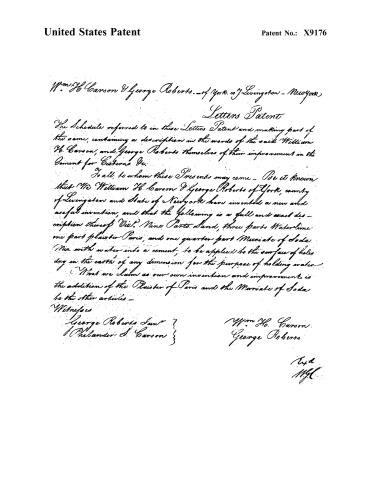 Page 2


U.S. Patent and Trademark Office · Google Patents
Show the transcription Hide (231 words)
Machine transcription (LightOnOCR) of the pages as scanned by the USPTO, most of them the handwritten copies made when the records were restored after the 1836 fire. Not checked; it can misread handwriting, so compare it with the scan.
Page 2.
United States Patent
Patent No.: X9176
Wm. H. Carson & George Roberts. — of York, co. Livingston — New York
Letters Patent
The Schedule referred to in these Letters Patent and making part of the same, containing a description in the words of the said William H. Carson, and George Roberts themselves of their improvement in the Cement for Cisterns &c.
To all, to whom these Presents may come — Be it known that We William H. Carson & George Roberts of York, county of Livingston and State of New York have invented a new and useful invention, and that the following is a full and exact description thereof: viz. Nine Parts Sand, three parts Waterlime, one part plaster Paris, and one quarter part Muriate of Soda. Mix with water into a cement, to be applied to the surface of holes dug in the earth of any dimension for the purpose of holding water.
What we claim as our own invention and improvement is the addition of the Plaster of Paris and the Muriate of Soda to the other articles —
Witnesses
George Roberts Junr
Philander S. Carson
Wm. H. Carson
George Roberts
End
Mgk
Published accounts: journal notice
Notice in the monthly list of patents, with remarks
Journal of the Franklin Institute, new ser., vol. 17 (1836), p. 338 · View the page
51. For Cement for Cisterns; William N. Carson and George Roberts, York, Livingston county, New York, October 17.
Remarks. The following is the whole description. "Nine parts sand, three parts water-lime, one part plaster paris, and one quart muriate of soda; mix with water into a cement; to be applied to holes dug in the earth of any dimensions, for the purpose of holding water. What we claim as our invention is the addition of the plaster of paris and the muriate of soda (common salt) to the other articles." The use of common salt, and of plaster of paris in such cements is not new, nor do we believe it to be of any use, as good hydraulic cement, made of the best water lime and sand, needs no improvement.
About this record
- Patentee
- the Journal of the Franklin Institute, Journal
- Date
- the Name and Date index of patents, USPTO records, Jim Shaw's X-patent list
- Invention
- the Name and Date index of patents
- Listed in
- the Name and Date index of patents, USPTO records, Jim Shaw's X-patent list, the Journal of the Franklin Institute, Burke's List of Patents (1847)
- The patentee's full name comes from the Franklin Institute's journal.
- The residence comes from the Franklin Institute's journal.
- Burke's 1847 Patent Office list gives the same patent.