

Drawings and documents
National Archives restored drawings: drawing
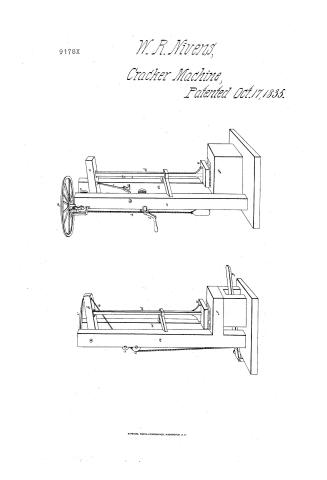
W. R. Nivens' Patent Drawing for a Machine for Culling Crackers and Biscuits

National Archives, Restored Patent Drawings (Record Group 241) · Full-size scan at the National Archives · Catalog record
Show the text on the drawing Hide (121 words)
Words on the drawing as machine-read by the National Archives; not checked. Useful mainly for searching.
65. KITCHEN UTENSILS. / (65) KITCHEN UTENSILS. / [6] / Cracker Mach's / (6) Bread and Cracker Machines. / to / Stamper / 9178-4 / Pat. Oct, 17-1885 / lock / DIVISION. / Culleng Crackers & Buiscuits / Patented ,17" 1835 / a. Frame / b. Horezontal lever / C. Horonoutal spring / d. Perpendicular Rod / e. Bussent lutters / of cutting Block / I. Foot board / h. Rope / k. Dream & Rag wheel with cog Wheel me our ent / c. Pullies / l. Chauth to wind up Machen / m. Cog Wheel runns on axis with crank / and connecting rod n / 0. small Drum / h. Hy Mheel - / shuchland Dec / Patent / Made under the direction of the communication? / Patents in conformity with ach of 3 March 1837 / WL summth / Commissioner gatural
USPTO scan
The patent as scanned by the USPTO
-
 Page 1
-
 Page 2
-
 Page 3


U.S. Patent and Trademark Office · Google Patents
Show the transcription Hide (727 words)
Machine transcription (LightOnOCR) of the pages as scanned by the USPTO, most of them the handwritten copies made when the records were restored after the 1836 fire. Not checked; it can misread handwriting, so compare it with the scan.
Page 1.
9178X
W. R. Nivens,
Cracker Machine,
Patented Oct. 17, 1835.

M. PETERS, PHOTO-LITHOGRAPHER, WASHINGTON, D. C.
Page 2.
9178x Oct. 17, 1835 25
William R. Nierens of New York City
Letters Patent
The Schedule referred to in these Letters Patent and making part of the same containing a description in the words of the said William R. Nierens himself of his improvement in the machine for cutting crackers and Biscuits.
To all to whom these presents shall come, Be it known that I William R. Nierens of the City, County and State of New York have invented a new and useful improvement in the construction of machinery for operating and cutting crackers, or soda Biscuits, and that the following is a full and exact description of the construction and operation of the said machine, as invented and improved by me. The constituent parts of the above mentioned machine are as follows: First a perpendicular frame is made of two posts, each about eight inches wide and about six inches thick, and about eight feet high; or of any other suitable stuff as may be necessary to make the said frame to any suitable size. Near the top of said frame and in the centre is a horizontal lever with one end fastened in the same extending in front about eighteen inches attached to a horizontal spring about the same length, the one end of said spring is fastened on the top of said frame directly above said lever about through the centre of the said lever is a mortice and in said mortice is fastened a perpendicular rod extending downwards about four feet, guided in its friction by a guard fastened in said frame which said rod passes through and at the lower end of said rod is attached the cracker or soda Biscuit cutter made of some sufficient metal. To cut the ordinary size of crackers or soda Biscuit from seven to thirteen at one revolution or any suitable number as may be necessary. Directly under the bottom of said cutter in said frame is attached a horizontal cutting
Page 3.
26
9178X
block about eighteen inches square and of proportional thickness made of suitable metal near the lower end of said frame is a foot board in front eighteen inches long, and at the back is fastened a rope, strap, or chain, extending upwards over the pulleys on the backside of said frame, then passing through the centre of said frame in front directly under and through said horizontal lever passing on the top of the same and fastened at the end in front where the aforesaid horizontal spring is fastened to said lever and by the operator with one foot on said foot board in front of said machine causes a quick motion through said machine.
And if necessary to use the clock motion on said machine a drum is to be placed where the lower pulley is running on an axle which passes through said frame, at one end of which will be affixed (a cogwheel and ratchet, and hand crank to wind up the said machine. On the said same axle, will be attached one wheel above said wheel is a cog wheel running on an axle to which a connecting rod is attached to the same axle with a crank on said axle not using the aforesaid horizontal spring. Near the top of said frame is a small drum that the cord passes twice round, on said cord is a weight that sets the said machine in motion on the axle that the drum runs on is a wheel and pinion, and above that is fastened an axle and bevel wheel and pinion that sets the fly wheel in motion, and if necessary to set two rollers in operation it will roll the dough to itself and by rolling the dough it is calculated to have a portable table to deliver the biscuits from said machine my particular claim in my improvement is this movement of said machine being entirely different from any other hitherto known.
Witnesses
William R. Maens
Ealeb Angerine
James Rummage
(Witness)
(Patentee)
Depository
About this record
- Patentee
- Jim Shaw's X-patent list
- Date
- the Name and Date index of patents, USPTO records, Jim Shaw's X-patent list
- Invention
- the Name and Date index of patents
- Listed in
- the Name and Date index of patents, USPTO records, Jim Shaw's X-patent list, Burke's List of Patents (1847)
- Burke's 1847 Patent Office list gives the same patent.