

Drawings and documents
National Archives restored drawings: drawing
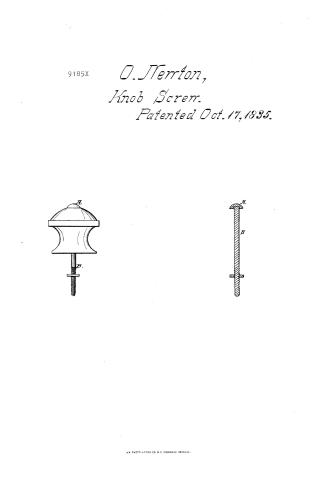
O. Newton's Patent Drawing for a Screw for Glass Knobs

National Archives, Restored Patent Drawings (Record Group 241) · Full-size scan at the National Archives · Catalog record
Show the text on the drawing Hide (97 words)
Words on the drawing as machine-read by the National Archives; not checked. Useful mainly for searching.
ilden th / Kno / 70. / O.Neutons / ro [03] / saxes a & / Serew for Glass knobs. / vol, 21. 535 / Patented Oct. 73th 1835 / 918512 / DIVICION / References. / A. Head B. Shank. / This is to certify. that this drawing mas made under the direction / S the net of March 1887 Sect 1st from and in accordance with the / of the Commissioner of Patent in conformity to the provision of / specification. on which letters Patent more granted to said Drin Newton / 17 th 1835 and recorded anow one the 14th of April 1838. / of Patents
USPTO scan
The patent as scanned by the USPTO
-
 Page 1
-
 Page 2
-
 Page 3
-
 Page 4


U.S. Patent and Trademark Office · Google Patents
Show the transcription Hide (777 words)
Machine transcription (LightOnOCR) of the pages as scanned by the USPTO, most of them the handwritten copies made when the records were restored after the 1836 fire. Not checked; it can misread handwriting, so compare it with the scan.
Page 1.
9185X
O. Terrton,
Knob Screw.
Patented Oct. 17, 1835.

A.M. PHOTO-LITHO. CO. N.Y. (OSSBORNES PROCESS)
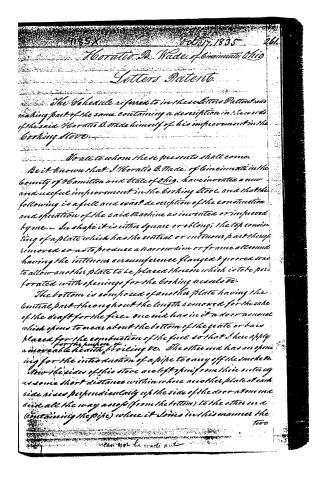
Page 2.
9185X Oct. 17, 1835 261
Horatio B. Wade of Cincinnati, Ohio
Letters Patent.
The Schedule referred to in these Letters Patent and making part of the same, containing a description in its own words of the said Horatio B. Wade himself of his improvement in the Cooking Stove.
To all to whom these presents shall come.
Be it known that I Horatio B. Wade, of Cincinnati in the County of Hamilton and State of Ohio, have invented a new and useful improvement in the Cooking Stove, and that the following is a full and exact description of the construction and operation of the said Machine as invented or improved by me. — In shape it is either square or oblong; the top consisting of a plate which has the central or interior part thereof removed so as to produce a narrow rim or frame all round having the interior circumference flanged & grooved so as to allow another plate to be placed thereon which is to be perforated with openings for the Cooking vessels &c.
The bottom is composed of another plate having the central part throughout the length removed for the sake of the draft for the fire. One end has in it a door or window which opens to near about the bottom of the grate or bars placed for the combustion of the fuel so that I here apply for the purpose of a movable hearth, boiling &c. The other end has an opening for the introduction of a pipe to carry off the smoke &c.
Now the sides of this stove are left open from their cutting at some short distance within where another plate at each side rises perpendicularly up the side of the door at one end and all the way as up (from the bottom) to the other end (containing the pipe) where it joins in this manner the two
can not be made out
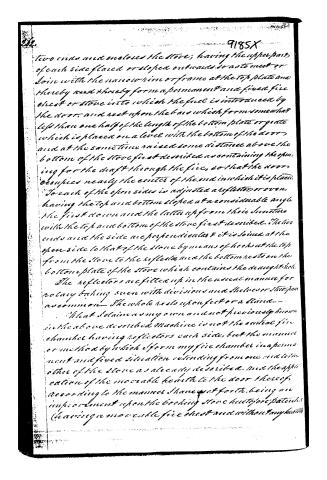
Page 3.
two ends and encloses the stove; having the upper part of each side flared or sloped outwards so as to meet or join with the narrow rim or frame at the top plate and thereby and thereby form a permanent and fixed fire chest or stove into which the fuel is introduced by the door, and rest upon the base which forms somewhat less than one half of the length of the bottom plate or grate which is placed on a level with the bottom of the door and at the same time raised some distance above the bottom of the stove first described as containing the opening for the draft through the fire, so that the door occupies nearly the center of the end in which it is placed. To each of the open sides is adjusted a reflector or oven, having the top and bottom sloped at a considerable angle the first down and the latter up from their junction with the top and bottom of the stove first described. The two ends and the side are perpendicular & it is joined at the open side to that of the stove by means of hooks at the top from the stove to the reflector and the bottom rests on the bottom plate of the stove which contains the draught hole. The reflectors are fitted up in the usual manner for roasting baking oven with divisions and shelves or tiers as common. The whole rests upon feet or a stand.
What I claim as my own and not previously known in the above described Machine is not the circular fire chamber having reflectors each side, but the manner or method by which I form my fire chamber in a permanent and fixed situation extending from one end to the other of the stove as already described, and the application of the movable hearth to the door thereof, according to the manner I have set forth, being an improvement upon the cooking stove heretofore patented (having a movable fire chest and without any hearth
Page 4.
In Testimony that the above is a full and exact description of my improvement as invented or improved by me, I have hereunto set my hand this twenty-seventh day of August in the year eighteen hundred and thirty-five.
Witnesses
Daniel H. Meader
R. Moorhead
Horatio B. Wade
9185X 269.
[928. nvd]
Tid.
H.H.
Published accounts: journal notice
Notice in the monthly list of patents
Journal of the Franklin Institute, new ser., vol. 17 (1836), p. 337 · View the page
44. For a Cooking-Stove; Horatio B. Wade, Cincinnati, Ohio, October 17.
About this record
- Patentee
- the Journal of the Franklin Institute, Journal
- Date
- the Name and Date index of patents, USPTO records, Jim Shaw's X-patent list
- Invention
- the Name and Date index of patents
- Listed in
- the Name and Date index of patents, USPTO records, Jim Shaw's X-patent list, the Journal of the Franklin Institute, Burke's List of Patents (1847)
- The National Archives' catalog gives the name differently.
- The patentee's full name comes from the Franklin Institute's journal.
- Burke's 1847 Patent Office list gives the same patent.
Shaw: lists Newton, O. here as 9185½