

Drawings and documents
National Archives restored drawings: drawing
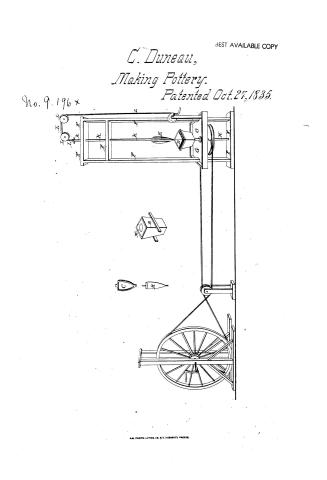
C. Duneau's Patent Drawing for a Method of Making Moulds for Loaf Sugar

National Archives, Restored Patent Drawings (Record Group 241) · Full-size scan at the National Archives · Catalog record
Show the text on the drawing Hide (34 words)
Words on the drawing as machine-read by the National Archives; not checked. Useful mainly for searching.
25. CLAY & POTTERY, / DIV. 15 / Pottery Machines / CLASSIFICATION / 9196-4 / Co JD UNEAU / Patented 24th Oct. 1835 / 200 24 p 101 / I. / T. / Strickland
USPTO scan
The patent as scanned by the USPTO
-
 Page 1
-
 Page 2
-
 Page 3
-
 Page 4
-
 Page 5
-
 Page 6


U.S. Patent and Trademark Office · Google Patents
Show the transcription Hide (1,433 words)
Machine transcription (LightOnOCR) of the pages as scanned by the USPTO, most of them the handwritten copies made when the records were restored after the 1836 fire. Not checked; it can misread handwriting, so compare it with the scan.
Page 1.
BEST AVAILABLE COPY
C. Duneau,
Making Pottery.
Patented Oct. 27, 1835.
No. 9,196 x

A.M. PHOTO-LITH. CO. N.Y. (OSBORNE'S PROCESS)
Page 2.
Oct. 27, 1835
Charles Duncan. (Patented 27 Oct. 1835)
Letters Patent.
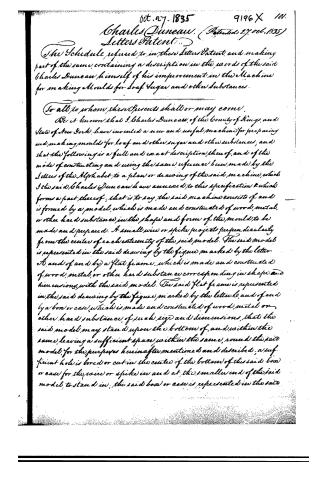
The Schedule referred to in these Letters Patent, and making part of the same, containing a description in the words of the said Charles Duncan himself of his improvement in the Machine for making Moulds for loaf Sugar and other substances.
To all to whom these Presents shall or may come,
Be it known that I, Charles Duncan, of the County of Kings, and State of New York, have invented a new and useful Machine for preparing and making moulds for loaf and other sugar and other substances, and that the following is a full and exact description thereof, and of the mode of constructing and using the same, reference being made by the Letters of the Alphabet to a plan or drawing of the said Machine, which I the said Charles Duncan have annexed to this specification & which forms a part thereof; that is to say, the said Machine consists of and is formed by a model, which is made and constructed of wood, metal, or other hard substance in the shape and form of the mould to be made and prepared. A small wire or spike projects perpendicularly from the center of each extremity of the said model. The said model is represented in the said drawing by the figure marked by the letter A, and of and by a flat frame, which is made and constructed of wood, metal, or other hard substance corresponding in shape and dimensions, with the said model. The said flat frame is represented in the said drawing by the figure marked by the letter B, and of and by a box or case, which is made and constructed of wood, metal or other hard substance, of such size and dimensions, that the said model may stand upon the bottom of, and within the same, leaving a sufficient space within the same, round the said model, for the purposes hereinafter mentioned and described; a sufficient hole is bored or cut in the center of the bottom of this said box or case for the wire or spike in and at the smaller end of the said model, to stand in; the said box or case is represented in the said
Page 3.
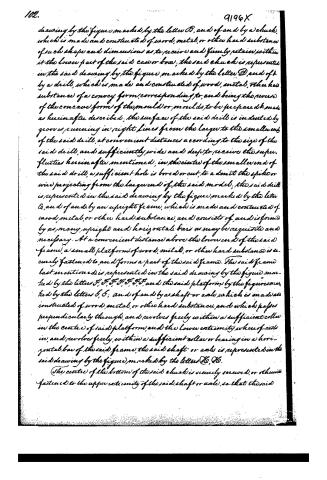
102. 9196X
drawing by the figure marked by the letter B, and of and by a chuck, which is made and constructed of wood, metal, …
Page 4.
9196X 103
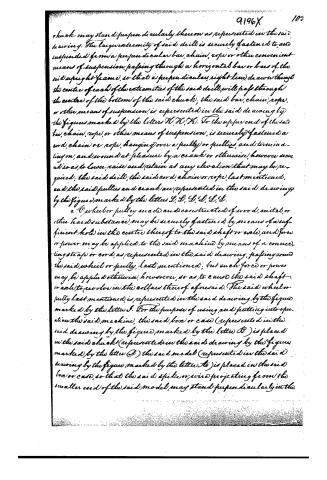
chuck may stand perpendicularly thereon as represented in the said drawing. The larger extremity of said drill is securely fastened to, and suspended from a perpendicular bar, chain, rope or other convenient means of suspension, passing through a horizontal bar or bars of the said upright frame, so that a perpendicular, right line drawn through the centre of each of the extremities of the said drill, will pass through the centre of the bottom of the said chuck; the said bar, chain, rope, or other means of suspension is represented in the said drawing by the figures marked by the letters H, H, H. To the upper end of the said bar, chain, rope, or other means of suspension, is securely fastened a cord, chain or rope, hanging over a pulley or pulleys, and terminating on, and wound at pleasure by, a crank or otherwise, however secured so as to lower, raise and retain at any elevation that may be required; the said drill, the said cord, chain or rope, last mentioned, and the said pulleys and crank are represented in the said drawings by the figures marked by the letters L, L, L, L, L, L.
A wheel or pulley made and constructed of wood, metal, or other hard substance, may be securely fastened by means of a sufficient hole in the centre thereof to the said shaft or axle, and force or power may be applied to the said machine by means of a connecting strap or cord, as represented in the said drawing, passing around the said wheel or pulley, last mentioned; but such force or power may be applied otherwise, howsoever, so as to cause the said shaft or axle to revolve in the collar thereof aforesaid. The said wheel or pulley last mentioned, is represented in the said drawing by the figure marked …
Page 5.
said hole in the bottom of the said box or case, the said drill (represented in the said drawing by the figure marked by the letter E,) is then let down until the said spike or wire in the larger extremity of the said mould is admitted and received into the said hole in the smaller extremity of the said drill. Liquid Plaster of Paris, or other convenient composition or matter, is then poured into the said box or case, so as to cover the sides or convex part of the said model, and to fill the space in the said box or case, round the said model. As soon as the said Plaster of Paris, or other composition or matter, has become hard and solid, the said model is taken out of the same, and a concave model or figure is discovered in the said Plaster of Paris or other composition or matter corresponding to and the reverse of the convex form or figure of the said model. The said concave model or figure is represented in the said drawing by the figure marked by the letter M, and which is contained within the aforesaid figure marked by the letter B. Potter's earth or clay prepared as Potter's prepared earth or clay, or other proper and convenient composition or matter, and placed within the said flat frame upon some smooth surface. Two pieces of said earth or clay or other matter or composition, shaped by, and corresponding to the figure of the said flat frame, and somewhat thicker than the mould to be formed therefrom as hereinafter mentioned, are then placed in, and against the sides of the said concave model or figure so as to join, touch, and cover the concave surface or sides of the said concave model or figure. The said shaft or axle is then made to revolve within the said collars thereof, by the means hereinbefore mentioned, so that the said chuck, and the said box or case also, revolve with the said shaft, the said drill is then lowered gradually, until it is sufficiently within the said Potter's earth or clay, or other composition or matter, and the said box or case with the said concave model or figure, and the said Potter's earth or clay or other composition or matter, as the case may be, are caused to revolve until the said drill has made the interior concave surface of the said Potter's earth or clay or other
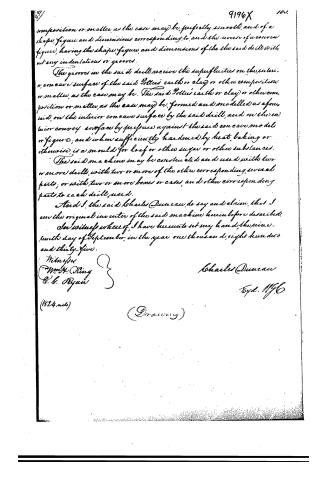
Page 6.
composition or matter, as the case may be, perfectly smooth, and of a shape, figure and dimensions corresponding to, and the reverse of a convex figure, having the shape, figure, and dimensions of the said drill with not any indentations or grooves.
The grooves in the said drill receive the superfluities on the exterior or concave surface of the said Potter's earth or clay or other composition or matter, as the case may be. The said Potter's earth or clay or other composition or matter, as the case may be, formed and modelled as aforesaid, on the interior concave surface by the said drill, and on the exterior convex surface by pressure against the said concave model or figure; and when sufficiently hardened by heat, baking or otherwise, is a mould for loaf or other sugar or other substances.
The said machine may be constructed and used with two or more drills, with two or more of the other corresponding several parts; or with two or more boxes or cases, and other corresponding parts to each drill used.
And I, the said Charles Duncan, do say and claim, that I am the original inventor of the said machine hereinbefore described.
In witness whereof, I have hereunto set my hand, the nineteenth day of September, in the year one thousand, eight hundred and thirty-five.
Witnesses
Wm H. King
C. L. Ryan
Charles Duncan
Exd. 1196
(1824 mds)
(Drawing)
Published accounts: journal notice
Notice in the monthly list of patents, with remarks
Journal of the Franklin Institute, new ser., vol. 17 (1836), p. 343 · View the page
69. For Moulds for Loaf Sugar, &c.; Charles Duncan, Williamsburg, Kings county, New York, October 27.
Remarks. A concave mould, or chuck, is to be made, and fixed upon a vertical shaft, which is to revolve like a potters' wheel. It is proposed to form the inside of this mould, or chuck, of plaster of Paris. The prepared clay for making the sugar mould, is to be laid within the concave, and a former, of the shape of the inside of the mould, is to be made to descend within it, so as to shape and smooth it. The specification, though verbose and involved, may, nevertheless, be sufficiently well understood to enable a person to carry the plan into operation. There is no claim.
About this record
- Patentee
- the Journal of the Franklin Institute, Journal
- Date
- the Name and Date index of patents, USPTO records, Jim Shaw's X-patent list
- Invention
- the Name and Date index of patents
- Listed in
- the Name and Date index of patents, USPTO records, Jim Shaw's X-patent list, the Journal of the Franklin Institute
- The National Archives' catalog gives the name differently.
- The patentee's full name comes from the Franklin Institute's journal.
- The residence comes from the Franklin Institute's journal.