

Drawings and documents
National Archives restored drawings: drawing
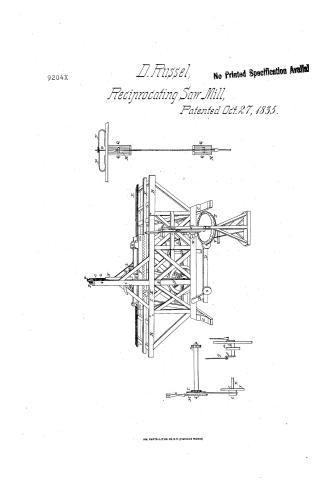
D. Russell's Patent Drawing for a Portable Saw Mill

National Archives, Restored Patent Drawings (Record Group 241) · Full-size scan at the National Archives · Catalog record
Show the text on the drawing Hide (56 words)
Words on the drawing as machine-read by the National Archives; not checked. Useful mainly for searching.
110. saws. / 143, WOOD SAWING, / Insurancial Frinklin waster / [180] Reciprocating Saw Mills / SAWING MACITINES / Reciprocating Saw: / D. RUSSEL'S / #2- / CLAISLINCATION / you / Portable Saw Mill. / A/C / th / 9204.1 / Patented 270ct:1835 / DIVISION: / CA / It / the / 17 / F¹ / ET / IT / T-K5 / Is / DD / F.B.dult)
USPTO scan
The patent as scanned by the USPTO
-
 Page 1
-
 Page 2
-
 Page 3
-
 Page 4


U.S. Patent and Trademark Office · Google Patents
Show the transcription Hide (893 words)
Machine transcription (LightOnOCR) of the pages as scanned by the USPTO, most of them the handwritten copies made when the records were restored after the 1836 fire. Not checked; it can misread handwriting, so compare it with the scan.
Page 1.
9204X
D. Russel,
Reciprocating Saw Mill,
Patented Oct. 27, 1835.
No Printed Specification Available
AM. PHOTO-LITHO. CO. N.Y. (OSBORNE'S PROCESS)
Page 2.
2391 9204X 441
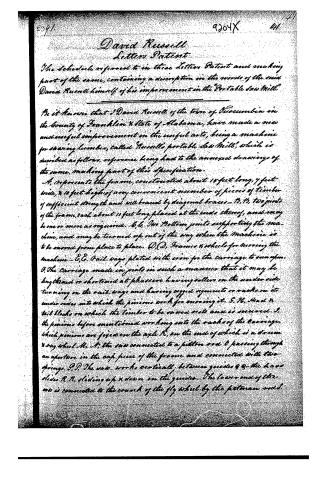
David Russell
Letters Patent
The Schedule annexed to his three Letters Patent and making part of the same, containing a description in the words of the said David Russell himself of his improvement in the "Portable Saw Mill."
Be it known that I David Russell of the town of Tuscaloosa in the county of Franklin & State of Alabama, have made a new and useful improvement on the useful arts, being a machine for sawing lumber, called "Russell's portable Saw Mill," which is described as follows, reference being had to the annexed drawings of the same, making part of this Specification.
A, represents the frame, constructed about 15 feet long, 7 feet wide, & 10 feet high of any convenient number of pieces of timber of sufficient strength and well braced by diagonal braces—B, B, two joints of the frame, each about 11 feet long, placed at the ends thereof, and may be one or more as required. C, C, Two Bottom joints supporting the machine, and may be turned up out of the way when the machine is to be moved from place to place. D, D, Frames & wheels for moving the machine—E, E, Rail ways plated with iron for the carriage to run upon. F, The Carriage made in joints in such a manner that it may be lengthened or shortened at pleasure having rollers on the under side turning on the rail ways and having cogged segments or racks on its under sides into which the pinions work for moving it. G, H, Head & tail blocks on which the timber to be sawed rests and is secured. I, the pinions before mentioned working into the racks of the Carriage, which pinions are fixed on the axle K, on the end of which is a drum & cog wheel M. N, the saw connected to a piston rod O passing through an aperture in the top piece of the frame and connected with two springs. P, P, The saw works vertically between guides Q Q—the head slides R R, sliding up & down on the guides. The lower end of the rod is connected to the crank of the fly wheel by the piston rod S.
Page 3.
The gearing consists of a horizontal cog wheel I about 4 feet in diameter fixed on a vertical shaft U, which is turned by a horse attached to the lever V of the shaft. A pinion N on the end of a horizontal shaft X, works into the horizontal cog wheel, by which the horizontal shaft is turned, on the end of which is a pulley or band wheel Y, 5 feet in diameter around which passes a band Z leading to the pulley a on the axle b of the fly wheel. On the horizontal shaft is another pulley C two feet in diameter around which passes a band leading to the drum on the cog wheel shaft for running the carriage back. On the other end of the fly wheel shaft is another crank f to which is attached a connecting rod g which is connected to an elbow h turning on a journal, on the end of which elbow is attached the feed hand e working in the cog wheel for feeding the machine.
Operation — The carriage is run back, the log rolled upon the head and tail blocks and secured by the dogs — the machine is put in motion — the feed hand dropped into the cog wheel — the horizontal cog wheel turns the pinion on the end of the horizontal shaft which is turned with the pulley thereon and the band passing around it turns the pulley and shaft of the fly wheel which turns the cranks on its shaft. One of the cranks works the saw up and down with the aid of the springs, while the other crank at the same time operates the feed hand — this turns the cog wheel which turns the shaft and pinions — these meshing into the racks of the carriage bring the carriage forward with the log to be sawed. When the log is sawed through from end to end the hand is lifted from the cog wheel which runs the carriage back, the hand is again dropped into the cog wheel and the operation continued till the log be entirely sawed — the machine is stopped.
This machine may be propelled by hands or by cogged gear or any word or men, and may be made double or single to drive one or more saws or gangs of saws, by water, steam, or horse power, and may be for table or fixed of such size to suit the convenience of the Builder.
Page 4.
9204X 143
What I claim as my invention and which I desire to secure by Letters Patent, consists in the combination and arrangement of the several parts of the before described Saw Mill.
Witness
David Russell
Mm. P. Elliott
Sam. Attinico
(Drawing)
(812 words)
Troy, N.Y.
Published accounts: journal notice
Notice in the monthly list of patents
Journal of the Franklin Institute, new ser., vol. 17 (1836), p. 343 · View the page
71. For a Portable Saw Mill; David Russell, Tuscumbia, Franklin county, Alabama, October 27.
About this record
- Patentee
- Jim Shaw's X-patent list
- Date
- the Name and Date index of patents, USPTO records, Jim Shaw's X-patent list
- Invention
- the Name and Date index of patents
- Listed in
- the Name and Date index of patents, USPTO records, Jim Shaw's X-patent list, the Journal of the Franklin Institute, Burke's List of Patents (1847)
- The Franklin Institute's journal spells the name differently.
- Burke's 1847 Patent Office list gives the same patent.