

Drawings and documents
National Archives restored drawings: drawing
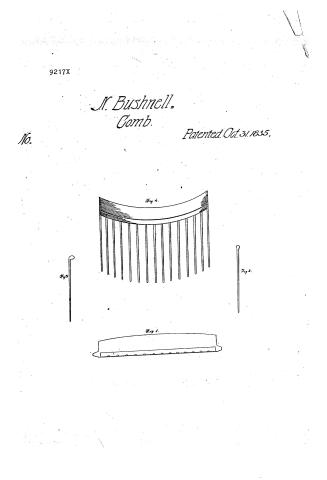
Nathaniel Bushnell's Patent Drawing for a Metallic Hair Comb

National Archives, Restored Patent Drawings (Record Group 241) · Full-size scan at the National Archives · Catalog record
Show the text on the drawing Hide (81 words)
Words on the drawing as machine-read by the National Archives; not checked. Useful mainly for searching.
W eye / 761] Cambs. / [282, DOCTOR, / nalh! Brishnil / Comber / Medallic Hair Comb. / 9217-4 / DIVISION. / Patented Oct 31 - 1835. / 9217X / Hig 4 / Higs / Fig 2. / the / Fig 1. / References / Figl. Top of the Comb prepared for inverting the teeth. / 2. Teeth other than the end teath. / 3. End-teeth / 4. or ornamenting. / Patent office 21" fuly 1838, / Made under the direction of the Commitioner of / Patents in comformity with acts.March 1837, / ML.M.Morth / Commissioner of satents
USPTO scan
The patent as scanned by the USPTO
-
 Page 1
-
 Page 2
-
 Page 3


U.S. Patent and Trademark Office · Google Patents
Show the transcription Hide (928 words)
Machine transcription (LightOnOCR) of the pages as scanned by the USPTO, most of them the handwritten copies made when the records were restored after the 1836 fire. Not checked; it can misread handwriting, so compare it with the scan.
Page 1.
9217X
No. 116.
J. Bushnell.
Comb.
Patented Oct. 31, 1835.
Fig. 4.
Fig. 3.
Fig. 2.
Fig. 1.
Page 2.
9217X
Oct. 31, 1835
Nathaniel Bushnell, of Middletown, Conn.
Letters Patent.
The schedule referred to in these Letters Patent, and making part of the same containing a description in the words of the said Nathaniel Bushnell himself of his improvement in the metallic Hair Comb.
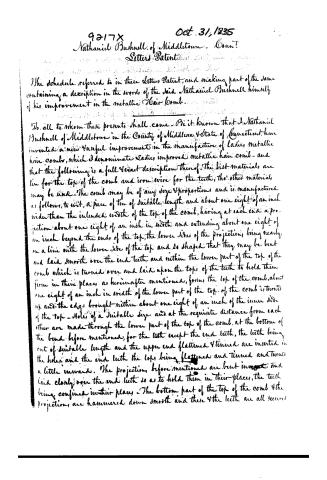
To all to whom these presents shall come—Be it known that I, Nathaniel Bushnell of Middletown in the County of Middlesex & State of Connecticut, have invented a new & useful improvement in the manufacture of ladies metallic hair combs, which I denominate Ladies improved metallic hair comb—and that the following is a full & exact description thereof: The best materials are tin for the top of the comb and iron wire for the teeth, tho’ other materials may be used. The comb may be of any size & proportions and is manufactured as follows, to wit, a piece of tin of suitable length and about one eight of an inch wider than the intended width of the top of the comb, having at each end a projection about one eight of an inch in width and extending about one eight of an inch beyond the ends of the top, the lower sides of the projections being nearly on a line with the lower side of the top and so shaped that they may be bent and laid smooth over the end teeth and within the lower part of the top of the comb which is turned over and laid upon the tops of the teeth to hold them firm in their places, as hereinafter mentioned, forms the top of the comb, about one eight of an inch in width of the lower part of the top of the comb is turned up and the edges brought within about one eight of an inch of the inner side of the top—Holes of a suitable size and at the requisite distance from each other are made through the lower part of the top of the comb, at the bottom of the bend before mentioned, for the teeth except the end teeth, the teeth being cut of suitable length and the upper end flattened & turned are inserted in the holes, and the end teeth the tops being flattened and turned and turned a little inward. The projections before mentioned are bent inward and laid closely over the end teeth so as to hold them in their places, the teeth being confined in their places. The bottom part of the top of the comb & the projections are hammered down smooth and then & the teeth are all secured
Page 3.
9217X
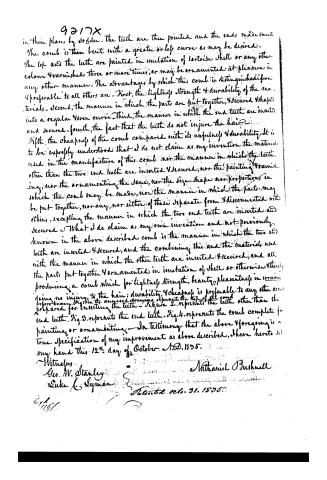
in their place, by solder. The teeth are then pointed and the ends made smooth. The comb is then bent with a greater or less curve as may be desired. The top and the teeth are painted in imitation of tortoise shell or any other colour varnished three or more times, or may be ornamented at pleasure in any other manner. The advantages by which this comb is distinguished from any other manner. The advantages by which this comb is distinguished from any other manner. The advantages by which this comb is distinguished from any other manner. First, the lightness, strength & durability of the materials. Second, the manner in which the parts are put together & secured. Third, the manner in which the end teeth are inserted into a regular even curve. Third, the manner in which the end teeth are inserted and secured. Fourth, the fact that the teeth do not injure the hair. Fifth, the cheapness of the comb compared with its usefulness & durability. It is to be expressly understood that I do not claim as my invention the material used in the manufacture of this comb nor the manner in which the teeth, other than the two end teeth are inserted & secured, nor the painting & varnishing, nor the ornamenting the same, nor the size, shape nor proportions in which the comb may be made, nor the manner in which the parts may be put together, nor any, nor either of these separate from & disconnected with others, excepting the manner in which the two end teeth are inserted and secured. What I do claim as my own invention and not previously known in the above described comb is the manner in which the two end teeth are inserted & secured, and the combining this and the materials used with the manner in which the other teeth are inserted & secured, and all the parts put together & ornamented in imitation of shell or otherwise thereby producing a comb which for lightness, strength, beauty, pleasantness in wearing doing no injury to the hair; durability & cheapness is preferable to any other comb before known. Fig. 1 is the angled drawing spring to the top of the comb prepared for inserting the teeth. Figure 2 represents the teeth other than the end teeth. Fig. 3 represents the end teeth. Fig. 4 represents the comb complete for painting or ornamenting. In testimony that the above & foregoing is a true specification of my improvement as above described, I have hereunto set my hand this 12th day of October A.D. 1835.
Witnesses
Geo. W. Stanley
Luke C. Lyman
Nathaniel P. Bushnell
Patented Oct. 31, 1835.
Published accounts: journal notice
Notice in the monthly list of patents, with remarks
Journal of the Franklin Institute, new ser., vol. 17 (1836), p. 348 · View the page
90. For Ladies Metallic Hair Combs; Nathaniel Bushnell, Middletown, Middlesex county, Connecticut, October 31.
Remarks. GAY'S Patent for Rearing Silk Worms. The comb described is to have the top made of tin, and the teeth of iron wire; the upper ends of the teeth are to be soldered to the plate, the edges of which are to be bent over to secure them in their places. The comb is afterwards to be painted in imitation of shell, or otherwise ornamented. Much is said about claiming and not claiming, which results, as we understand it, in there not being any thing new, excepting the manner of securing "the end teeth," which is a trifling affair, not worth describing, although worth patenting.
Originals known from auction sales: letters patent
Letters patent, signed by Andrew Jackson and John Forsyth, with the specification and drawing; the specification is endorsed "Received 1 May 1837 and recorded anew in this office pursuant to the act of Congress passed 3 March 1837" by Commissioner Henry L. Ellsworth
Offered by an online auction, 2019. Offered at auction; images exist but are not reproduced here.
X9217: Nathaniel Bushnell, metallic hair comb (October 31, 1835)
Source: the grantee's letters patent, specification and drawing. Offered at an online auction in 2019; transcribed from the listing images, which are not reproduced here. Only the printed form's filled-in parts and the endorsements are transcribed here; the specification text is too small in these images to read reliably. Handwritten words are in italics; [?] marks a tentative reading.
Letters patent
Whereas Nathaniel Bushnell a citizen of the United States, hath alleged that he has invented a new and useful improvement In the Metallic Hair Comb ... for the term of fourteen years from the Thirty first day of October one thousand eight hundred and thirty five ...
GIVEN under my hand at the City of Washington, this Thirty first day of October in the year of our Lord one thousand eight hundred and thirty five and of the independence of the United States of America the sixtieth.
Andrew Jackson
BY THE PRESIDENT, John Forsyth, Secretary of State.
Certified as examined, B. F. Butler, Attorney General of the United States.
Numbers written at the top corners: 121 (left) and 078 (right).
Specification
Ends: "In testimony that the above & foregoing is a true specification of my improvement as above described I have hereunto set my hand this 12th day of October A.D. 1835. Nathaniel Bushnell." Witnesses: Geo. W. Stanley [?], Luke C. Lyman [?].
Endorsed, with the Patent Office seal:
> Patent Office. Received 1 May 1837 and recorded anew in this office pursuant to the act of Congress passed 3 March 1837. Henry L. Ellsworth, Commissioner of Patents.
Drawing
Figs. 1–4: the comb's back, two teeth, and the finished comb. Signed Nathaniel Bushnell and endorsed Rec'd Oct 23 [?].
About this record
- Patentee
- the Journal of the Franklin Institute, Journal
- Date
- the Name and Date index of patents, USPTO records, Jim Shaw's X-patent list
- Invention
- an original document offered at auction (see below)
- Listed in
- the Name and Date index of patents, USPTO records, Jim Shaw's X-patent list, the Journal of the Franklin Institute, an original document offered at auction (see below), Burke's List of Patents (1847)
- The patentee's full name comes from the Franklin Institute's journal.
- An original document for this patent has been offered at auction.
- Burke's 1847 Patent Office list gives the same patent.