

Drawings and documents
National Archives restored drawings: drawing
J.G. Hotchkiss' Patent Drawing for a Rotary Steam Engine

National Archives, Restored Patent Drawings (Record Group 241) · Full-size scan at the National Archives · Catalog record
Show the text on the drawing Hide (75 words)
Words on the drawing as machine-read by the National Archives; not checked. Useful mainly for searching.
of A. / STEAM ENGMES / Rotary Impret / #130 / I l Mothkin / classicication / 9232-1 / old Hitchlin / DIVISION / 9232X / Pretary Pream Engine. / Patented 7th November 1835. / V. 24. h. 169. / blaim / drawn from patent any the same direction Cap to covers all but last one K / number of wheels B.D, K. may he used the moving altinately.on / End.Greenough / Claims Combin of these wheels,
USPTO scan
The patent as scanned by the USPTO
-
 Page 1
-
 Page 2
-
 Page 3


U.S. Patent and Trademark Office · Google Patents
Show the transcription Hide (828 words)
Machine transcription (LightOnOCR) of the pages as scanned by the USPTO, most of them the handwritten copies made when the records were restored after the 1836 fire. Not checked; it can misread handwriting, so compare it with the scan.
Page 1.
9232X
J. G. Hotchkiss,
Rotary Steam Engine.
Patented Nov. 7, 1835.

AM. PHOTO-LITHO. CO. N.Y. (OSBORNE'S PROCESS.)
Page 2.
John L. Holchkiess.
Letters Patent. (Dated November 7, 1855.)
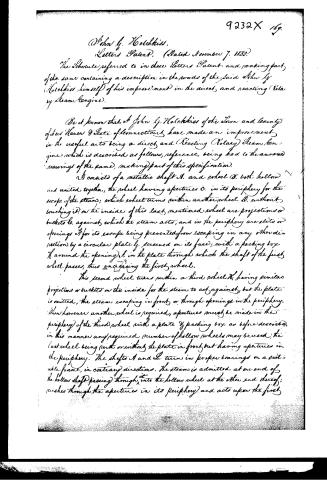
The Schedules referred to in these Letters Patent, and making part of the same containing a description in the words of the said John L. Holchkiess himself of his improvement in the direct and reacting Rotary Steam Engine.
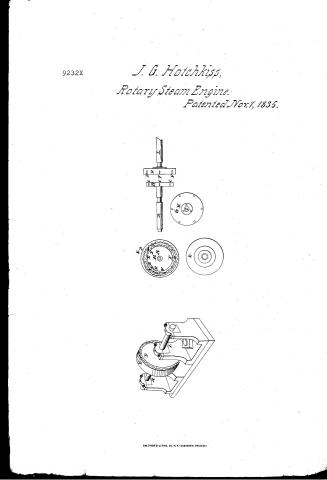
Be it known that I John L. Holchkiess of the town and county of New Haven & State of Connecticut have made an improvement in the useful arts being a direct and Reacting Rotary Steam Engine which is described as follows, reference, being had to the annexed drawings of the same, making part of this specification.
It consists of a metallic shaft A, and a wheel B, both hollow and united together, the wheel having apertures C, in its periphery for the escape of the steam; which wheel turns within another wheel D, without touching it, on the inside of this last mentioned wheel are projections or buckets E, against which the steam acts, and in the periphery are slits or openings F for its escape being prevented from escaping in any other direction by a circular plate G, screwed on its face, with a packing box H around the opening I, in the plate through which the shaft of the first wheel passes, thus engaging the first wheel.
This second wheel turns within a third wheel K, having similar projections or buckets on the inside for the steam to act against, but the plate is omitted, the steam escaping in front or through openings in the periphery. When however another wheel is required, apertures must be made in the periphery of the third wheel with a plate & packing box as before described, in this manner any required number of hollow wheels may be used, the last wheel being with or without the plate in front but having apertures in the periphery. The shafts A and D, turn in proper bearings on a suitable frame, in contrary directions. The steam is admitted at one end of the hollow shaft passing through it into the hollow wheel at the other end thereof; passes through the apertures in its periphery and acts upon the first
Page 3.
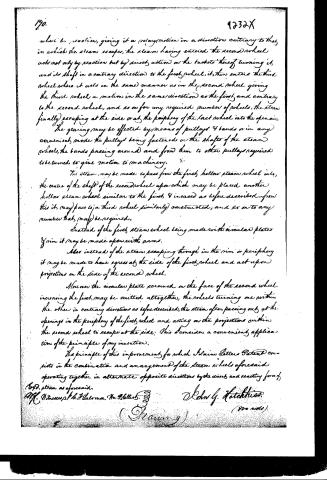
wheel by reaction, giving it a rotary motion in a direction contrary to that in which the steam escapes, the steam having entered the second wheel acts not only by reaction but by direct action on the buckets thereof turning it, and its shaft in a contrary direction to the first wheel, it then enters the third wheel where it acts in the same manner as in the second wheel giving the third wheel a motion in the same direction as the first and contrary to the second wheel, and so on for any required number of wheels, the steam finally escaping at the side or at the periphery of the last wheel into the open air.
The gearing may be effected by means of pulleys & bands or in any convenient mode the pulleys being fastened on the shafts of the steam wheels, the bands passing around and from them to other pulleys required to be turned to give motion to machinery.
The steam may be made to pass from the first hollow steam wheel into the centre of the shaft of the second wheel upon which may be placed another hollow steam wheel similar to the first & increased as before described from this it may pass to a third wheel similarly constructed, and so on to any number that may be required.
Instead of the first steam wheel being made with circular plates & rim it may be made open with arms.
Also instead of the steam escaping through in the rim or periphery it may be made to have orifices at the side of the first wheel and act upon projections on the side of the second wheel.
Moreover the circular plate screwed on the face of the second wheel increasing the first may be omitted altogether, the wheels turning one within the other in contrary directions as before described, the steam after passing out at the openings in the periphery of the first wheel and acting on the projections within the second wheel to escape at the side. This I consider a convenient application of the principle of my invention.
The principle of this improvement for which I claim Letters Patent consists in the combination and arrangement of the steam wheels aforesaid operating together in alternate opposite directions by the direct and reacting force of the steam as aforesaid.
W. H. Witmer, J. C. F. Salomon, Th. P. Kellner.
John G. Hatchfield.
(900 words)
Published accounts: journal notice
Notice in the monthly list of patents
Journal of the Franklin Institute, new ser., vol. 17 (1836), p. 144 · View the page
689. Rotary Steam Engine.-John G. Hotchkiss, New Haven, Connecticut,
Published accounts: journal notice
Notice in the monthly list of patents, with remarks
Journal of the Franklin Institute, new ser., vol. 17 (1836), p. 404 · View the page
8. For a Rotary Steam Engine; John G. Hotchkiss, New Haven, New Haven county, Connecticut, November 7.
Remarks. of skill Abortive attempts at constructing rotary steam engines have been nearly as numerous as the attempts themselves; some of them, however, have evinced a great degree of although unsuccessfully applied; but in the machine which forms the subject of the present patent, we do not perceive much waste of talent, nor any thing likely to disappoint any reasonable expectations. The whole scheme, in fact, is one which evinces an entire absence of elementary knowledge, on the subject of steam in particular, and of mechanics in general. Steam is to be admitted through a hollow shaft into a revolving metallic drum fixed upon it; this drum has slots, or openings, on its periphery, through which the steam is to escape, and to strike against what are called "buckets," on the inside of a circular rim, by which it is surrounded, and which it nearly touches; the so called buckets are represented as grooves crossing the hollow rim, and formed like saw-teeth. This hollow rim has also slots, or openings, to allow the steam to pass through, and act upon a American Patents for November, with Remarks. second rim similarly constructed. Circular heads are to enclose the whole, excepting the last hollow rim, from which the steam may escape at the ends of each bucket. 1 "The principle of this improvement consists in the combination and arrangement of the steam wheels aforesaid, operating together in alternate opposite directions, by the direct and reacting force of the steam, as aforesaid."
About this record
- Patentee
- the Journal of the Franklin Institute, Journal
- Date
- the Name and Date index of patents, USPTO records, Jim Shaw's X-patent list
- Invention
- the Name and Date index of patents
- Listed in
- the Name and Date index of patents, USPTO records, Jim Shaw's X-patent list, the Journal of the Franklin Institute
- The patentee's full name comes from the Franklin Institute's journal.
- The residence comes from the Franklin Institute's journal.