

Drawings and documents
National Archives restored drawings: drawing
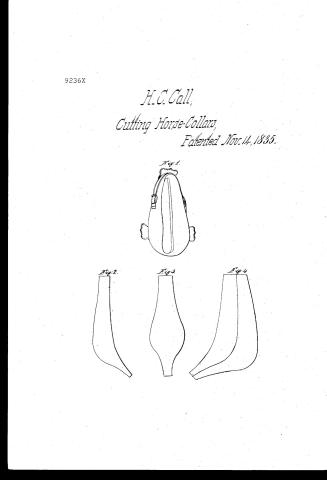
H.C. Cole's Patent Drawing for an Improvement in Cutting Horse Collars

National Archives, Restored Patent Drawings (Record Group 241) · Full-size scan at the National Archives · Catalog record
Show the text on the drawing Hide (80 words)
Words on the drawing as machine-read by the National Archives; not checked. Useful mainly for searching.
Coll H.C. Calli / Chaptin cutting Horse collars. / Patented sha Nov: 183. / classEcication / 9236.A / Tig., / DIVISION / 9236 X / Fig.2 / Tig. / Fig.4. / NE / References / Fid.3. Pattern to crimp on both sides. / Figs. Collar complete tig2 Crimping board / tig.4. Pattern to crimp on one side. / Patent office May 18th 1838- / Made under direction of the commissioner of / in / contomity / with / the / act / of / 3"March / 1834 / NL Ellsworth / but
USPTO scan
The patent as scanned by the USPTO
-
 Page 1
-
 Page 2
-
 Page 3


U.S. Patent and Trademark Office · Google Patents
Show the transcription Hide (563 words)
Machine transcription (LightOnOCR) of the pages as scanned by the USPTO, most of them the handwritten copies made when the records were restored after the 1836 fire. Not checked; it can misread handwriting, so compare it with the scan.
Page 1.
9236X
H.C. Call,
Cutting Horse-Collars,
Patented Nov. 14, 1835.
Fig. 1.
Fig. 2. Fig. 3. Fig. 4.
Page 2.
9236X
Nov. 14, 1835
Henry B. Ball, of Sterling, Connecticut
Letters Patent.
The schedule referred to in these Letters Patent and making part of the same, containing a description in the words of the said Henry B. Ball, himself, of his improvement in the mode of cutting and making Horse collars.
To all persons to whom these presents shall come, Henry B. Ball, of Sterling, in the county of Windham and State of Connecticut, mechanic, sends Greeting. Be it known that I the said Henry B. Ball, have invented, constructed, made and applied to use, a new and useful improvement in the mode of making or manufacturing Horse collars, called "Henry B. Ball's improvement in the manufacture of Horse collars," specified in the words following to wit: This improvement consists in cutting the whole pad of the collar in one piece thus saving all necessity of any seam, welt or stitching upon that part of the collar, which has heretofore been furnished and supposed to be necessary. The shape and form of the collar when finished is made the same as the most approved in present use, consisting of the following parts viz: The pad being the under part of the collar resting against the breast of the horse and upon which the hands are drawn, the sole being the upper part of the collar rising above the hands, the cap and the protecting straps. The three last of which are constructed & made as the same are now made, and no improvement in them is claimed. But the improvement consists in the process of cutting whole and making without seam or welt the pad of the collar.
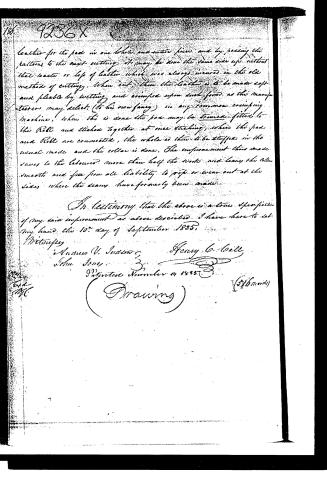
Mode of cutting — prepare the pattern according to the size of the collar designed to be made. The patterns herewith annexed, being for the usual or common size, then by the pattern, cut the
Page 3.
leather for the pad in one whole and entire piece and by passing the pattern to the next cutting it may be done the same side up without that waste or loss of leather which was always incurred in the old method of cutting. When cut, then the leather is to be made soft and pliable by wetting and crimped upon such form as the manufacturer may select (to his own fancy) in any common crimping machine, when this is done the pad may be formed fitted to the Roll and stitched together at once stitching, when the pad and Roll are connected, the whole is then to be stuffed in the usual mode and the collar is done. The improvement thus made saves to the labourer more than half the work and leaves the collar smooth and free from all liability to rip or wear out at the sides where the seams have formerly been made.
In testimony that the above is a true specification of my said improvement as above described I have here to set my hand the 10th day of September 1835.
Witnesses
Andrew V. Jackson
Henry G. Ball
John Jones
Patented November 11 1835
(Drawing)
Published accounts: journal notice
Notice in the monthly list of patents
Journal of the Franklin Institute, new ser., vol. 17 (1836), p. 144 · View the page
695. Horse Collars.-H. C. Call, Sterling, Connecticut,
Published accounts: journal notice
Notice in the monthly list of patents, with remarks
Journal of the Franklin Institute, new ser., vol. 17 (1836), p. 406 · View the page
14. For an improvement in the Manufacturing of Horse Collars; Henry C. Call, Sterling, Windham county, Connecticut, November 14.
Remarks. This collar is, when finished, to be in the form of the most approved collars now in use; "the improvement consists in the process of cutting whole, and making without seam, or welt;" we are told, also, that "the pattern hereunto annexed is for the usual, or common, size;" but the drawing does not represent any such pattern, nor is any attempt at describing it made in the specification.
About this record
- Patentee
- the Journal of the Franklin Institute, Journal
- Date
- the Name and Date index of patents, USPTO records, Jim Shaw's X-patent list
- Invention
- the Name and Date index of patents
- Listed in
- the Name and Date index of patents, USPTO records, Jim Shaw's X-patent list, the Journal of the Franklin Institute, Burke's List of Patents (1847)
- The National Archives' catalog gives the name differently.
- The patentee's full name comes from the Franklin Institute's journal.
- Burke's 1847 Patent Office list gives the same patent.