

Drawings and documents
National Archives restored drawings: drawing
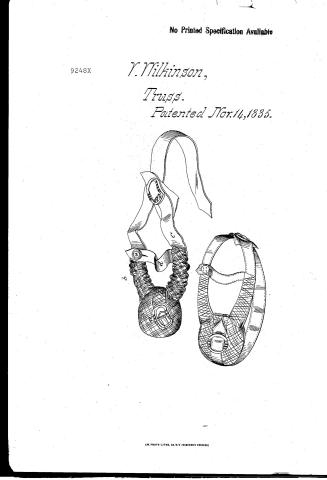
Vernum Wilkinson's Patent Drawing for a Gum Elastic Truss


National Archives, Restored Patent Drawings (Record Group 241) · Full-size scan at the National Archives · Catalog record
Show the text on the drawing Hide (84 words)
Words on the drawing as machine-read by the National Archives; not checked. Useful mainly for searching.
Sheet 1. nusses / 128 / [156] Trusses, / Dernum Wilkinson / 9248X / #1se / CLASSIFICATION / 9248X / Farm / 14 her / 1835 / a pad / b card / C band / a smaller band / l Buckies, / Patent Office 28thApril 1838 / Aladd under direction of the Commition of Patents / in comformity with the act March 183jes / Henryh. Eumorth / Commissioner of Patents
Sheet 2. CLASSIFICATION / 9248 X / DIVISION. / 128 STRGETY / [156] Trus. / ui / A: / v.wilkinson / Inne / Pas. Nor 14 - 1835 / the photo shows 2 figures / of which their is one.
USPTO scan
The patent as scanned by the USPTO
-
 Page 1
-
 Page 2
-
 Page 3
-
 Page 4


U.S. Patent and Trademark Office · Google Patents
Show the transcription Hide (977 words)
Machine transcription (LightOnOCR) of the pages as scanned by the USPTO, most of them the handwritten copies made when the records were restored after the 1836 fire. Not checked; it can misread handwriting, so compare it with the scan.
Page 1.
No Printed Specification Available
9248X
Y. Wilkinson,
Truss.
Patented Nov. 14, 1835.

A.M. PHOTO-LITHO. CO. N.Y. (OSBORNE'S PROCESS)
Page 2.
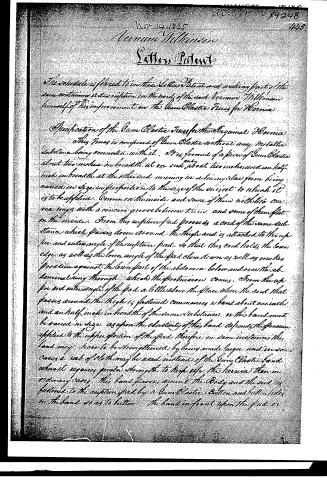
Nov 14 1835
Nemano Milliman
Letters Patent
The schedule referred to in this Letter Patent and making parts of the same containing a description in the words of the said Nemano Milliman himself of his improvement on the Gum Elastic Truss for Hernia.
Specification of the Gum Elastic Truss for the Inguinal Hernia
This Truss is composed of Gum Elastic without any metallic substance being connected with it. It is formed of a piece of Gum Elastic about two inches in breadth at one end and about two inches and one half inch in breadth at the other end running in a triangular form being varied in size in proportion to the size of the subject to which it is to be applied. Corners on the inside and some of them with two convex rings with a concave groove between them and some of them flat on the inside. From this upright pad proceeds a cord of the same substance which passes down around the thigh and is attached to the upper and outer angle of the upright pad so that this cord holds the lower edge as well as the lower angle of the pad close down as well as makes pressure against the lower part of the abdomen below and over the abdominal ring through which the protrusion comes. From the upper and outer angle of the pad a little above the place where the cord that passes around the thigh is fastened commences a band about one inch and an half inch in breadth of the same substance, or this band must be varied in size as upon the elasticity of this band depends the pressure applied to the upper portion of the pad therefore in some instances this band may have to be strengthened by being made larger and in some cases a web of cloth may be used instead of the Gum Elastic band when it requires greater strength to keep up the hernia than in ordinary cases. This band passes around the Body and the end is fastened to the upright pad by a Gum Elastic Button and button holes in the band so as to button the band in front upon the pad or.
Page 3.
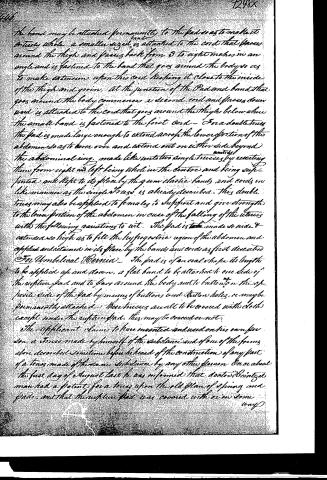
the band may be attached permanently to the pad so as to make it entirely whole. A smaller sized pad is attached to the cord that passes around the thigh and passes back from 3 to eight inches in an angle and is fastened to the band that goes around the body so as to make extension upon this cord keeping it close to the inside of the thigh and groin. At the junction of the Pad and band that goes around the body commences a second cord and passes down and is attached to the cord that goes around the thigh below where the small band is fastened to the first cord. For a double truss the pad is made large enough to extend across the lower portion of the abdomen so as to cover over and extend out on either side beyond the abdominal ring. Made like unto two single trusses by ascertaining them from right and left being whole in the centre and being sufficiently joined and kept to its place by the gum elastic bands and cords in like manner as the single truss is already described. This double truss may also be applied to females to support and give strength to the lower portion of the abdomen in case of the falling of the uterus with the following variations to wit. The pad is made so wide & extended so high as to fill the hypogastrie region of the abdomen and applied and retained in its place by the bands and cords as first described.
For Umbilical Hernia — The pad is of an oval shape its length to be applied up and down, a flat band to be attached to one side of the nuptine pad and to pass around the body and to button on the opposite side of the pad by means of buttons and button holes, or maybe permanently attached. The trusses are all to be covered with cloth except under the nuptine pad. This may be covered or not.
The applicant claims to have invented and used on his own person a truss made by himself of the substance and of one of the forms above described sometime before he heard of the construction of any part of a truss made of the same substance by any other person. On or about the first day of August last he was informed that doctor Heintzelman had a patent for a truss upon the old plan of spring and pads, and that the nuptine pad was covered with or in some way
Page 4.
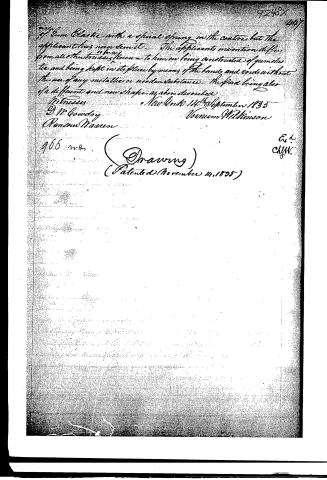
of Gum Elastic with a special spring in the centre but the applicant has now remitted. The applicant's invention differs from all that has heretofore been known to him in being constructed of gum elastic and being kept in its place by means of the bands and cords without the use of any metallic or wooden substance. The pad being also of a different and new shape as above described.
New York 14th September 1835
Witnesses
D W Cowdry
Ransom Warren
Vernon Wilkinson
966 w.8.
(Drawing)
(Patented November 11, 1835)
Published accounts: journal notice
Notice in the monthly list of patents
Journal of the Franklin Institute, new ser., vol. 17 (1836), p. 144 · View the page
705. Truss for hernia.-V. Wilkinson, city of New York,
Published accounts: journal notice
Notice in the monthly list of patents, with remarks
Journal of the Franklin Institute, new ser., vol. 17 (1836), p. 408 · View the page
24. For a Truss of Gum Elastic, for Inguinal Hernia; Varnum Wilkinson, city of New York, November 14.
Remarks. The distinguishing feature of this truss is said to be the formation of it without the employment of metal or of wood, in any part of it; the pad also American Patents for November, with Remarks. being different in shape from others. The patentee says that he had used India rubber before Dr. Heintzelman obtained his patent for a pad of that material, but we could point to trusses where not only the pad, but the strap also was of India rubber, made some years prior to Heintzelman's patent, which latter was not for the material employed, but for the particular manner of using it. The present patentee has left his description so vague and general as to be very far indeed from fulfilling the requirements of the patent law.
About this record
- Patentee
- the Journal of the Franklin Institute, Journal
- Date
- the Name and Date index of patents, USPTO records, Jim Shaw's X-patent list
- Invention
- the Name and Date index of patents
- Listed in
- the Name and Date index of patents, USPTO records, Jim Shaw's X-patent list, the Journal of the Franklin Institute, Burke's List of Patents (1847)
- The patentee's full name comes from the Franklin Institute's journal.
- Burke's 1847 Patent Office list gives the same patent.