

Drawings and documents
National Archives restored drawings: drawing
A. Unknown's Patent Drawing for a Spring Riding Saddle

National Archives, Restored Patent Drawings (Record Group 241) · Full-size scan at the National Archives · Catalog record
Show the text on the drawing Hide (88 words)
Words on the drawing as machine-read by the National Archives; not checked. Useful mainly for searching.
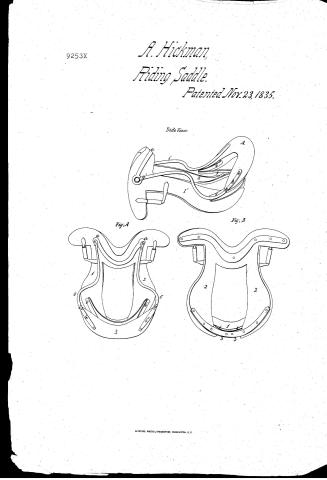
54. HARNESS / f2 / [72] Riding Saddles / AL THIE / 92534 / espring / DIVISION. / 92531 / sideview / HIG.A 7&2 Wooden Bars / No3. Cantle / No485 steel Bars. a " FrontPlating / 7. 7. Rivets / prig B. Noz cantle / CN. 2.2. wooden 3a73 / No3.3. Hind plating / N°4 operating spring / sideview.... canele. 182 Wooden Bars / No4 operating spring / No4.5..teelBars / N°7E2 woollen Bars / Fig.B. / Made under the direction of the Commition / Patric office 10th Nov 1838 / of Patents in comformity with act 3 March189 / Commition of fatents
USPTO scan
The patent as scanned by the USPTO
-
 Page 1
-
 Page 2
-
 Page 3


U.S. Patent and Trademark Office · Google Patents
Show the transcription Hide (521 words)
Machine transcription (LightOnOCR) of the pages as scanned by the USPTO, most of them the handwritten copies made when the records were restored after the 1836 fire. Not checked; it can misread handwriting, so compare it with the scan.
Page 1.
9253X
A. Hickman,
Riding Saddle.
Patented Nov. 23, 1835.
Side View:
Fig. A
Fig. B
Page 2.
Nov 23, 1835
Adam Hickman
Letters Patent
The Schedule referred to in these Letters Patent and making part of the same containing a description in the words of the said Adam Hickman himself of his improvement in the Spring Saddle
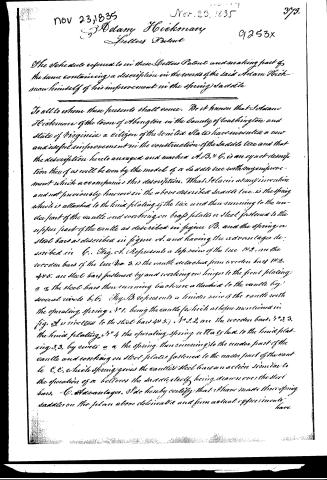
To all to whom these presents shall come. Be it known that Adam Hickman of the town of Arlington in the County of Washington and State of Virginia a citizen of the United States have invented a new and useful improvement in the construction of the Saddle tree and that the description hereunto annexed and marked A.B. & C. is an exact description thereof as will be seen by the model of a Saddle tree with my improvement which accompanies this description. What I claim as my invention and not previously known in the above described Saddle tree is the Spring which is attached to the hind plating of the tree and then running to the under part of the cantle and working on brass plates or steel fastened to the upper part of the cantle as described in figure B. and the Spring or steel bars as described in figure A. and having the advantages described in C. Fig. A. Represents a top view of the tree. 1, 2, are the wooden bars of the tree. 3, is the cantle detached from wooden bars 1, 2, 4, 5, are steel bars fastened by and working on hinges to the front plating; a, a the steel bars then running back are attached to the cantle by several rivets b, b. Fig. B. represents a hind view of the cantle with the operating Spring. 1, 1, being the cantle (which as before mentioned in fig. A is riveted to the steel bars 4, 5.) 2, 2, are the wooden bars. 3, 3, the hind plating. 4, 4 the operating Spring. 5, 5, 5, 5, 5, 5, the steel bars to the hind plating 3, 3, by rivets a, a the Spring then running to the under part of the cantle and working on steel plates fastened to the under part of the cantle C, C, which Spring gives the cantle & Steel bars an action similar to the operation of a bellows the saddle itself being drawn over the Steel bars. C. Advantages. I do hereby certify that I have made these Spring Saddles on the plan above delineated and from actual experiments have
Page 3.
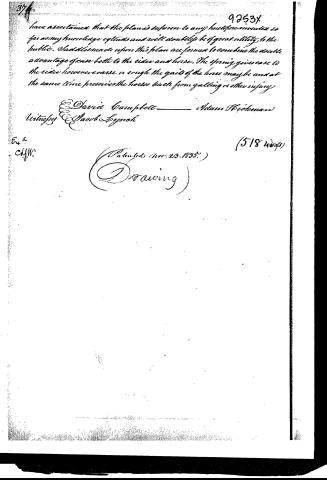
have ascertained that the plan is superior to any heretofore invented so far as my knowledge extends and will doubtless be of great utility to the public. Saddles made upon this plan are formed to combine the double advantage of ease both to the rider and horse. The spring gives ease to the rider however coarse or rough the gait of the horse may be and at the same time preserves the horses back from galling or other injury.
David Campbell — Adam Heichman
Witness Jacob Lynch
(518 words)
(Patented Nov. 23, 1835.)
(Drawing)
Published accounts: journal notice
Notice in the monthly list of patents
Journal of the Franklin Institute, new ser., vol. 17 (1836), p. 144 · View the page
717. Spring saddle.-Adam Hickman, Abingdon, Virginia,
Published accounts: journal notice
Notice in the monthly list of patents, with remarks
Journal of the Franklin Institute, new ser., vol. 17 (1836), p. 412 · View the page
36. For a Spring Saddle; Adam Hickman, Abington, Washington county, Virginia, November 23.
Remarks. The claim made is to a "spring, which is attached to the hind plating of the tree, thence running to the under part of the cantle, and working on brass or steel plates, fastened to the under part of the cantle;" "which spring gives the cantle and steel bars an action similar to the operation of a bellows, the saddle itself being drawn over the steel bars."
About this record
- Patentee
- the Journal of the Franklin Institute, Journal
- Date
- the Name and Date index of patents, USPTO records, Jim Shaw's X-patent list
- Invention
- the Name and Date index of patents
- Listed in
- the Name and Date index of patents, USPTO records, Jim Shaw's X-patent list, the Journal of the Franklin Institute, Burke's List of Patents (1847)
- The National Archives' catalog gives the name differently.
- The patentee's full name comes from the Franklin Institute's journal.
- Burke's 1847 Patent Office list gives the same patent.