

Drawings and documents
National Archives restored drawings: drawing
Campbell and Whittington's Patent Drawing for a Marine Hoisting Apparatus


National Archives, Restored Patent Drawings (Record Group 241) · Full-size scan at the National Archives · Catalog record
Show the text on the drawing Hide (46 words)
Words on the drawing as machine-read by the National Archives; not checked. Useful mainly for searching.
Sheet 1. Plate 2 y / 17- / GAMBELL unel / Marine lloisling / Apparalnis / CLASS 114. SHIPS, 45 / 51. Samels / patented 26 / Vol23 of Restored Patents, / 7.433. / 9268. 7 / DIVISION. / 9268 x / this / / II / -NC / HAT / zi
Sheet 2. bed / 896b / NOISIAIC / 4-8966 / (i )
USPTO scan
The patent as scanned by the USPTO
-
 Page 1
-
 Page 2
-
 Page 3
-
 Page 4
-
 Page 5


U.S. Patent and Trademark Office · Google Patents
Show the transcription Hide (861 words)
Machine transcription (LightOnOCR) of the pages as scanned by the USPTO, most of them the handwritten copies made when the records were restored after the 1836 fire. Not checked; it can misread handwriting, so compare it with the scan.
Page 1.
9268X
Cambell & Withington,
Camel & Floating Dock.
Patented Nov 26, 1855.
2 Sheets. Sheet 1.
Fig. 1.
Page 2.
9268X
Cambell & Withington,
Camel & Floating Dock.
Patented Nov. 26, 1835.
2 Sheets. Sheet 2.
Fig. 1.
Fig. 2.
Page 3.
9268 Nov 25, 1835
John H. Campbell and Thomas W. Williamson of Boston, May,
Letters Patent
We do hereby in favor to the above-named Patentees and one thing, part of the same, containing a description in the words of the said John H. Campbell and Thomas Williamson Williamson, the use and of their improvement on the following Day, Nov 25, 1835.
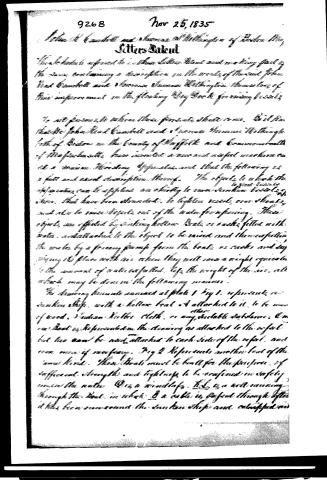
To all persons to whom these presents shall come, We at the request of John H. Campbell and Thomas Williamson, both of Boston, in the county of Suffolk, and Commonwealth of Massachusetts, have invented a new and useful machine for the purpose of making, applying, and using the following as a fast and exact description thereof. The object is to make the information more explicit and clearly to some certain vessels, those that have been stranded, to lighten vessels, or to make, and also to raise vessels out of the water for repairing. These objects are effected by sinking hollow boats, or casks filled with water, and attached to the object to be raised and then expelling the water by a forcing pump from the boats or casks and by placing the place with air, which thing will soon a weight equivalent to the amount of water expelled. For this weight of the air, etc., which may be done use the following manner.
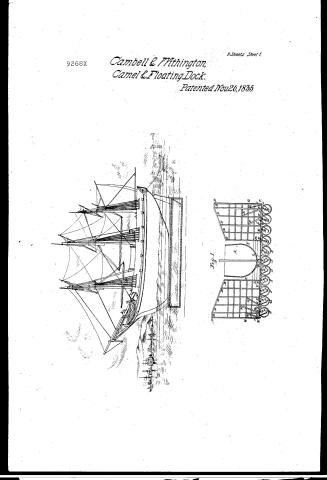
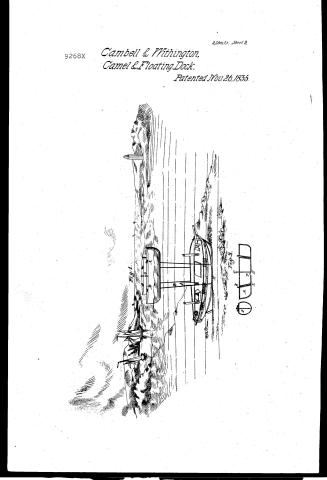
The drawing herewith annexed at plate 1 fig 1 represents a sinking ship, with a hollow boat A attached to it, to be made of wood, Indian rubber cloth, or any other suitable substance. One end B of the boat is represented in the drawing as attached to the vessel, but can be used attached to each side of the vessel, and even more if necessary. Fig 2 represents another boat of the same kind. These boats must be built for the purpose, of sufficient strength and tightness to be confined in safety within the water. O is a windlass, L is a well running through the boat, in which D a cable is passed through after it has been removed the sinking ship and stripped of
Page 4.
9268X
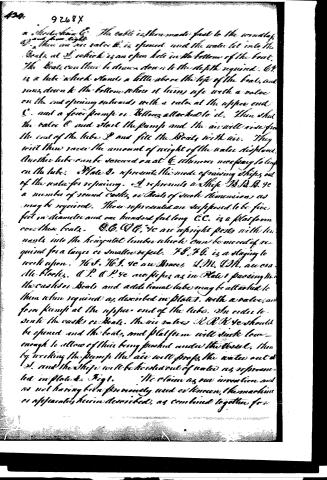
an "airlock" chamber C. The bubble is then made fast to the cord of D. Then an air valve B is opened and the water let into the boats at A which is an open hole in the bottom of the boat. The boats can then be drawn down to the depth required. G is a tube which stands a little above the top of the boat and runs down to the bottom where it turns up with a valve on the end opening outward with a valve at the upper end C, and a force pump or bellows attached to it. Then shut the valve C and start the pump and the air will rise from the end of the tube D and fill the boats with air. They will then raise the amount of weight of the water displaced. Another tube can be secured on at C whenever necessary to help on the tube. Plate 2 represents the mode of raising ships out of the water for repairing. A represents a ship. B, B, B, etc. a number of round casts or boats of such dimensions as may be required. These represented are supposed to be five feet in diameter and one hundred feet long. C, C is a platform over these boats. O, O, O, etc. are upright posts with tenements into the horizontal timbers which can be moved if required for a larger or smaller vessel. F, F, F, etc. is a staging to walk upon. H, H, H, etc. are braces. I, M, I, M, are cross timbers. A, P, A, P, etc. are pipes as in Plate 1 passing through the casts or boats and additional tubes may be attached to them when required as described in Plate 1, with a valve, and force pump at the upper end of the tube. In order to sink the casts or boats, the air valves R, R, R, etc. should be opened and the boats and platform will sink low enough to allow of their being pushed under the vessel, then by working the pump the air will force the water out of A, and the ships will be hoisted out of water as represented in Plate 2, Fig 1. We claim as our invention and as not having been previously used or known, the machines or apparatus herein described, as combined together for
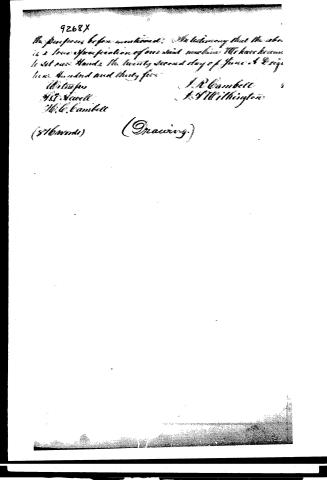
Page 5.
9268X
the purposes before mentioned. In testimony that the above is a true specification of our said machines We have hereunto set our Hands the twenty second day of June A.D. eight hundred and thirty five.
Witnesses
H. C. Newell
W. C. Campbell
J. R. Campbell
R. H. Withington
(Signatures) (Drawing)
Published accounts: journal notice
Notice in the monthly list of patents
Journal of the Franklin Institute, new ser., vol. 17 (1836), p. 144 · View the page
718. Floating dry dock.-J. R. Campbell, and J. S. Withington, Boston, Mass.,
Published accounts: journal notice
Notice in the monthly list of patents, with remarks
Journal of the Franklin Institute, new ser., vol. 17 (1836), p. 412 · View the page
37. For a Marine Hoisting Apparatus; John C. Campbell, and Increase S. Withington, Boston, Massachusetts, November 26.
Remarks. This apparatus, we are informed, is intended to raise sunken vessels; to float stranded vessels off shore; to carry vessels over shoals; and to raise them out of the water for repair. "These objects are effected by sinking hollow boats, or casks, filled with water, and attached to the object to be raised, and then expelling the water by a forcing pump from the boats, or casks, and supplying its place with air." The manner in which this may be done is described, presenting nothing new in principle, or in practice, but exhibiting the application of a mode of raising vessels which has been more frequently resorted to than any other, and that from time immemorial. The patentees, however, limit themselves to the particular construction of the apparatus described, their claim being to "the machine, or apparatus, herein described, as combined together for the purposes before mentioned."
About this record
- Patentee
- Jim Shaw's X-patent list
- Date
- the Name and Date index of patents, USPTO records
- Invention
- the Name and Date index of patents
- Listed in
- the Name and Date index of patents, USPTO records, Jim Shaw's X-patent list, the Journal of the Franklin Institute
- The sources give different dates; the date shown is the one most of them agree on.
- The residence comes from the Franklin Institute's journal.
- The Franklin Institute's journal confirms the date shown.