

Drawings and documents
National Archives restored drawings: drawing
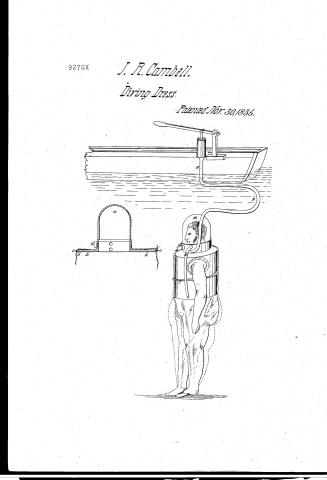
J. R. Cambell's Patent Drawing for a Diving Dress

National Archives, Restored Patent Drawings (Record Group 241) · Full-size scan at the National Archives · Catalog record
Show the text on the drawing Hide (85 words)
Words on the drawing as machine-read by the National Archives; not checked. Useful mainly for searching.
E1 / / HYDRAULIC / Diving / 62 / ENGINEERING. Armor. offer / Nol. 23. huge 437 / Palented Nov 30" 1835 / 9270.4 / SEVERATION / 9270X / J.B. O CAMBELL / Diving Driss / a. glass can / b. Copper band l Groovein you DO / d. Rounaholr closed with a screw Tap / C. Escapetherible Tube / f. Cylendrical case of Metal / 9. Herble Tube for supplying his / Patent office augfice 1842 / Strickland Del / Made under the direction of the Communication of / Patients / in / Comformity / with / ach / of / 3' / March / 1842
USPTO scan
The patent as scanned by the USPTO
-
 Page 1
-
 Page 2
-
 Page 3
-
 Page 4


U.S. Patent and Trademark Office · Google Patents
Show the transcription Hide (953 words)
Machine transcription (LightOnOCR) of the pages as scanned by the USPTO, most of them the handwritten copies made when the records were restored after the 1836 fire. Not checked; it can misread handwriting, so compare it with the scan.
Page 1.
9270X
J. R. Campbell.
Diving Dress.
Patented Nov. 30, 1836.
Page 2.
9270x Nov. 30 1835 437
John A. Campbell of Boston & Mass.
Letters Patent.
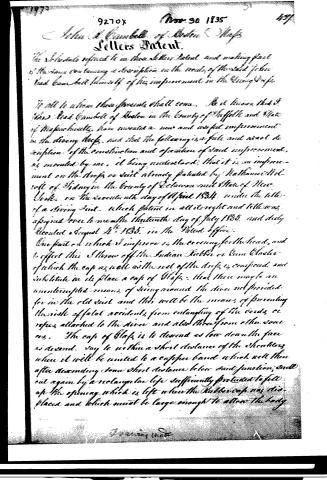
The subscribers referred to in their Letters Patent and making part of the same are hereby a description in the words of the said John Read Campbell himself of his improvement in the Diving Dress.
It all to whom these presents shall come. Be it known that I John Read Campbell of Boston in the County of Suffolk and State of Massachusetts, have invented a new and useful improvement in the diving dress, and that the following is a full and exact description of the construction and operation of said improvement, as invented by me, it being understood that it is an improvement on the dress or suit already patented by Nathaniel McCall of Sidney in the County of Delaware and State of New York, on the seventeenth day of April 1834, under the title of a diving suit, which patent in all its right and title was assigned over to me the thirtieth day of July 1835, and duly recorded August 4th 1835 in the Patent Office.
One part on which I improve is the covering for the head, and to effect this I throw off the Indian Rubber or Gum Elastic of which the cap as well as the rest of the dress is composed, and substitute in its place a cap of flaps: that there may be an uninterrupted means of diving around the dress not provided for in the old suit, and this will be the means of preventing the risk of fatal accidents from entangling of the cords or ropes attached to the dress and also those from other sources. The cap of flaps is to descend as low down the face as desired, say to within a short distance of the shoulders when it will be united to a copious band which will then after descending some short distance below said junction, swell out again by a rectangular lip sufficiently protruded to fill up the opening which is left when the Rubber cap was displaced and which must be large enough to allow the body
J. A. Campbell
Page 3.
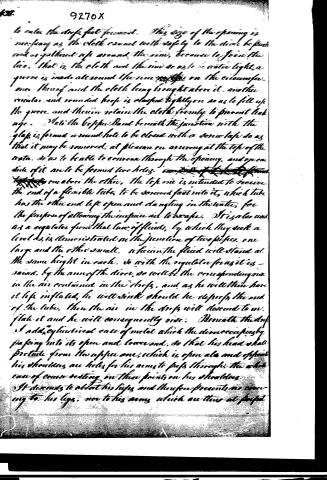
to enter the drops feet foremost. This size of the opening is necessary as the cloth cannot with safety to the diver be fastened or gathered up around the rim, because to join the two, that is, the cloth and the rim so as to be water tight, a groove is made all round the rim on the circumference thereof and the cloth being brought above it, another circular and rounded hoop is clasped tightly on so as to fill up the groove, and therein retain the cloth firmly to prevent leakage. Into the Cripple Band beneath the junction with the glass is formed a round hole to be closed with a screw lap so as that it may be removed at pleasure on account at the top of the water, so as to be able to descend through the opening, and on each side of it are to be formed two holes, one above the other, the top one is intended to receive the end of a flexible tube, to be screwed fast into it, which tube has the other end left open and dangling in the water, for the purpose of allowing the impure air to escape. It is also used as a regulator from that law of fluids, by which they seek a level as is demonstrated in the junction of two pipes, one large and the other small, wherein the fluid will stand at the same height in each. So with the regulator for as it is raised, by the arm of the diver, so will be the corresponding rise in the air contained in the drops, and as he will then have it less inflated, he will sink should he depress the end of the tube, then the air in the drops will descend to inflate it and he will consequently rise. Beneath the drop I add, cylindrical case of metal which the diver occupies by passing into its open and lower end, so that his head shall protrude from the upper one, which is open also and opposite his shoulders are holes for his arms to pass through, the whole case of course resting on these points on his shoulders. It descends to about his hips and therefore presents no covering to his legs, nor to his arms which are thus at perfect
Page 4.
9270X
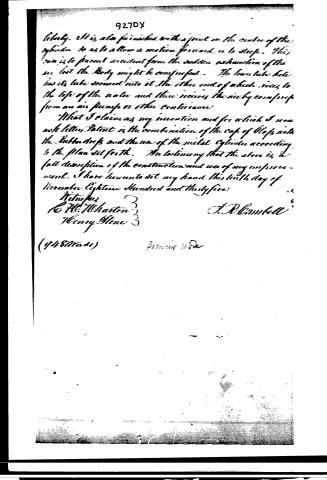
liberty. It is also furnished with a joint on the centre of the cylinder so as to allow a motion forward or to stop. This case is to prevent accident from the sudden exhaustion of the air lest the body might be compressed. The lower tube hole has its tube screwed into it, the other end of which rises to the top of the water and there receives the air by compression from an air pump or other contrivance.
What I claim as my invention and for which I now ask letters Patent is the combination of the cap of the pump with the rubber drop and the use of the metal cylinder according to the plan set forth. I do testify that the above is a full description of the construction and use of my improvement. I have hereunto set my hand this tenth day of November Eighteen Hundred and thirty-five.
Witnesses
W. H. Wharton
Henry Stone
J. R. Campbell
(94807041)
Published accounts: journal notice
Notice in the monthly list of patents
Journal of the Franklin Institute, new ser., vol. 17 (1836), p. 144 · View the page
760. Door locks.-J. K. & H. C. Campbell, Charleston, Mass.
Published accounts: journal notice
Notice in the monthly list of patents, with remarks
Journal of the Franklin Institute, new ser., vol. 17 (1836), p. 417 · View the page
53. For a Diving Dress; John Read Campbell, Boston, Massachusetts, November 30.
Remarks. This is said to be an improvement on the diving suit patented by Nathaniel Wolcott, on the 17th of April, 1834, which has been assigned to the present patentee. One notice of that patent may be seen at page 330, vol. XIV. The improvements proposed are the making the cap, or case, for the head, entirely of glass, to increase the field of vision, and the encircling the body by a metallic case, under the India rubber cloth, to prevent compression. The philosophy of some of the appendages described, we do not comprehend, nor can we discover that any of the ordinary difficulties in the use of such dresses are more completely obviated than by previous contrivances.
About this record
- Patentee
- the Journal of the Franklin Institute, Journal
- Date
- the Name and Date index of patents, USPTO records, Jim Shaw's X-patent list
- Invention
- the Name and Date index of patents
- Listed in
- the Name and Date index of patents, USPTO records, Jim Shaw's X-patent list, the Journal of the Franklin Institute, Burke's List of Patents (1847)
- The patentee's full name comes from the Franklin Institute's journal.
- Burke's 1847 Patent Office list gives the same patent.