

Drawings and documents
National Archives restored drawings: drawing
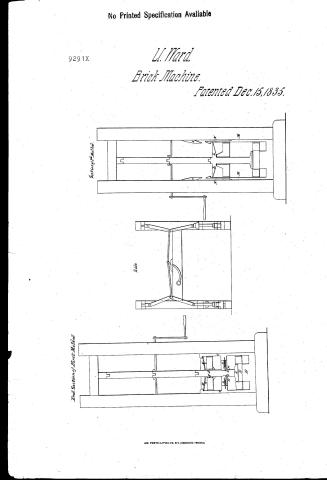
U. Ward's Patent Drawing for a Machine for Pressing and Delivering Brick and Other Substances

National Archives, Restored Patent Drawings (Record Group 241) · Full-size scan at the National Archives · Catalog record
Show the text on the drawing Hide (104 words)
Words on the drawing as machine-read by the National Archives; not checked. Useful mainly for searching.
25. Clay & Pottery, / Briok Machines / 92917 / Prom Box Mold; Stationary. / Intented / Compacting Single Surface, / gr / CLASSIFICATION / secting "Method / Hindl section of Methor / 9291-X / Dec 15-76 1835* / Find Section of FirstMethod / DIVISION. / TO WARD / pressing and delivering Bitch & / side / A Pestor / L.. Bar / B. Follower / ML Rods / c sliding nats / N.Elastic Shanks / D. Montle / 0. wedges attached A'rome / E.I.evers / cnss / a spital snriugs / H. wedpes / Patent office july 1" 1832 / TO Frame / Made under the disition of the commissioner of patents in / couformity with act 3 "March 1837
USPTO scan
The patent as scanned by the USPTO
-
 Page 1
-
 Page 2
-
 Page 3
-
 Page 4


U.S. Patent and Trademark Office · Google Patents
Show the transcription Hide (1,481 words)
Machine transcription (LightOnOCR) of the pages as scanned by the USPTO, most of them the handwritten copies made when the records were restored after the 1836 fire. Not checked; it can misread handwriting, so compare it with the scan.
Page 1.
No Printed Specification Available
9291X
L. Ward.
Brick Machine.
Patented Dec. 15, 1835.

AM. PHOTO-LITHO. CO. N.Y. (OSBORNE'S PROCESS)
Page 2.
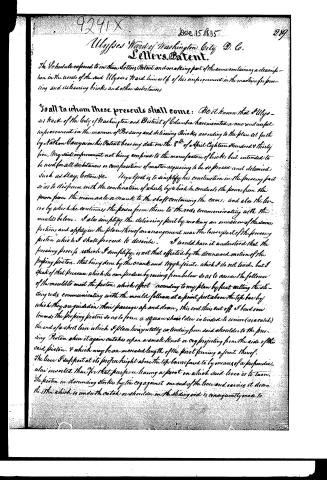
Ulysses Ward of Washington City D. C.
Letters Patent.
The Schedule referred to in these Letters Patent and on making part of the same containing a description in the words of the said Ulysses Ward himself of his improvement in the machine for pressing and delivering bricks and other substances.
To all to whom these presents shall come: Be it known that Ulysses Ward of the City of Washington and District of Columbia have invented a new and useful improvement in the manner of Pressing and delivering Bricks according to the plan set forth by Nathan Clancy in his Patent bearing date on the 8th of April Eighteen Hundred & Thirty Five. My said improvement not being confined to the manufacture of bricks but intended to be used for all substances or composition of matter requiring to be so pressed and delivered such as clay, cotton, etc. My object is to simplify his construction in the pressing part so as to dispense with the combination of wheels by which he conducts the power from the power frame the manacle or crank to the shaft containing the cams, and also the levers by which he continues the power from them to the rods communicating with the moulds below. I also simplify the delivering part by making an omission of the same positions and apply in the place thereof an arrangement near the lower part of the pressing piston which I shall proceed to describe. I would have it understood that the pressing process which I simplify, is not that effected by the downward motion of the pressing piston, that being done by the crank and toggle joints, which I do not touch, but I speak of that pressure which he can produce by raising from below so as to cause the follower of the mould to meet the piston, which effect according to my plan by first letting the sliding rods communicating with the mould follow at a point just above the top bar by which they are guided in their passage up and down, this end thus cut off I bend over towards the pressing piston so as to form a square shoulder in order to receive (as a catch) the end of a short lever which I place horizontally extending from said shoulder to the pressing Piston where it again catches upon a small Pin or cog projecting from the side of the said piston, & which may be on increased length of the pin forming a joint thereof. The lever I support at its proper height above the top bar so found to by means of a perpendicular inserted there for that purpose having a pivot on which said lever is to turn. The piston in descending strikes by the cog against one end of the lever and carries it down the other which is under the catch or shoulder on the sliding rod is consequently made to
Page 3.
290. 9291 X
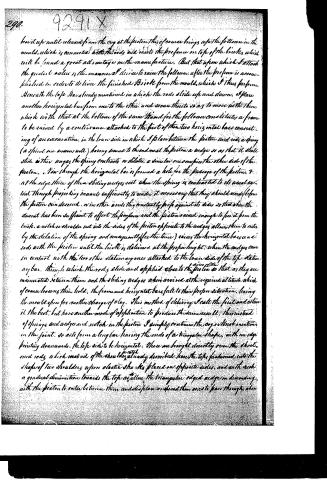
bravit up until released from the cog at the piston. This of course brings up the follower in the mould, which is connected with the rods and meets the pressure on top of the bricks which will be found a great advantage in the manufacture. But that upon which I attach the greatest value is the manner I devise to raise the follower after the pressure is accomplished in order to deliver the finished brick from the mould, which I thus perform. Beneath the top I have already mentioned in which the rods slide up and down, I place another horizontal bar from one to the other and secure thereto in a way to move with them which with that at the bottom of the same stand for the follower constitutes a frame to be raised by a contrivance attached to the first of these two horizontal bars consisting of an excavation in the lower side in which I place between the piston and rods a spring (a spiral one answers well) having secured to the end next the piston a wedge so as that it shall slide within as the spring contracts or dilates, a similar one occupies the other side of the piston. View through the horizontal bar is formed a hole for the passage of the piston, and at the edge three of these sliding wedges rest when the spring is contracted to its usual extent though projecting inwardly sufficiently to render it necessary that they should recede before the piston can descend, or in other words they constantly press against its sides so that when the descent has been sufficient to effect the pressure and the piston is raised enough to free it from the brick, a notch or shoulder cut into the sides of the piston opposite to the wedges allows them to enter by the dilation of the spring and consequently (for the time) raises the horizontal bars and rods with the piston until the brick is delivered at the proper height. When the wedges come in contact with the two other stationary ones attached to the lower side of the top stationary bar, through which the rods slide and applied close to the piston so that as they are insinuated between them and the sliding wedges when arrived at the original altitude which of course looses their hold, the frame and horizontal bars fall to their proper situation, leaving the mould open for another charge of clay. This method of delivering I call the first and esteem it the best, but have another mode of application to produce the same result. Thus instead of springs and wedges and notch in the piston I simply continue the cog or knoth mentioned in the joint, so as to form a long bar having the ends of a triangular shape, with one edge pointing downwards, the top side to be horizontal. These are brought directly over the shortened rods which instead of the shoulder already described have the tops fashioned into the shape of two shoulders upon elastic shavings placed on opposite sides, and with such a gradual diminution towards the top as allow the triangular edged edges in descending with the piston to enter between them and displace or spread them over to pass through when
Page 4.
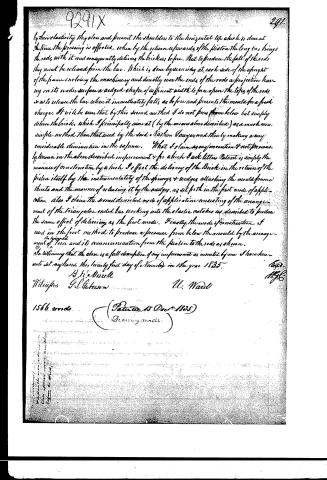
by their elasticity they allow and present the shoulders to the horizontal top which is done at the time the pressing is effected, when by the return upwards of the piston the long bar brings the rods with it and consequently delivers the bricks as before. But to produce the fall of the rods they must be released from the bar. Which is done by an idy at each side of the upright of the frame enclosing the machinery and directly over the ends of the rods a projection having on its under surface a wedged shape of sufficient width to force open the tops of the rods so as to release the bar when it immediately falls as before and presents the mould for a fresh charge. It will be seen that by this second method I do not press from below but simply deliver the bricks, which I principally aim at (by the means above described) as a much more simple method than that used by the said Nathan Vaugen and thereby making a very considerable diminution in the expense. That I claim as my invention & not previously known in the above described improvement & for which I ask letters Patent is simply the manner of construction by which I effect the delivery of the Brick in the return of the piston itself by the instrumentality of the springs & wedges attaching the mould frame sheets and the manner of releasing it by the wedges, as set forth in the first mode of application. Also I claim the second described mode of application consisting of the arrangement of the triangular ended bar working into the elastic catches as described to produce the same effect of delivery as the first mode. Finally, the mode of construction I used in the first method to produce a pressure from below the mould by the arrangement of the upright lever and its communication from the piston to the rods as shown.
In testimony that the above is a full description of my improvement as inserted by me I have hereunto set my hand this twenty first day of November in the year 1835.
B. H. Morell
Witnesses: G. L. Peterson U. Ward
1566 words
(Patented 15 Decr 1835)
Drawing made.
Published accounts: journal notice
Notice in the monthly list of patents
Journal of the Franklin Institute, new ser., vol. 17 (1836), p. 144 · View the page
752. Pressing brick.-Ulysses Ward, Washington City,
Published accounts: journal notice
Notice in the monthly list of patents, with remarks
Journal of the Franklin Institute, new ser., vol. 18 (1836), p. 40 · View the page
18. For an improvement in the Machine for Pressing and delivering Bricks; Ulysses Ward, Washington city, December 15.
Remarks. This patent is obtained for an improvement upon the brick machine patented by Nathan Sawyer, on the 8th April, 1835, which it is proposed to simplify by dispensing with the combination of wheels for conveying the power to the press, and by certain alterations in the apparatus by which the pressed brick is delivered. These alterations, or improvements, could not be clearly described without the drawings; we are informed that the improvements, are really such, as they have been carried into operation, fairly tested and compared with the original machine.
About this record
- Patentee
- DATAMP
- Date
- the Name and Date index of patents, DATAMP, USPTO records
- Invention
- DATAMP
- Listed in
- the Name and Date index of patents, DATAMP, USPTO records, Jim Shaw's X-patent list, the Journal of the Franklin Institute