

Drawings and documents
USPTO scan
The patent as scanned by the USPTO
-
 Page 1
-
 Page 2
-
 Page 3


U.S. Patent and Trademark Office · Google Patents
Show the transcription Hide (623 words)
Machine transcription (LightOnOCR) of the pages as scanned by the USPTO, most of them the handwritten copies made when the records were restored after the 1836 fire. Not checked; it can misread handwriting, so compare it with the scan.
Page 1.
9292½X
R. Wilder
Mill Bolt.
Patented Dec. 16, 1886.
Fig. 1.
Fig. 2.
Page 2.
9292½X
No. 43
Dec. 15, 1835 77
D. Aelius Wilder — Mount Morris, New York
Sellers Patent
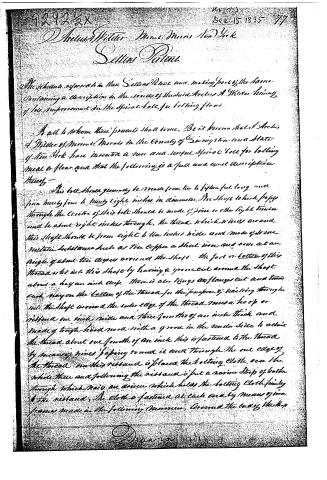
The scheme referred to in the Sellers Patent was, making part of the same, containing a description in the course of the said Aelius A. Wilder having of his improvement in the spiral bolt for bolting flour.
To all to whom these presents shall come, Be it known that Aelius A. Wilder of Mount Morris in the County of Livingston and State of New York have invented a new and useful Spiral Bolt for bolting meal or flour, and that the following is a full and exact description thereof—
This bolt should generally be made from ten to fifteen feet long and from twenty-four to twenty-eight inches in diameter. The shape which passes through the centre of this bolt should be made of pine or other light timber and be about eight inches through. The thread which is run around this shape should be from eight to ten inches wide and made of some metallic substance such as tin copper or sheet iron and run at an angle of about ten degrees around the shape. The foot or bottom of this thread is let into this shape by having a groove cut around the shape about a half an inch deep. There is also a ring or flange cut and turned each way on the bottom of the thread for the purpose of holding through into the shape around the outer edge of the thread. A hoop or ribband one inch wide and three-fourths of an inch thick and made of tough hard wood with a groove in the under side to admit the thread about one-fourth of an inch, this is fastened to the thread by means of some paper round it and through the outer edge of the thread. On this ribband is placed the bolting cloth, over the whole then and following the ribband is put a narrow strip of leather through which runs an arrow which holds the bolting cloth firmly to the ribband. The cloth is fastened at each end by means of iron frames made in the following manner, around the ends of the shape
Page 3.
9292½x
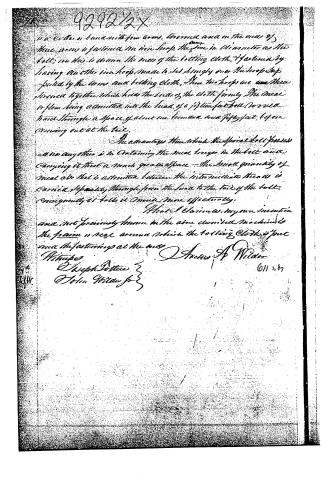
is a cotton band with four arms, formed and on the rear of the arm is fastened on one loop the same in diameter as the bolt; on this is drawn the rear of the bolting cloth. I fasten by having an other iron loop made to set directly over the loop supported by the arms and bolting cloth. Then the loops are then screwed together which holds the rear of the cloth firmly. The meal or flour being admitted into the head of a fifteen foot bolt would travel through a space of about one hundred and fifty feet before coming out at the tail.
The advantage then which the spiral bolt possesses over any other is in containing the meal longer in the bolt and carrying it through a much greater space—the small quantity of meal also that is admitted between the intermediate threads is carried separately through from the head to the tail of the bolt. Consequently it bolts it much more effectively.
What I claim is, my own invention and not previously known in the above described machine to the frame or reel around which the bolting cloth is fixed and the fastening at the end.
Witnesses
Joseph Potter
John Wilder
Andrew A. Wilder
6/11/27
Published accounts: journal notice
Notice in the monthly list of patents
Journal of the Franklin Institute, new ser., vol. 17 (1836), p. 144 · View the page
753. Flour bolt.-Aritus A. Wilder, Mount Morris, N. Y.
Published accounts: journal notice
Notice in the monthly list of patents, with remarks
Journal of the Franklin Institute, new ser., vol. 18 (1836), p. 40 · View the page
19. For a Spiral Bolt, for Bolting Meal and Flour; Aretus A. Wilder, Mount Morris, Livingston county, New York, December 15.
Remarks. A spiral thread is to extend from end to end of the bolt, and from the shaft to the bolting cloth. Upon the outer edge of this thread there is a strip of tough hard wood, to which the bolting cloth is to be nailed; and at the ends the cloth is to be fastened by being received between iron hoops screwed together. The advantages of the spiral thread are set forth as though this was new, but care is taken not to include it in the claim, which is to "the frame, or reel, round which the bolting cloth is put, and the fastenings at the ends." This claim is rather obscure, as the frame or reel would include the whole, a claim which cannot be sustained. As to the "fastening at the ends," any workman, who was at a loss to devise means equally good, without interfering with the present patentee, would not be a don at his business.
About this record
- Patentee
- the Journal of the Franklin Institute, Journal
- Date
- the Name and Date index of patents, USPTO records
- Invention
- the Name and Date index of patents
- Listed in
- the Name and Date index of patents, USPTO records, the Journal of the Franklin Institute
- The Name and Date index has a note on this number.
- The patentee's full name comes from the Franklin Institute's journal.
- The residence comes from the Franklin Institute's journal.