

Drawings and documents
National Archives restored drawings: drawing
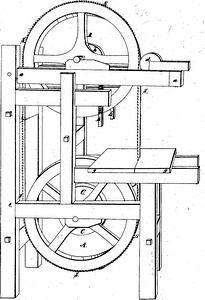
Benjamin Barker's Patent Drawing for an Elastic Belt Saw


National Archives, Restored Patent Drawings (Record Group 241) · Full-size scan at the National Archives · Catalog record
Show the text on the drawing Hide (53 words)
Words on the drawing as machine-read by the National Archives; not checked. Useful mainly for searching.
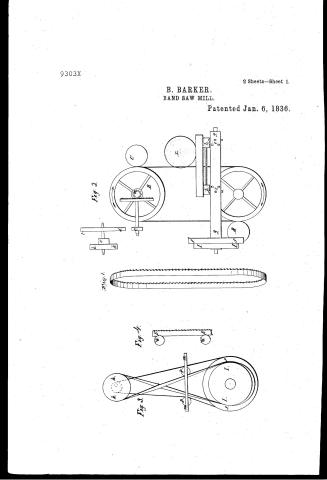
Sheet 1. BARKER'S / WOOD SAWING: / Band Saw Mackines; / Table / 9303X CLASSINICATION 9303 DIVIZION. TRC BELL s / Patented 6 Jan. 1836. / O-
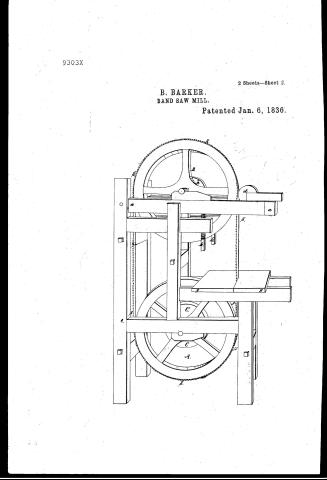
Sheet 2. 110. / [130] Mills, / in / Frg.1. / Frg 2. / 143. WOOD Band SAWING: Saw Machines; / Table / classipication / 9303 X / ap / C. / DIVISION. / 9303 , / 18 I / Frg. 3. / Fig4.
USPTO scan
The patent as scanned by the USPTO
-
 Page 1
-
 Page 2
-
 Page 3
-
 Page 4


U.S. Patent and Trademark Office · Google Patents
Show the transcription Hide (940 words)
Machine transcription (LightOnOCR) of the pages as scanned by the USPTO, most of them the handwritten copies made when the records were restored after the 1836 fire. Not checked; it can misread handwriting, so compare it with the scan.
Page 1.
9303X
2 Sheets—Sheet 1.
B. BARKER.
BAND SAW MILL.
Patented Jan. 6, 1836.
Fig. 2.
Fig. 1.
Fig. 4.
Fig. 3.
Page 2.
9303X
2 Sheets—Sheet 2.
B. BARKER.
BAND SAW MILL.
Patented Jan. 6, 1836.
Page 3.
Jan 6, 1836
Benjamin Barker, of Ellsworth, Maine. 9303X
Letters Patent.
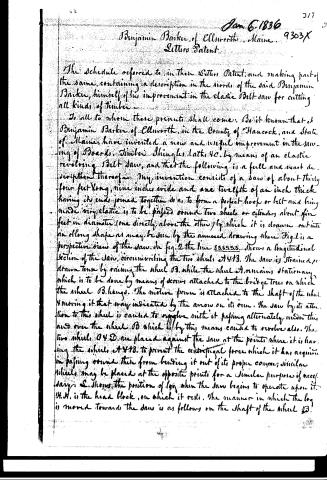
The Schedule referred to in these Letters Patent, and making part of the same, containing a description in the words of the said Benjamin Barker, himself of his improvement in the elastic Belt saw for cutting all kinds of timber.
To all to whom these presents shall come: Be it known that I Benjamin Barker of Ellsworth, in the County of Hancock, and State of Maine, have invented a new and useful improvement in the sawing of Boards, Timber, Shingles, Laths, &c. by means of an elastic revolving Belt saw, and that the following is a full and exact description thereof. My invention consists of a saw of about thirty-four feet long, nine inches wide and one twelfth of an inch thick having its ends joined together so as to form a perfect hoop or belt and being made very elastic is to be passed round two wheels or cylinders about five feet in diameter (one directly above the other) by which it is drawn out into an oblong shape as may be seen by the annexed drawing where Fig. 1 is a perspective view of the saw. In Fig. 2 the line SSSSSS... shows a longitudinal section of the saw, circumscribing the two wheels A & B. The saw is strained or drawn tense by raising the wheel B, while the wheel A remains stationary, which is to be done by means of screws attached to the bridge trees on which the wheel B hangs. The motive power is attached to the shaft of the wheel A moving it that way indicated by the arrow on its rim. The saw by its attachment to this wheel is caused to revolve with it passing alternately under this and over the wheel B which is by this means caused to revolve also. The two wheels A & B are placed against the saw at the points where it is having the wheels A & B to prevent the centrifugal force which it has acquired in passing round them from bending it out of its proper course; similar wheels may be placed at the opposite points for a similar purpose if necessary. Fig. 3 shows the position of log when the saw begins to operate upon it. H.H. is the head block, on which it rests. The manner in which the log is moved towards the saw is as follows on the shaft of the wheel B.
Page 4.
3/8.
9303X
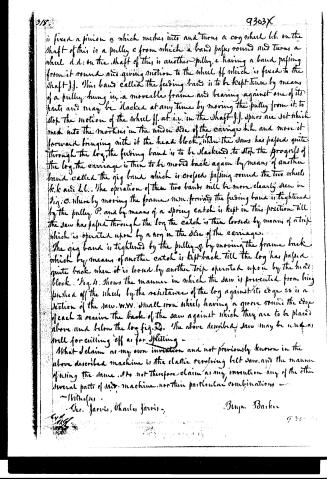
is fixed a pinion a which meshes into and turns a cog wheel b.b. on the shaft of this is a pulley c from which a band passes round and turns a wheel d.d: on the shaft of this is another pulley e having a band passing from it round and giving motion to the wheel ff. which is fixed to the shaft jj. This band called the feeding band is to be kept tense by means of a pulley hung in a moveable frame and bearing against one of its parts and may be slackened at any time by moving the pulley from it to stop the motion of the wheel ff. at i.e. in the shaft jj. Spurs are set which mesh into the notches in the under side of the carriage k.k. and move it forward bringing with it the head block and log when the saw has passed quite through the log, the feeding band is to be slackened to stop the progress of the log, the carriage is then to be moved back again by means of another band called the gig band which is crossed passing round the two wheels k.k and l.l.. The operation of these two bands will be more clearly seen in Fig. O. whereby moving the frame mm. forcing the feeding band is tightened by the pulley P. and by means of a spring catch is kept in this position till the saw has passed through the log the catch is then loosed by means of a trip which is operated upon by a rod in the side of the carriage.
The gig band is tightened by the pulley q by moving the frame back which by means of another catch is kept back till the log has passed quite back when it is loosed by another trip operated upon by the head block. Fig. 4. Shows the manner in which the saw is prevented from being pushed off the wheel by the resistance of the log against its edge ss is a section of the saw. w.w. small iron wheels having a groove round the edge of each to receive the back of the saw against which they are to be placed above and below the log fig. D. The above described saw may be used as well for cutting off as for splitting -
What I claim as my own invention and not previously known in the above described machine is the elastic revolving belt saw, and the manner of using the same. I do not therefore claim as my invention any of the other several parts of said machine, nor their particular combinations -
Witnesses:
Geo. Jarvis, Charles Jarvis,
Benja. Barker
930
Published accounts: journal notice
Notice in the monthly list of patents, with remarks
Journal of the Franklin Institute, new ser., vol. 18 (1836), p. 112 · View the page
2. For an Elastic revolving belt Saw; Benjamin Barker, Ellsworth, Hancock county, Maine, January 6.
Remarks. The patentee says, "what I claim as my invention, and not previously known in the above described machine is, the elastic revolving belt saw, and the manner of using the same. I do not therefore, claim as my invention any of the other several parts of said machine, nor their particular combination." If the patentee could have made any new arrangement of the parts for operating this saw, he might have claimed such arrangement with some propriety, but the saw itself which he does claim is quite an old affair; it is mentioned in Rees' Cyclopædia; has previously been patented more than once in the United States; has been repeatedly tried, and as frequently abandoned as worthless in operation; and such will again be its fate, should it again be essayed by the present patentee.
DATAMP: illustration
Illustrations from DATAMP

DATAMP (Directory of American Tool and Machinery Patents), via the Internet Archive · Archived DATAMP page
About this record
- Patentee
- DATAMP
- Date
- the Name and Date index of patents, DATAMP, USPTO records
- Invention
- DATAMP
- Listed in
- the Name and Date index of patents, DATAMP, USPTO records, Jim Shaw's X-patent list, the Journal of the Franklin Institute, Burke's List of Patents (1847)
- Burke's 1847 Patent Office list gives the same patent.