

Drawings and documents
National Archives restored drawings: drawing
J. H. Hubbard's Patent Drawing for a Washing Machine

National Archives, Restored Patent Drawings (Record Group 241) · Full-size scan at the National Archives · Catalog record
Show the text on the drawing Hide (73 words)
Words on the drawing as machine-read by the National Archives; not checked. Useful mainly for searching.
68. LAUNDRY. / [91] ast Mach's / POUNDERS. / 9305.7 / VIBION: / 9305X / Washing Machine / Patented 6"gan'1836 / A Box / B. Pounders / C. Bottom of Box / D. Rods attached to pounders / F: Steel spring.s / <0 / a. Geur wheels / H Cains / I. Crank / G. / Patrul offeced bit 183,87 / Made under the direction of the Commission of / Patents in comformsty with act 3 March 1835 / of Patients,
USPTO scan
The patent as scanned by the USPTO
-
 Page 1
-
 Page 2
-
 Page 3


U.S. Patent and Trademark Office · Google Patents
Show the transcription Hide (933 words)
Machine transcription (LightOnOCR) of the pages as scanned by the USPTO, most of them the handwritten copies made when the records were restored after the 1836 fire. Not checked; it can misread handwriting, so compare it with the scan.
Page 1.
9305X
J. H. Hubbard,
Washing Machine.
Patented Jan. 6, 1836.

Page 2.
9305X
Jan 6, 1836
Joab H. Hubbard, of Bloomfield, Conn't
Letters Patent
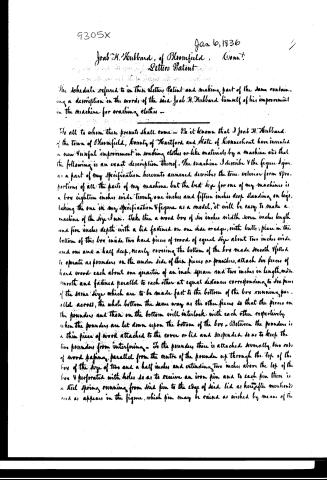
The schedule referred to in these Letters Patent and making part of the same containing a description in the words of the said Joab H. Hubbard himself of his improvement in the machine for washing clothes —
To all to whom these presents shall come — Be it known that I Joab H. Hubbard of the town of Bloomfield, County of Hartford and State of Connecticut have invented a new and useful improvement in washing clothes or like materials by a machine and that the following is an exact description thereof. The machine I describe & the figure I give as a part of my Specification herewith annexed describes the true exterior form & proportions of all the parts of my machine but the best size for one of my machines is a box eighteen inches wide twenty-one inches and fifteen inches deep standing on legs, taking the one in my Specification & figure as a model, it will be easy to make a machine of the size I use. Take then a wood box of six inches width seven inches length and five inches depth with a lid fastened on one side or edge, with bolts; place in the bottom of this box inside two hard pieces of wood of equal size about two inches wide and one and a half deep, nearly covering the bottom of the box made smooth & filled to operate as pounders on the under side of their pieces or pounders, attach six pieces of hard wood each about one quarter of an inch square and two inches in length, made smooth and fastened parallel to each other at equal distances corresponding to six pieces of the same size which are to be made fast to the bottom of the box running parallel across, the whole bottom the same way as the other pieces so that the pieces on the pounders and those on the bottom will interlock with each other respectively when the pounders are let down upon the bottom of the box. Between the pounders is a thin piece of wood attached to the cover or lid and suspended so as to keep the two pounders from interfering. To the pounders there is attached severally two rods of wood passing parallel from the centre of the pounder up through the top of the box of the size of two and a half inches and extending two inches above the top of the box & perforated with holes so as to receive an iron pin and to each pin there is a steel spring running from said pin to the edge of said lid as hereafter mentioned and as appears in the figure, which pin may be raised as wished by means of the
Page 3.
9305X
Jan 6, 1836
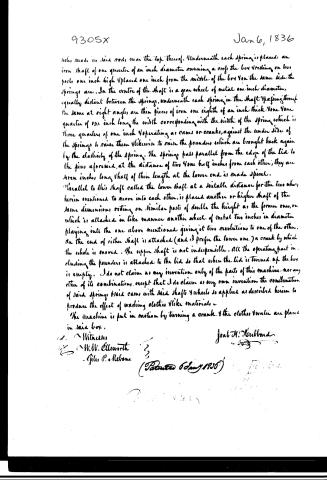
Holes made in said rods near the top thereof. Underneath each spring is placed an iron shaft of one quarter of an inch diameter running a cross the box resting on two posts one inch high & placed one inch from the middle of the box on the same side the springs are. In the centre of the shaft is a gear wheel of metal one inch diameter, equally distant between the springs, underneath each spring in the shaft passing through the same at right angles are thin pieces of iron one eighth of an inch thick. One quarter of one inch long the width corresponding with the width of the spring which is three quarters of one inch & operating as cams or cranks, against the under side of the springs to raise them likewise to raise the pounders which are brought back again by the elasticity of the spring. The springs pass parallel from the edge of the lid to the pins aforesaid, at the distance of two & one half inches from each other; they are seven inches long & half of their length at the lower end is made spiral.
Parallel to this shaft called the lower shaft, at a suitable distance for the two wheels herein mentioned to move into each other, is placed another or higher shaft of the same dimensions resting on similar posts of double the height as the former ones, on which is attached in like manner another wheel of metal two inches in diameter playing into the one above mentioned giving it two revolutions to one of the other. On the end of either shaft is attached (and I prefer the lower one) a crank by which the whole is moved. The upper shaft is not indispensable. All the operating part including the pounders is attached to the lid so that when the lid is turned up the box is empty. I do not claim as my invention only of the parts of this machine, nor any other of its combinations, except that I do claim as my own invention the combination of said springs, said cams with said shafts & wheels so applied as described herein to produce the effect of washing clothes & like materials.
The machine is put in motion by turning a crank & the clothes & materials are placed in said box.
Witnesses
W.W. Ellsworth
Giles P. Melbone
Joab H. Hubbard
(Patented 6 Jan 1836)
Published accounts: journal notice
Notice in the monthly list of patents, with remarks
Journal of the Franklin Institute, new ser., vol. 18 (1836), p. 113 · View the page
5. For a Washing Machine; Joab H. Hubbard, Bloomfield, Harford county, Connecticut, January 6.
Remarks. By this machine the clothes are to be "pounded" in a box, upon the bottom of which there are pins projecting upwards; the pounders, two in number, having pins on their lower sides which pass into the spaces between those within the box. The pounders have each a rod extending up from them through the lid of the box, and these being operated upon by cams and springs, are raised by the former and forced down by the latter. A horizontal shaft carrying a cog wheel, and turned by a winch, causes a second shaft, having a pinion on it, to revolve, this latter, carrying the cams, or lifters rather a complicated child of ingenuity this, and one, which we opine, will not find many foster mothers.
About this record
- Patentee
- DATAMP
- Date
- the Name and Date index of patents, DATAMP, USPTO records
- Invention
- DATAMP
- Listed in
- the Name and Date index of patents, DATAMP, USPTO records, Jim Shaw's X-patent list, the Journal of the Franklin Institute, Burke's List of Patents (1847)
- Burke's 1847 Patent Office list gives the same patent.