

Drawings and documents
USPTO scan
The patent as scanned by the USPTO
-
 Page 1
-
 Page 2
-
 Page 3
-
 Page 4
-
 Page 5


U.S. Patent and Trademark Office · Google Patents
Show the transcription Hide (1,193 words)
Machine transcription (LightOnOCR) of the pages as scanned by the USPTO, most of them the handwritten copies made when the records were restored after the 1836 fire. Not checked; it can misread handwriting, so compare it with the scan.
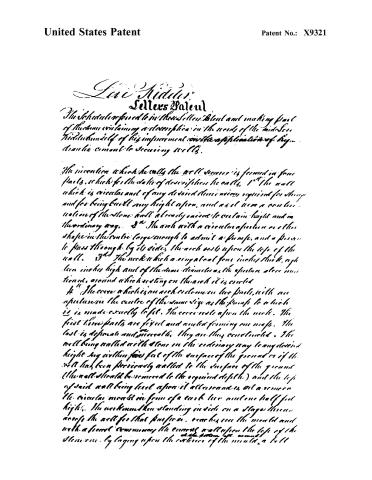
Page 2.
United States Patent
Patent No.: X9321
Levi Middles
Sellers Patent
The Scholastic referred to in the Seller's Patent and making part of the same containing a description in the words of the said Levi Middles himself of his improvement in the application of hydraulic cement to securing wells.
The invention which he calls the well seamer is formed in four parts, which for the sake of description he calls, 1st The wall which is circular and of any desired dimensions required for strength and for being built any height upon, and as it were a continuation of the stone wall already raised to certain height and in the ordinary way. 2nd The arch with a circular aperture or other shape in the centre large enough to admit a pump, and a pipe to pass through by its sides, the arch rests upon the top of the wall. 3rd The neck which a single or four inches thick, eighteen inches high and of the same dimensions, the aperture above mentioned, around which resting on the arch it is erected. 4th The cover which is an arch cut down in two parts, with an aperture in the centre of the same size as the pump to which it is made exactly to fit. The cover rests upon the neck. The first three parts are fixed and nailed forming one mass. The last is separate and movable, they are thus constructed. The well being walled with stone in the ordinary way to any desired height say within five feet of the surface of the ground or if the well has been previously walled to the surface of the ground (the wall should be removed to the required depth) and the top of said wall being level upon it all around is set a round the circular mould in form of a circle two and one half feet high. The workman then standing inside on a stage thrown across the well for that purpose, reaches on the mould and with a hand hammer, the cement wall upon the top of the stone. By laying upon the exterior of the mould, a full
Page 3.
United States Patent
Patent No.: X9321
a layer of cement mortar first prepared for this use, thus forming the first section of the wall about four inches thick and five inches high or of other dimensions if required an arrangement which when the earth is shoveled around firmly founded, filling the space between this section of the wall and the sides of the well pit. In the same way is molded another section of the wall uniting with the first, and the earth as before thrown in and packed. In this manner the operation is continued until the wall is raised to the top of the molded section it is complete. The pump if not before should now be introduced and fixed perpendicular in the center after which the mold should be removed and a stage supported by props resting on the first mentioned stage should be thrown across the well around the pump within about two inches of the top of the cement wall, on this stage a mound of earth is erected and firmly packed in the form of an arch or dome, with an elevation in the center around the pump of about eighteen inches above the top, and within the interior circumference of the cement wall. This earthen dome forms the mold for the second part the arch. At the top of this mold is placed centrally in a horizontal position around the pump a ring of sheet iron or other material, about twenty-two inches wide and twenty-four inches in diameter, made generally. This ring from the aperture into the well, and at the same time the inside surface the third part or neck which may be of any other shape if desired. Said ring being fixed the second part or arch is cast upon the mold about four inches thick or the height required and extending from the exterior of the ring all over the mold and to the exterior of the wall, upon the top of which when the mold is removed it will rest. Another similar ring is now placed horizontally upon the arch outside of the first ring and parallel with it at the distance of three or four inches. These rings are placed from the mold in which is cast
Page 4.
United States Patent
Patent No.: X9321
The neck of which they determine the dimensions. The neck is cast by filling the space between the rings with the cement mortar uniting with the arch just formed. Thus are made the first three parts which are now united monomafs. To form the cover fill up the space around the pump between it and the first mentioned ring with earth which rises in the form of an arch or dome elevated about six inches above the top of the neck. This constitutes the mould for the cover. Now lay upon the top of the neck a covering of thick wrapping paper or other material to form a separation between the neck and cover, and in order to have the cover in two parts insert perpendicularly within the mould on opposite sides of the pump two strips or pieces of sheet iron extending from the pump to the exterior of the neck with their upper edges arched and as much above the mould say three inches as the thickness of the cover is to be. This done cast the cover extending from the pump to which it is moulded to the exterior of the neck upon which it is to fit and rest, inserting as you desire at proper places suitable metallic fastenings and handles for the purpose of fastening or removing the cover at pleasure.
The well screen is now formed and time being allowed for the cement sufficiently to set or harden, the earth may be thrown in upon the arch and against the neck level with the surface of the surrounding ground. The cover which with about six inches of the neck is above the ground may now be taken off and the moulds and the stages from the inside removed, after which replace and fasten the cover and you have completed the well screen, a perfect defence against the influx of water and the depredations of vermin.
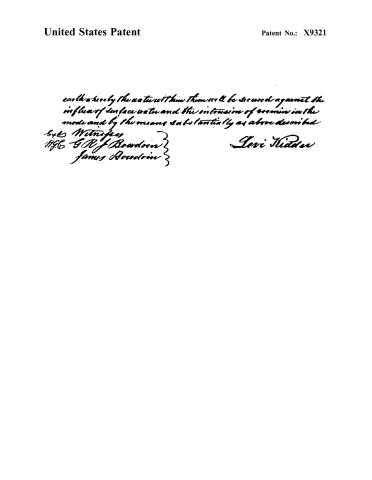
The principle of this improvement consists in the construction in hydraulic cement of a protecting cover and sides to wells cisterns reservoirs, and other vessels in the
Page 5.
United States Patent
Patent No.: X9321
earth and by the water within them will be secured against the influx of surface water and the intrusion of steam in the mode and by the means substantially as above described
by
W. M. T. Jones
H. G. G. R. J. B. B. B.
James B. B. B.
Levi H. H. H.
Published accounts: journal notice
Notice in the monthly list of patents, with remarks
Journal of the Franklin Institute, new ser., vol. 18 (1836), p. 116 · View the page
18. For the application of hydraulic cement to making Covers for Wells, &c.; Livi Kidder, city of New York, January 15.
Remarks. This patent is taken for covers pretty much like those above described; that is to say, a cover for wells, cisterns, &c. is to be made in the form of a dome, leaving a suitable opening for a man to pass through, or for other purposes; it appears, however, that the design is to secure the particular mode of forming such covers, which is as follows: A mound of earth is made in the shape of the inside of the cover, and upon this mound the cement is to be cast, or spread, to the thickness of four inches, more or less. When the cover is large, it is to be divided into sections of a convenient size for removal. "The improvement which this applicant claims to have invented, consists in making said covers, not upon the well, cistern, or other vessel, where they are to be used, but in a shop or suitable manufactory in which they can have time to season, and from which they can afterwards be removed to the place of use."
About this record
- Patentee
- DATAMP
- Date
- the Name and Date index of patents, DATAMP, USPTO records
- Invention
- DATAMP
- Listed in
- the Name and Date index of patents, DATAMP, USPTO records, Jim Shaw's X-patent list, the Journal of the Franklin Institute, Burke's List of Patents (1847)
- Burke's 1847 Patent Office list gives the same patent.