

Drawings and documents
National Archives restored drawings: drawing
L.B. Olmsted's Patent Drawing for a Portable Reflecting Baker

National Archives, Restored Patent Drawings (Record Group 241) · Full-size scan at the National Archives · Catalog record
Show the text on the drawing Hide (36 words)
Words on the drawing as machine-read by the National Archives; not checked. Useful mainly for searching.
126. / [154 / Domestic Ovens. / fl / 9329X / DIVISION. / 9329X / THIS Climsted; / Sortable Reflecting Baker / Palented 20th fancery 1836 / sutented Jan, 20-1836 / Tig.3. / kig.2 / plan
USPTO scan
The patent as scanned by the USPTO
-
 Page 1
-
 Page 2
-
 Page 3


U.S. Patent and Trademark Office · Google Patents
Show the transcription Hide (496 words)
Machine transcription (LightOnOCR) of the pages as scanned by the USPTO, most of them the handwritten copies made when the records were restored after the 1836 fire. Not checked; it can misread handwriting, so compare it with the scan.
Page 1.
L. B. OLMSTED.
Domestic Oven.
Patented Jan. 20, 1836.
Fig. 1.
Fig. 2.
Fig. 3.
THE NORRIS PETERS CO., PHOTO-LITHO., WASHINGTON, D. C.
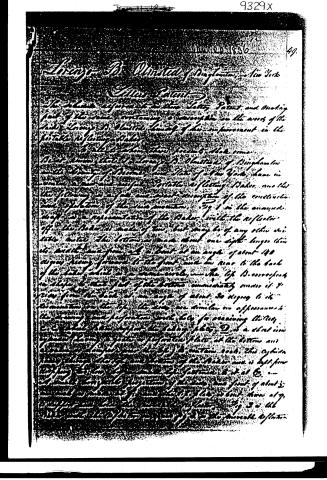
Page 2.
9329X
June 20, 1856 49.
Loring B. Olmsted / Binghamton, New York
Letters Patent.
The scheme referred to in the Letters Patent and making part of the same, containing a description on the work of the said Loring B. Olmsted himself of his improvement in the portable reflecting Baker.
It is to all to whom these presents shall come.
Be it known that I, Loring B. Olmsted of Binghamton in the County of Broome, and State of New York, have invented a new and useful Portable reflecting Baker, and the following is a full and exact description of the construction and operation of the said invention. Fig 1 is the annexed draft or a representation of the Baker with the reflector off. The Baker is made of tin, but may be of any other suitable metal. The bottom is made about one eighth longer than its width and from A is bent at an angle of about 140 degrees rising forward to the front and up near to the back of the Baker which is a semi-circle, and the top B corresponds in shape to that part of the bottom immediately under it. It rises from the back at an angle of about 30 degrees to its termination on the top. The sides are similar in appearance to the drawing and perforated with holes for receiving the key. C C are small plates support the baking plate. D is a sheet iron cylinder having a grate or perforated plate at the bottom and a bottom or clapper near the top to retain coals. This cylinder having through the top and bottom of the Baker and is kept from touching the top by a small key fastened to it at E. — and small holes with perforations of the key, one front of about 3 inches and one rear of 3 inches. The key is bent down at F, G and H and has the small key reflector. Fig 2 is the side view of the Baker and Fig 3 is the movable reflector.
Page 3.
That I claim as new is first the peculiar shape of the Baker, being the best calculated to concentrate the heat radiating from the cylinder upon the matter to be baked, 2nd the movable reflector and 3rd the construction and position of the cylinder. The operation is performed by placing the matter to be baked on plates and placing the latter on the rods or the reflectors adjusted as in fig. 2 and two coats placed in the cylinder the operation is then performed sooner than in any known oven or Baker, with an immense saving of fuel.
Witness
George Park, Esq.
Lorenzo B. Blumenthal
468 hot
Grawing
Published accounts: journal notice
Notice in the monthly list of patents, with remarks
Journal of the Franklin Institute, new ser., vol. 18 (1836), p. 117 · View the page
In addition to the close doors, the patentee has grate bars placed under the fuel, resembling the revolving vertical dampers, or valves, used in some stoves, and consisting of two plates with openings, which may be made to coincide, or which may be closed by the unperforated parts. If we do not greatly err, such a grate will be obstructed by the coal, and choaked by the ashes. There may be enough in some of the individual arrangements pointed out, upon which to found and sustain a claim, but they are not made to stand alone, and it is not in our power to put them in a situation to do so. 24. For a Portable Reflecting Baker; Lorenzo B. Olmstead, Binghampton, Broom county, New York, January 20.
Remarks. This tin baker is to be heated by means of a cylinder of sheet-iron, which is to contain ignited charcoal, and to pass vertically down through the back of the box which constitutes the baker. This latter is a kind of eight sided oven, the top being ridged like a roof, and the bottom in the same form inverted, the back circular, and the front, which lifts off, being straight; we mention these things because the peculiar form is claimed. The articles to be baked are put into pans, which stand on wires within the baker, and the fire being kindled, and the front reflector affixed in its place, we are assured that the desired operation will be "performed sooner than in any known oven or baker, with an immense saving of fuel."
About this record
- Patentee
- DATAMP
- Date
- the Name and Date index of patents, DATAMP, USPTO records
- Invention
- DATAMP
- Listed in
- the Name and Date index of patents, DATAMP, USPTO records, Jim Shaw's X-patent list, the Journal of the Franklin Institute, Burke's List of Patents (1847)
- The Franklin Institute's journal spells the name differently.
- Burke's 1847 Patent Office list gives the same patent.