

Drawings and documents
National Archives restored drawings: drawing
Thomas Neill's Patent Drawing for a Rat Trapp

National Archives, Restored Patent Drawings (Record Group 241) · Full-size scan at the National Archives · Catalog record
Show the text on the drawing Hide (46 words)
Words on the drawing as machine-read by the National Archives; not checked. Useful mainly for searching.
that / 43 FISHING & TRAPPING. / Cage-Traps. / H 93364 / CLASSITICATTOST / DIVISION / 9336-4 / Chicago Naire / Rat Trape / Patented Iar:2341836. / of / nh / It / to / Figs. / A. contre slide / B Drops. / c Triggers. / D. Wire guides.
USPTO scan
The patent as scanned by the USPTO
-
 Page 1
-
 Page 2
-
 Page 3


U.S. Patent and Trademark Office · Google Patents
Show the transcription Hide (603 words)
Machine transcription (LightOnOCR) of the pages as scanned by the USPTO, most of them the handwritten copies made when the records were restored after the 1836 fire. Not checked; it can misread handwriting, so compare it with the scan.
Page 1.
9336X
T. Neill,
Cage Trap,
Patented Jan. 23, 1836.
Fig. 3.
Page 2.
Jan. 23. 1836
Thomas Neill, Hockersville, Ohio.
Letters Patent.
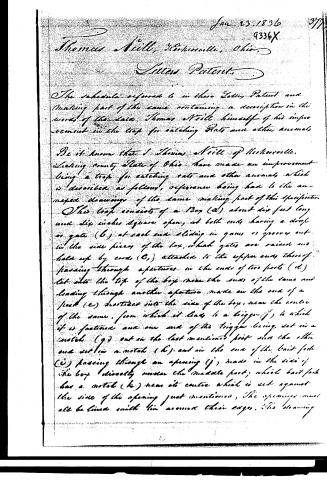
The schedule referred to in these Letters Patent and making part of the same containing a description in the words of the said Thomas Neill himself of his improvement in the trap for catching Rats and other animals.
Be it known that I Thomas Neill of Hockersville, Licking county State of Ohio have made an improvement being a trap for catching rats and other animals which is described as follows, reference being had to the annexed drawings of the same making part of this specification.
This trap consists of a Box (a) about six feet long and six inches square open, at both ends having a drop or gate (b) at each end sliding in grooves or grooves cut in the side pieces of the box, which gates are raised and held up by cords (c,) attached to the upper ends thereof passing through apertures in the ends of two posts (d) set into the top of the box near the ends of the same and leading through another aperture made in the end of a post (e) inserted into the side of the box, near the center of the same, from which it leads to a trigger (f) to which it is fastened and one end of the trigger being set in a notch (g) cut in the last mentioned post near the other end set in a notch (h) cut in the end of the bait fork (i) passing through an opening (j) made in the side of the box directly under the middle post, which bait fork has a notch (k) near its center which is set against the side of the opening just mentioned, The openings must all be lined with tin around their edges. The drawing
Page 3.
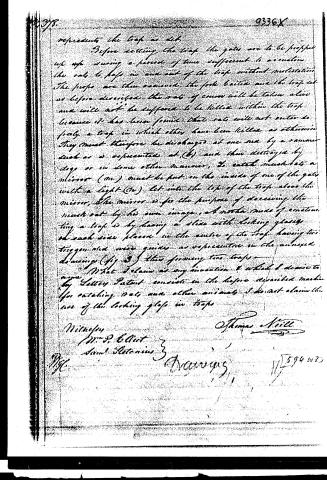
represents the trap as set.
Before setting the trap the gates are to be propped up so as during a period of time sufficient to accustom the rats to pass in and out of the trap without molestation. The props are then removed, the fork baited and the trap set as before described. The rats of course will be taken alive and will not be supposed to be killed within the trap because it has been found that rats will not enter so fatally a trap in which others have been killed as otherwise. They must therefore be discharged at one end by a hammer such as is represented at (b) and then destroyed by dogs or in some other manner. To catch much rats a mirror (m) must be put on the inside of one of the gates with a light (l) let into the top of the trap above the mirror. The mirror is for the purpose of deceiving the much rats by his own image. Another mode of constructing a trap is by having a slide with looking glasses on each side placed in the centre of the trap, having two triggers and wire guides as represented in the annexed drawing (fig 3) thus forming two traps.
What I claim as my invention to which I desire to give Letters Patent consists in the before described machine for catching rats and other animals. I do not claim the use of the looking glass in traps.
Witness
Thomas Veil
M. P. Elliot
Saml. Stenhouse
Brewing,
594 (1858)
Published accounts: journal notice
Notice in the monthly list of patents, with remarks
Journal of the Franklin Institute, new ser., vol. 18 (1836), p. 121 · View the page
38. For a Trap for Rats and other Animals; Thomas Neil, Kirkersville, Licking county, Ohio, January 23.
Remarks. This trap is so much like some others, that the claim to "the before described machine" appears to us to be a claim to that which had been made, if not described, long before. The trap is a long box, with a fall at each end, held up by a trigger very much like other triggers. In the centre of the box are placed two pieces of looking glass, to invite tenants to enter; an old and well known device.
About this record
- Patentee
- DATAMP
- Date
- the Name and Date index of patents, DATAMP, USPTO records
- Invention
- DATAMP
- Listed in
- the Name and Date index of patents, DATAMP, USPTO records, Jim Shaw's X-patent list, the Journal of the Franklin Institute, Burke's List of Patents (1847)
- The Franklin Institute's journal spells the name differently.
- Burke's 1847 Patent Office list gives the same patent.