

Drawings and documents
National Archives restored drawings: drawing
Rodney G. Cochran's Patent Drawing for a Cooking Stove

National Archives, Restored Patent Drawings (Record Group 241) · Full-size scan at the National Archives · Catalog record
Show the text on the drawing Hide (107 words)
Words on the drawing as machine-read by the National Archives; not checked. Useful mainly for searching.
190. STOVISS a FURNACES / [154] Cooking Stoves, / 150 / of Anthon's / 9344-1 / DIVISTORT / Cooking, Mare / 9344X / Fig:1. / Patented: / Fig:S. / Bottom of the Stove. / Top of stove. / T. / .B / R. / Side vicw & interior section of Stove. / Fig:3. / Fig: 4. / Grent of Stove. / Backs of Fire place & damper. / References. / J # A, B, / Consists of orifices varying by means of / lids from 15% inches to 5344 inches in diameter. / Consists of orifices varying from 11% to / binches in diameter. / C. Consists of two orifices ginches & binches / in diameter. / D, IN " single orifice binches in diameter. / Endit,
USPTO scan
The patent as scanned by the USPTO
-
 Page 1
-
 Page 2
-
 Page 3
-
 Page 4
-
 Page 5


U.S. Patent and Trademark Office · Google Patents
Show the transcription Hide (1,449 words)
Machine transcription (LightOnOCR) of the pages as scanned by the USPTO, most of them the handwritten copies made when the records were restored after the 1836 fire. Not checked; it can misread handwriting, so compare it with the scan.
Page 1.
9344X
R.G. Cochran,
Cook Stove.
Patented Feb. 3, 1836.
Fig. 5.
Fig. 2.
Fig. 4.
Fig. 3.
Fig. 1.
Page 2.
9344 X 2-3-1836 1.
Rodney G. Cochran
Letters Patent
The Schedule referred to in these Letters Patent and making part of the same, containing a description in the words of the said Rodney G. Cochran himself of his improvement in the Cooking Stove:
To all to whom these Presents shall come:
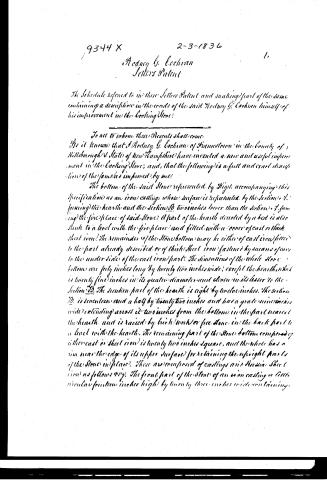
We it known that I Rodney G. Cochran of Franconia in the County of Hillsborough & State of New Hampshire have invented a new and useful improvement in the Cooking Stove; and, that the following is a full and exact description of the same as improved by me:
The bottom of the said Stove represented by Fig. 1, accompanying this Specification as an iron casting whose surface is represented by the Section A. forming the hearth and the Section B two inches lower than the Section A forming the fireplace of said Stove. A part of the hearth denoted by a bed is also sunk to a level with the fireplace and filled with a cover of cast or thick sheet iron. The remainder of the Stove bottom may be either of cast iron fitted to the part already described or of thick sheet iron fastened by means of nails to the under sides of the cast iron parts. The dimensions of the whole Stove bottom are forty inches long by twenty two inches wide, except the hearth which is twenty five inches in its greater diameter and eleven in its lesser to the Section B. The southern part of the hearth is eight by twelve inches. The Section B is seventeen and a half by twenty two inches and has a grate nine inches wide extending across it two inches from the bottom in the part nearest the hearth and is raised by brick work or free Stone in the back part to a level with the hearth. The remaining part of the Stove bottom composed of either cast or sheet iron is twenty two inches square, and the whole has a rim near the edge of its upper surface for retaining the upright parts of the Stove in place. These are composed of castings and Russian Sheet iron as follows viz. The front part of the Stove of an iron casting a little circular fourteen inches high by twenty three inches wide containing
Page 3.
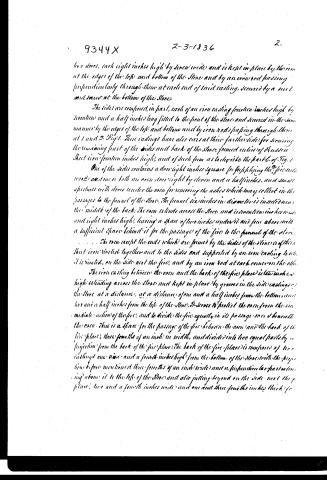
two doors, each eight inches high by seven wide and is kept in place by the iron at the edges of the top and bottom of the stove and by an iron rod passing perpendicularly through them at each end of said casting, secured by a nut and screw at the bottom of the stove.
The sides are composed, in part, each of an iron casting fourteen inches high by seventeen and a half inches long fitted to the front of the stove and secured in the same manner by the edges of the top and bottom and by iron rods passing through them at 1 and 2 Fig 1. These castings have also ears at their farther sides for securing the remaining part of the sides and back of the stove, formed entirely of Russian Sheet iron fourteen inches high, and of such form as to deguide the part C of Fig 1.
One of the sides contains a door eight inches square for supplying the fire with wood; and one or both an oven eight by eleven and a half inches, and small apertures with doors under the oven for removing the ashes which may collect in the passages to the funnel of the stove. The funnel six inches in diameter is inserted near the middle of the back. The oven extends across the stove and intersects in its width and eight inches high, leaving a space of two inches under it and four above with a sufficient space behind it for the passage of the fire to the funnel of the stove.
The oven except the ends which are formed by the sides of the stove is of thin sheet iron riveted together and to the sides and supported by an iron casting to which it is riveted, on the side next the fire, and by an iron rod at each corner on the other.
The iron casting between the oven and the back of the fire place is two inches high extending across the stove and kept in place by grooves in the side castings of the stove at a distance, at a distance of one and a half inches from the bottom and two and a half inches from the top of the stove. It serves to protect the oven from the immediate action of the fire, and to divide the fire equally in its passage over and beneath the oven. There is a space for the passage of the fire between the oven and the back of the fire place, three fourths of an inch in width, and divided into two equal parts by a projection from the back of the fire place. The back of the fire place is composed of two castings one nine and a fourth inches high from the bottom of the stove with the projection before mentioned three fourths of an inch wide and a projection farther extending above it to the top of the stove and also jutting beyond on the side next the fire place, two and a fourth inches wide and one and three fourths inches thick for
Page 4.
9344X 23.1836 3,
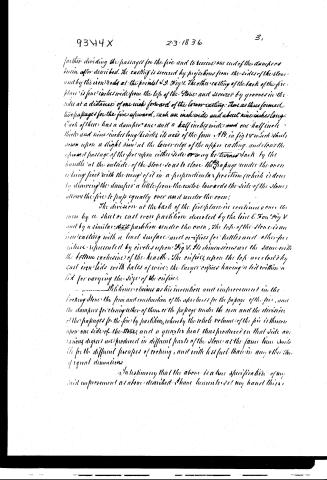
further dividing the passages for the fire and to receive one end of the dampers herein after described. The casting is secured by projections from the sides of the Stone and by the iron rods at the points I & J. Fig I. The other casting of the back of the fireplace is four inches wide from the top of the Stone and secured by grooves in the sides at a distance of one inch forward of the lower casting. There are thus formed two passages for the fire upward, each an inch wide and about nine inches long. Each of these has a damper one and a half inches wide and one half inch thick and nine inches long besides its axis of the form A B. in fig IV which shuts down upon a slight turn at the lower edge of the upper casting, and closes the upward passage of the fire upon either side or may be turned back by the handle at the outside of the Stone so as to close the passage under the oven or being fixed with the swing of it in a perpendicular position (which is done by drawing the damper a little from the centre towards the side of the Stone) allows the fire to pass equally over and under the oven.
The division at the back of the fireplace is continued over the oven by a short or cast iron partition denoted by the line E. F. in Fig V and by a similar cast partition under the oven. The top of the Stone is an iron casting with a level surface and orifices for kettles and other furniture represented by circles upon Fig V. Its dimensions are the same with the bottom exclusive of the hearth. The orifices upon the top are closed by cast iron lids with holes of wire; the larger orifices having a lid within a lid for varying the size of the orifices.
——— Believing claims as his invention and improvement in the Cooking Stone the form and construction of the apertures for the passage of the fire, and the dampers for closing either of them or the passage under the oven and the division of the passages for the fire by partition, whereby the whole volume of the fire is thrown upon one side of the Stone, and a quarter heat thus produced on that side and various degrees are produced in different parts of the Stone at the same time suitable for the different purposes of cooking, and with less fuel than in any other Stone of equal dimensions.
In testimony that the above is a true specification of my said improvement as above described I have hereunto set my hand this
Page 5.
9344 X 2-3-1836 4.
ninth day of November - anno Domini 1835. Rodney G. Cochran
Witnesses.
Sam L. Smith
Charles H. Starnett
Gide. (Published Third Feb. 1836)
1836. Rec’d & Recorded anew Sept. 19, 1840. (1871 Words)
(Drawing)
Published accounts: journal notice
Notice in the monthly list of patents, with remarks
Journal of the Franklin Institute, new ser., vol. 18 (1836), p. 182 · View the page
2. For a Cooking Stove; J. R. Cochran, Francestown, Hillsborough county, New Hampshire, February 3.
Remarks. There is nothing in this stove worthy of special notice, its virtues depending upon the particular arrangement of the passages for heated air, and the dampers or valves. The claims are to "the form and construction of the apertures for the passage of the fire, and the dampers for closing either of them, or the passage under the oven, and the division of the passages for fire, by partitions, whereby the whole volume of fire is thrown on one side of the stove, and a greater heat thus produced on that side, and various degrees are produced in different parts of the stove at the same time, suitable for the different processes of cooking, and with less fuel than in any other stove of equal dimensions." As one object professed to be attained in a new cooking stove is, in nearly every case, to save fuel, we shall, by the time we have another five hundred stoves patented, not only save the whole, but have some to spare, should each of them save a little upwards of one five hundredth part only.
About this record
- Patentee
- DATAMP
- Date
- the Name and Date index of patents, DATAMP, USPTO records
- Invention
- DATAMP
- Listed in
- the Name and Date index of patents, DATAMP, USPTO records, Jim Shaw's X-patent list, the Journal of the Franklin Institute, Burke's List of Patents (1847)
- Burke's 1847 Patent Office list gives the same patent.