

Drawings and documents
National Archives restored drawings: drawing
Daniel William's Patent Drawing for an Improvement in Stoves

National Archives, Restored Patent Drawings (Record Group 241) · Full-size scan at the National Archives · Catalog record
Show the text on the drawing Hide (80 words)
Words on the drawing as machine-read by the National Archives; not checked. Useful mainly for searching.
126. STÃO yorn A CES. / Certify that the drawings below Letters answering Bathert ofform figmes united States am a true delineelin / of my improviment in Steves as described in of the gra tid em menter / thi s w day of toluming 1836 functions through have hearts name this lign / daugh In 1839 aitness / David Shiting / Camillitions / CLASSZICATION / 9350 X / Fy.III / Parifility 301836 / Fig .IV / 55 / Fig.I / 00 / Do
USPTO scan
The patent as scanned by the USPTO
-
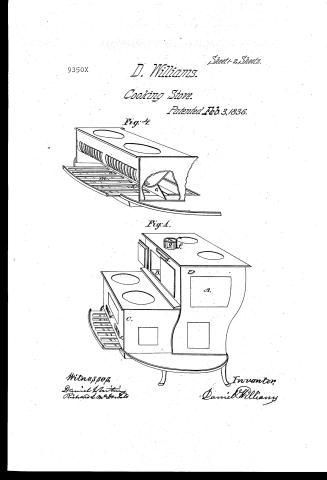 Page 1
-
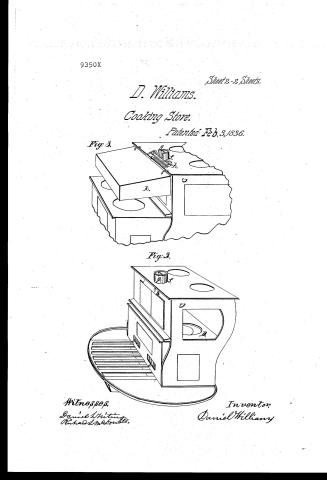 Page 2
-
 Page 3
-
 Page 4
-
 Page 5
-
 Page 6
-
 Page 7
-
 Page 8
-
 Page 9


U.S. Patent and Trademark Office · Google Patents
Show the transcription Hide (2,829 words)
Machine transcription (LightOnOCR) of the pages as scanned by the USPTO, most of them the handwritten copies made when the records were restored after the 1836 fire. Not checked; it can misread handwriting, so compare it with the scan.
Page 1.
9350X
Sheet-2 Sheets.
D. Williams.
Cooking Stove.
Patented Feb. 3, 1836.
Fig. 4.
Fig. 1.
Witnesses
Daniel H. Martin
Richard L. McDonald
Inventor
Daniel Williams
Page 2.
9350X
Sheet 2 - 2 Sheets.
D. Williams.
Cooking Store.
Patented Feb. 3, 1836.
Fig. 3.
Fig. 2.
Witnesses,
Daniel Whitin
Richard McDonald.
Inventor,
Daniel Williams
Page 3.
9350 X
1.
Daniel Williams.
Letters Patent. (Patented Feb. 3, 1856)
The Schedule referred to in these Letters Patent, and making part of the same, containing a description in the words of the said Daniel Williams himself, of his improvement in the Cooking Stove.
(To all to whom these presents shall come.)
Be it known that I, Daniel Williams, of the Town of Schaghticoke, in the County of Rensselaer, and State of New York, have invented new and useful improvements in Stoves, and that the following is a full and exact description thereof.
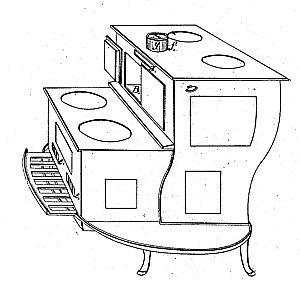
Stoves upon the principles of the improvements herein to be described, are designed principally for Cooking, Baking and Heating Water for Washing, &c. In size it may be varied at discretion. Its dimensions however should be such as to accommodate its particular parts or members. As for instance; it should be of a length and breadth that will allow room for the boilers designed for it; and in height, as well as horizontal extent, space must be provided for a proportional fire place and oven, as well as passages for the circulation of heat round the oven for draft of air to the fire, and for carrying off the smoke. So also, if the hearth being formed by an extension of the bottom plate of the stove in front, and at the ends, it must be proportioned to the fire place, and suited to the practical purposes required in relation thereto. These are matters of judgment, as will be indicated in the description, are here by without further description in these particulars.
The fire place from the hearth upwards, should occupy about one half of the stove in height, and horizontally extend from one end to the other, and from front to rear at the bottom. The oven including the passage for heat and smoke over the top, constitutes about the other half. The flue from the fire place passing up the back side of the oven, requires the back plate of the stove to be extended out beyond the oven, along its entire length and height, sufficient for the
Additional improvement added, 26. March 1856.
Page 4.
9350X 2-3-1836 2.
purpose. This extension may be by carrying the plate up in a curve, or otherwise, beginning about half way of the fire place in respect to its height. The end plates of the stove, which are to extend from the hearth to the top, must be made to correspond with this curve or swell of the back plate. In order to extend the heat quite over the top of the oven, the opening for it to pass off with the smoke into the stove pipe, should be near the centre, at the front edge of the top plate of the stove, near the back edge of the same plate, one or more openings for brims may be provided.
The oven should have a single or double door in front, and also a door at one end or both. The fire place is to be detached from the upper right part of the stove, and is to be made movable backwards and forwards, so as to be drawn out from under the oven to the front of the hearth, that being sufficiently extended, to receive it. The fire place is to be furnished with openings on the top for brims, one or more, according to the size of the stove, and also, with a single or double door in front, and at one end a door or opening is to be made corresponding with a door to be provided in the end plate of the stove, so that when the fire place is shoved back to its station under the oven, the two openings shall constitute one end door to the fire place. A closing lid to the outside opening may be attached with hinges in the usual way, while that of the fire place, when drawn out, may be closed by a sliding plate or otherwise, so as to be taken off, or removed when shoved back within the stove.
By means of covers to the openings upon the fire place for brims, in addition to their ordinary use, the action of the fire against the bottom of the oven, when placed under it, may be regulated according to its intensity, or as the articles in the oven may require by leaving the lids off or on, as shall be expedient.
Directly over one, or each of these openings, a like opening is to be made in the bottom plate of the oven, in order that articles may be cooked as over the fire itself, by bringing the cooking utensil into immediate contact with it. By this provision the steam and effluence
Page 5.
9350 X 2-3-1836 3.
common to such a process, are kept within the oven, or so, as not to affect the air of the room. In aid of which improvement a further opening shall be provided in the upper plate of the oven, and under, or nearly under the stove pipe, so that the steam, &c. generated in the cooking, or in baking, may be carried off into the stove pipe. For this purpose also, a flange should be provided across the underside of the top plate of the stove, extending from side to side, so as to pass across the center of the opening provided in it for the stove pipe, and extending up with the opening as a partition or plate, to the top of the collar with which the opening is to be supplied on the upper side of the top plate by which the opening will be divided into two equal parts. In connection with this partition, the first joint of the stove pipe may, in like manner, be divided vertically, so that when placed upon the collar, thus provided for it, the dividing plate of the stove pipe shall be as a continuation of that which divides the opening through the collar. Then, by providing a damper for the opening in the top plate of the oven, and attaching it at the back edge to a rod or wire extended upon the oven, across the stove, a little forward of the flange, but in the same direction, so that when the damper is turned up for the purpose of opening the passage which it covers, its upper edge will rest against the flange. This damper should also extend from side to side of the stove, so as to close the passage between the top of the oven, and the top plate of the stove, thus forming a partition from the oven to the top of the first joint of the stove pipe. This is to make good the draft for the steam, &c. from the oven, and to prevent its being driven back by the current from the fire place, and also, to prevent the smoke of the fire from coming into the oven. When the damper is down over the opening from the oven, the draft from the fire place will be through both divisions of the pipe. The rod to which the damper is attached, should come through one side plate of the stove, so as to be turned by the end on the outside.
The steam and vapors also, arising from boiling or cooking upon the fire place, may be conducted into the same draft, which is thus
Page 6.
provided for the oven by means of a plate of tin, or other material attached to the front edge of the top plate of the stove, and extended forward horizontally, or inclined downward till it overreaches the apex or utensils upon the fire place. From the forward edge and end of this plate, a flange or lip may be extended downward to as great or less distance at discretion. The lower edge of the end flange should be about horizontal from the front to the stove, or be made wider at the stove than at the forward edge of the plate, so that by setting their back edges against the front of the stove, they will answer the purpose of braces to support the plate in its extended position.
This being the conductor of the steam, an opening is to be provided for it to pass through the front plate into the passage between the top of the oven and the top plate of the stove, to which opening a door is to be attached in front. The steam conductor should be so attached to the top plate of the stove by hooks and pins, or otherwise, as to be turned back so as to rest against the stove pipe, or be taken off as occasion shall require.
A middle section of the hearth, or bottom plate, extending from front to rear, and in width to within a small distance of each end of the plate of the fire place is to be sunk down or cast with its surface below the other part of the hearth, similar to those of other stoves now in use. This sink is to be covered with a plate or sliding hearth, provision being made upon the upper edge of its sides or jambs to place the surface of the sliding oven with that of the permanent part of the hearth. A gate is to be made in that part of it which is under the fire, when the fire place and plate are both in their stations in the oven. The section to be formed into a grate, may commence immediately within the front plate of the fire place, and from it extend back half the distance of its width, more or less. Another grate should also be made in the same plate, and of about the same dimensions, forward or outside of the front of the stove. These are the purpose of admitting air to the fire, the same passing down through the outside grate, and up through the other to the fire.
Page 7.
9350 X 2-3-1836 5.
To give the draft of air this direction, and prevent it from passing under the inner grate, and into the flue back of the fire place, the sliding hearth should be provided with a flange back of the grate, extending down near to the bottom, and across the width of the sink, yet so as to move backwards and forwards with the slide.
The inside grate may be made to consist of one range or two, being in the latter case divided in the centre from front to rear, so as to have one of the divisions under each place for the boiler on the top of the fire place, when two are provided. A sliding damper may be placed over each of these divisions of the grate to be regulated by a wire handle coming through the front plate, or otherwise, by which the draft of air can be admitted to the fire under one boiler, and excluded from the other, if required. The bottom of the fire place itself, may also consist of grates, either horizontal from rear to front, or commencing at any discretionary line upon the bottom, and extended up in front, towards the front plate, or independent of the plate by a curve or angle to such distance as shall be deemed expedient. The grate also, may be divided like that for the draft, or otherwise, or not at all, at discretion. An opening may be provided in the front plate, corresponding, in horizontal extent, to each division of the grate, or otherwise, and extending up and down such distance as shall be considered sufficient, either for occasional draft of air for the fire, or for other purposes, may also, be in the form of glass and provided with doors to close them, or with iron glass to admit the light of the fire through when closed.
The end plates of the fire place should have the back edge of each fitted to the curve or swell of the back plate of the stove, so as to sit snugly to it, when in its place under the oven. The forward edges also of the end plates of the stove, from as high up as the fire place column should be made to correspond with the back edges so as to be parallel or nearly so, with them; the end plates and front of the fire place may, in like manner, correspond with the forward edges of the end plates of the stove, or they may be made straight, a single or double
Page 8.
9350 X 2-3-1836
door in front of the fire place, above the opening or grate therein, as above described, and also, above the inside grate of the fire place may be provided for the introduction of fuel or other purposes. The back plate of the fire place, from a line that will allow what shall be considered a suitable width for it at the bottom, should be extended up nearly in the direction of the back edge of the top plate of the fire place to a distance + + + shall leave between the two plates a space sufficient for the passage of the smoke, &c. from the fire, or the two plates may be nearly closed in the center, and the upper edge of the back plate scrolled out, or otherwise made low enough for such smoke passage, in rear of each boiler, for the purpose of giving a direction for the fire and heat under or round the boiler. A flange is also to be extended from the underside of the fire place, back of the grate down to the sliding hearth, so as to prevent the air, intended for the fire, from passing under, and so up the backside.
Fire places for these stores, which are designed exclusively or principally for burning coal, may be constructed without an opening in the end plate, and the bottom of the grate of the fire place, may be moved, or a greater space left between it and the sliding hearth, so that a pan of tin or sheet iron, or other article perforated as a filter, may be placed under it to receive the droppings from the fire. And the form the grate, as well as its capacity for holding fuel, may be adapted to purposes at discretion, either with a view of burning coal or wood, or both, and with the front door open or closed, or without doors, as shall be deemed expedient, or stores constructed upon the principles of these movements, may be supplied with a fire place for coal, and another for wood, both fitted alike to the same apartment of the store, where shall be the choice of the purchaser. The top of the fire place for coal may be made to be raised up upon the back edge, or upon a projection near each corner of the back edge, as a hook or bracket to rest upon, corresponding projections being provided for it from the flat plates of the fire place, so as to have the forward edge of the top plate to be movable up and down upon a pin or hinge joint, and at the same time be kept in its place.
Page 9.
9350 X 2-3-1836 7.
Provision should be made by a handle or otherwise for drawing out the fire place upon the hearth, and returning it to its place as occasion shall require. Of the improvements above specified and described I claim as my own invention the movable or sliding fire place with its provisions and appendages as connected with the other permanent parts of the stove; and especially the improvement of furnishing thereby in the oven, what is equivalent to a double bottom, and with it, the advantages thereby obtained of regulating the heat, or allowing it to act with greater or less intensity upon the oven. And also, the manner of presenting cooking utensils to the immediate action of the fire within the oven, together with the provisions of carrying off the steam, &c. to be generated in the oven, or upon the fire place, all these I claim, and the principles thereby embraced as especially connected and combined with each other, and with the other parts and members of the stove as a whole.
Subscribed this 8th day of December, 1835.
Witnesses
Abm. Wright Jr.
Daniel Whiting
Daniel Williams
Sept. 11, 36.
249 (pounds)
(Pro. 1. Recorded June 4, 1837.)
Published accounts: journal notice
Notice in the monthly list of patents, with remarks
Journal of the Franklin Institute, new ser., vol. 18 (1836), p. 182 · View the page
(See specification.) 4. For a Cooking Stove; Daniel Williams, Scaghticoke, Rensselear county, New York, February 3.
Remarks. This stove resembles, in form, a number of other cast-iron cooking stoves, having a body nearly rectangular, a fire place furnished with folding doors, an oven similarly furnished above it, and openings towards the back of the top plate, for cooking utensils. Its claim to novelty consists in making the fire place a sliding drawer, which can be brought forward upon the bottom plate; this drawer has a grate upon which the fuel is sustained, and a top plate, perforated for cooking utensils. When pushed in, there is, necessarily, a double plate between the fire and the interior of the oven.
DATAMP: illustration
Illustrations from DATAMP

DATAMP (Directory of American Tool and Machinery Patents), via the Internet Archive · Archived DATAMP page
About this record
- Patentee
- DATAMP
- Date
- the Name and Date index of patents, DATAMP, USPTO records
- Invention
- DATAMP
- Listed in
- the Name and Date index of patents, DATAMP, USPTO records, Jim Shaw's X-patent list, the Journal of the Franklin Institute, Burke's List of Patents (1847)
- Burke's 1847 Patent Office list gives the same patent.