

Drawings and documents
National Archives restored drawings: drawing
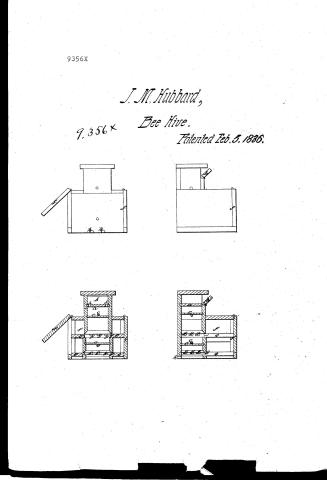
James M. Hubbard's Patent Drawing for a Bee Hive

National Archives, Restored Patent Drawings (Record Group 241) · Full-size scan at the National Archives · Catalog record
Show the text on the drawing Hide (130 words)
Words on the drawing as machine-read by the National Archives; not checked. Useful mainly for searching.
6. BEE CULTURE. / Bee-Hives. / 9356-t / Thus Hive / DIVISION. / 9356) / Patented Febr. 5th 1836. / Front Slevation / side Elevation / References. / a Floor of the upper story / b. Door to the same . I / sticks to support the honey comb / holes through which the bees enter / into the refsels placed over them / Floors of the any asting pait of the hive / Doors to the same / stutes or groover for the bees to enter / from the principal thing to the chamber / or outward stored. / h. / Ditro for the bees to enter the principal / have from the outside. / Section / Section. / Patent Office 25GH, 1838, / (ele. Benne del: / Made under the direction of Commition / of Patents in comformity with act 3. March (issy / Commitioner of Patents
USPTO scan
The patent as scanned by the USPTO
-
 Page 1
-
 Page 2
-
 Page 3


U.S. Patent and Trademark Office · Google Patents
Show the transcription Hide (650 words)
Machine transcription (LightOnOCR) of the pages as scanned by the USPTO, most of them the handwritten copies made when the records were restored after the 1836 fire. Not checked; it can misread handwriting, so compare it with the scan.
Page 1.
9356X
J. M. Hubbard,
9,356X Bee Hive.
Patented Feb. 5, 1886.

Page 2.
Feb. 5, 1836 9356X 4/
James M. Hubbard of Canterbury, county of Merrimack and State of New Hampshire
Letters Patent
The Schedule referred to in these Letters Patent, and making part of the same, containing a description in the words of the said James M. Hubbard himself of his improvement in the Bee Hive.
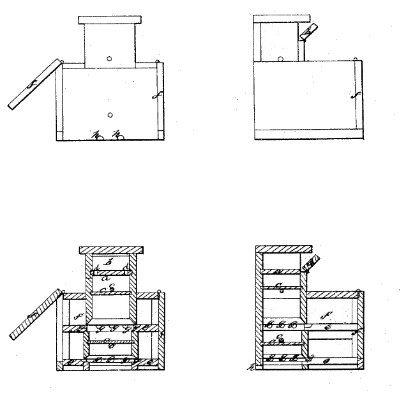
Be it known, that I, James M. Hubbard of Canterbury in the county of Merrimack and State of New Hampshire have invented a new and useful improvement in the Bee hive, and the following is a full and accurate description of the said improvement. A hive is constructed about twelve inches square with a cover nailed fast on the top like that of the hive in common use. A floor is made in the hive about five inches from the top. Below this floor are sticks laid horizontally to support the honey comb as in the hive in common use. In the back side of the Hive is a door sufficiently large to open the hive from the first floor to the top of the hive. Through this floor are several holes, three fourths of an inch in diameter near all the sides of the hive excepting the back side. Over these holes may be placed with the bottom upwards, cups, boxes, glass tumblers, or vessels of any convenient size into which the bees readily enter and deposit the delicious fruits of their labour. Any of these vessels may be removed at pleasure in which case the aperture leading to it should be immediately closed or another vessel left in its place. It will be readily perceived that the bees cannot enter the room containing the vessels except they be within those vessels. If a vessel like a tumbler be used with the open end downward, a plate of wood should cover the open end with a hole at one edge of it for the bees to enter, but the vessel should be glued by the bees to the floor of the hive. In addition to that portion of the hive already described there are two other stories the center hive resting on the floor of the first. The floors of these stories project into the body of the main hive, half an inch for the bees to walk and rest upon, these floors being fluted or grooved as usual.
Page 3.
places at their edge to let the bees pass in a horizontal manner from the principal hive to the chambers or outward stores. It is obvious that the fluted or horizontal channels projecting into the main hive make the most convenient passage for the bees and are preferable to holes in a perpendicular form. What I claim as my invention is the manner of constructing the outward stores with the horizontal channels fluted for the easy passage of the bees from the principal hive to the refills in the outward rooms, and the arrangement with which they are connected with the inward hive. The front of the hive presents a smooth perpendicular surface, the projecting stores have doors to open and close at pleasure for the convenience of adjusting the refills to the fluted channels as before described. By placing a piece of dry honeycomb on the refill, the bees will the more readily proceed to fill them. Should the bees from the severity of the season at any time need feeding, it may be done by placing a refill of honey on the top floor or over the horizontal apertures in the projecting stores.
Witnesses
John Greenough
J. S. Bryant
James H. Hubbard
(Patents 5244 1125)
[Signature]
Published accounts: journal notice
Notice in the monthly list of patents, with remarks
Journal of the Franklin Institute, new ser., vol. 18 (1836), p. 186 · View the page
21. For a Bee Hive; James W. Hubbard, Canterbury, Merrimac county, New Hampshire, February 5.
Remarks. There is not any thing in the contrivance of this hive which appears to merit particular notice, the thing claimed is a mere trifling matter of arrangement.
DATAMP: illustration
Illustrations from DATAMP

DATAMP (Directory of American Tool and Machinery Patents), via the Internet Archive · Archived DATAMP page
About this record
- Patentee
- DATAMP
- Date
- the Name and Date index of patents, DATAMP, USPTO records
- Invention
- DATAMP
- Listed in
- the Name and Date index of patents, DATAMP, USPTO records, Jim Shaw's X-patent list, the Journal of the Franklin Institute, Burke's List of Patents (1847)
- Burke's 1847 Patent Office list gives the same patent.