

Drawings and documents
National Archives restored drawings: drawing
Lewis Maus' Patent Drawing for a Mould for Casting

National Archives, Restored Patent Drawings (Record Group 241) · Full-size scan at the National Archives · Catalog record
Show the text on the drawing Hide (361 words)
Words on the drawing as machine-read by the National Archives; not checked. Useful mainly for searching.
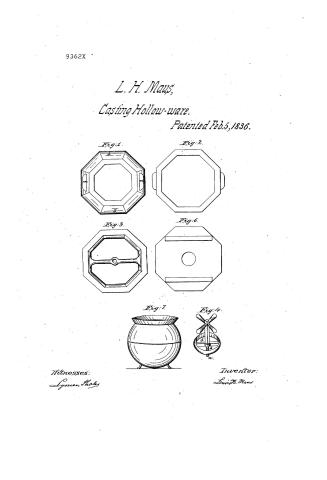
22. METAL FOUNDING. / 22 METAL FOUNDING / IN MOLDED MOLDS. / Hollow-ware Ordnance. / Hollow Ware. 93627 / CLASZIFICATION / 9362-4 / Suvis / Patunted 5th Feby 1830 / DIYISION. / Fig 2 / Main for / explanation of the ferging plate Representing Lewis H.Mauis / improvement in making patters and flasks for casting iron ware / Fig. 1 Scalop view of the cope with its handles a.a. to life it by, and / Cope / middle / hooks 6.b. by which to fasten it to the middle piece. / Fig: 2. Represents a lop view of the middle piece, with handles similar to those / on the Hope, and Eyes placed to correspond with the hooks on the cope; and / also with those on the drug by which all three arefastened together / Fig c. Represents a top view of the drag with K bar acrofs it, and a hole in the / middle of the bar, receive one end of the anchor / Tig.3 / dig.6 / Frig 4 Reporesents the anchor to lift the core with, when formed in moulding / b.t. are two openings in the ring through which to ram the Jand to form The / core, and a is the and to be inserted into the hole in the bar of the / Bouces beard / drag. / Sign 5-6 Represent the top and bollom boards to be used in moulding as / directed in the specifications; and they may be made either of wood or / of iron plates. / Tigy Referents the pattern cut horizontally in two places in in the widest / and marriert - / County of Calumbias, / state / on then 31 day of may my/ / Before Pegence Ahules one of the duties / of the year in and for daim Country / grint / personally appeared Leuis The mam / Bath that he is I've leneslees Inventer / of saids County and make dolown / Pallen / goint / Mark's con casting Decrease for wane Improvements to Leceive in making yb main you therms and and / Date : the s and the annexe above drawness with the teffers / therenuto are as he desirely believes a the limen tion ofthe / Trian term as deserve hears in the daid la their mathent / fils / keven and Subsecture they / see above / build H.Mary
USPTO scan
The patent as scanned by the USPTO
-
 Page 1
-
 Page 2
-
 Page 3
-
 Page 4


U.S. Patent and Trademark Office · Google Patents
Show the transcription Hide (1,168 words)
Machine transcription (LightOnOCR) of the pages as scanned by the USPTO, most of them the handwritten copies made when the records were restored after the 1836 fire. Not checked; it can misread handwriting, so compare it with the scan.
Page 1.
9362X
L. H. Maus,
Casting Hollow-ware.
Patented Feb. 5, 1836.
Fig. 1. …
Page 2.
1
9362X
Feb 5, 1836
Lewis M. Haas, Danville, Pennsylvania
Letters Patent
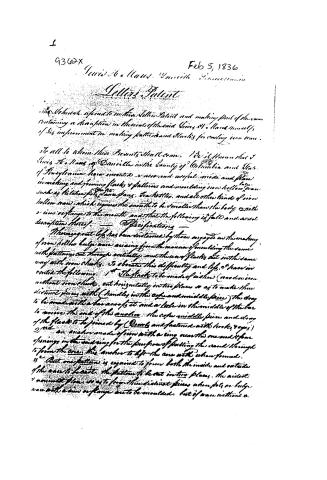
The undersigned, I, Lewis M. Haas, do hereby declare that I have invented a new and useful mode and plan for making and forming flasks & bottles and moulding iron hollow ware, such as kitchen pots, sauce pans, tea kettles, and all other kinds of iron hollow ware, which requires the mouth to be smaller than the body or with a rim or flange to the mouth, and that the following is a full and exact description thereof.
Specifications —
The undersigned has been sustained by those engaged in the making of iron hollow large ware arising from the manner of moulding the same with patterns cut through vertically, and the use of flasks cut in the same way with iron clamps. To obviate this difficulty and to have invented the following:
1st. The flasks to be made of either (wood or iron without iron clamps), cut horizontally in two pieces, so as to make three distinct pieces with (handles in the top and middle pieces) the top to be made with a bar across it and a hole in the middle of the bar to receive the end of the anchor. The cope middle piece and drop of the flask to be joined by (Dowels and fastened with hooks & eyes)
2nd. An anchor made of iron with a ring near the one end & four openings in the end ring for the purpose of pulling the sand through to form the core. This anchor to lift the core with when formed.
3rd. But one pattern is required to form both the inside and outside of the ware to locate the pattern to be cut in two places, the inside & outside places so as to form three distinct pieces when pots or kettles ware with a rim or flange are to be moulded, but if ware without a
Page 3.
2
9362X
Feb 5, 1836
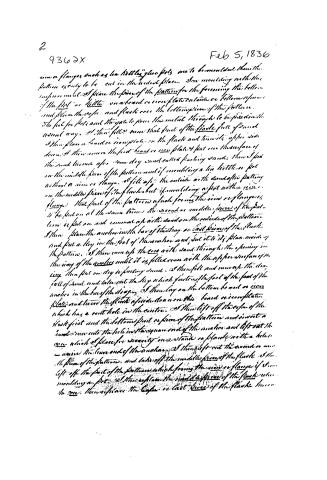
rim or flanges such as tea kettles, glass pots, are to be moulded, then the pattern is only to be cut in the widest places. In moulding with this improvement, place the first piece of the pattern for the forming the bottom of the pot or kettle on a board or incomplete plate outside or bottom of iron and place the cope and flask over the bottom piece of the pattern. The feet for pots and kettles to press the metal through to be fixed in the usual way. At then fill: some that part of the flask full of sand and then place a board or incomplete plate on the flask and turn its upper side down. At then remove the first board or incomplete plate and put over the surface of the sand turned up, some dry sand called packing sand. Then put on the middle piece of the pattern and if moulding a tea kettle or pot without a rim or flange, fill up the outside with sand after putting on the middle piece of the flask but if moulding a pot with a rim or flange, that part of the pattern which forms the rim or flange is to be put on at the same time. The second or middle piece of the pattern is put on and rammed up with sand on the outside of the pattern. At then place the anchor in the box of standing or cast pieces of the flask and put a key in the hole of the anchor and put it to its place inside of the pattern. At then run up the cope with sand through the opening in the ring of the anchor until it is filled over with the upper surface of the ring. Then put on dry packing sand. At then fill and run up the dry full of sand and take out the key which fastens the foot of the foot of the anchor in the box of the ring. At then lay on the bottom board or incomplete plate and turn the flask upside down on this board or incomplete plate which has a vent hole in the center. At then lift off the cope of the flask first and the bottom part or piece of the pattern and insert a board over into the hole in the square end of the anchor and lift out the cope which is placed for security in a stand or plate with a hole to receive the lower end of the anchor. At then lift out the second or middle piece of the pattern and take off the middle piece of the flask. At then lift off the part of the pattern which forms the rim or flange if there moulding a pot. At then replace the middle piece of the flask where the cope. Then remove the cope or last piece of the flask from
Page 4.
3
9362x
Feb 5, 1836
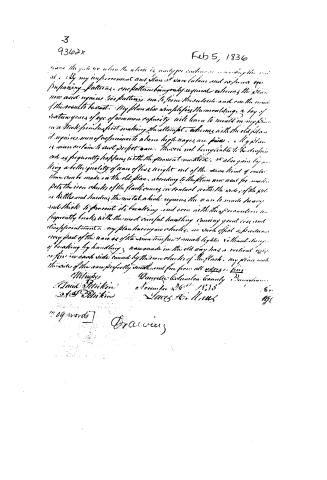
have the plan as when the whole is ready for casting, or removing the sand. By my improvement and plan I save labor and expense upon preparing patterns, one pattern being only required when using the plan now used requires two patterns, one to form the outside and one the inside of the vessel to be cast. My plan also simplifies the moldings, a boy of sixteen years of age of common capacity will learn to mould on my plan in a week from his first making the attempt, whereas with the old plan it requires men of experience to whom high wages are paid. My plan is more certain to cast perfect ware. There are not being unable to be defective as frequently happens with the present method. It also gains by producing a better quality of ware of less weight out of the same kind of metal than can be made on the old plan, according to the plan now used for making pots the iron shells of the flask comes in contact with the ends of the pots or bottles and hardens the metal which requires the ware to make heavy and thick to prevent its breaking and even with the present method frequently breaks with the most careful handling causing great loss and disappointment. My plan having no shells, no such effect is produced every kind of the ware as of the same time produces much lighter without danger of breaking by handling; ware made in the old way has a vertical edge or face on each side caused by the iron shells of the flasks. My plan makes the sides of the ware perfectly smooth and free from all edges or lines.
Witness
David Dickinson
A. P. Dickinson
Dunville, Columbia County, Pennsylvania
February 26th, 1836
Lars H. Hines
Ex.
Mf.
1009 words
Drawings
Published accounts: journal notice
Notice in the monthly list of patents, with remarks
Journal of the Franklin Institute, new ser., vol. 18 (1836), p. 187 · View the page
22. For Flasks for moulding hollow bulge Ware; Lewis H. Maus, Danville, Columbia county, Pennsylvania, February 5.
Remarks. At page 60 of the last volume, we published the specification of a patent obtained by David Stewart of Danville, under a title, and for a purpose, similar to the foregoing. We have not had time to compare the two plans with all that care which is necessary to enable us to point out their resemblances and differences, but our present impression is, that they are substantially the same. In the former case there is a distinct claim made, pointing out the particulars of the improvement, as may be seen by turning to the specification; in that before us, certain peculiarities in the plan pursued are spoken of, but there is not any formal claim, although one may probably be made out by construction. We shall probably publish Mr. Maus' specification hereafter.
About this record
- Patentee
- DATAMP, Burke's List of Patents (1847)
- Date
- the Name and Date index of patents, DATAMP, USPTO records
- Invention
- DATAMP
- Listed in
- the Name and Date index of patents, DATAMP, USPTO records, Jim Shaw's X-patent list, the Journal of the Franklin Institute, Burke's List of Patents (1847)
- The name conflict was settled by Burke's 1847 list.
- Burke's 1847 Patent Office list gives the same patent.