

Drawings and documents
National Archives restored drawings: drawing
Lyman Whittier's Patent Drawing for a Churn

National Archives, Restored Patent Drawings (Record Group 241) · Full-size scan at the National Archives · Catalog record
Show the text on the drawing Hide (101 words)
Words on the drawing as machine-read by the National Archives; not checked. Useful mainly for searching.
king Body Una. / type / Ugr professional / Gatenas Aeli co 10. 1836; / to / CLASSIFICATION / 48 / 9383 X / Chier / Val. 27. ps.193 / 83 / 9383 X / Ay.i / Preferences. / a. a sidepines. / l. f. unright slats. / C roller / d shaft with lader. / l. eagnhul. / f. crappines beneen elw slats. / g. the gearing middle picer / h. rod to living the churing / Tig. i promition view. / big 2. view of piece g. / h. / OR / dis. 2. / America affir has 29th iffs. / the dinetir of th Emmition / of batens, in conformity with act of 2 marel is3y / Comminister of but
USPTO scan
The patent as scanned by the USPTO
-
 Page 1
-
 Page 2
-
 Page 3


U.S. Patent and Trademark Office · Google Patents
Show the transcription Hide (657 words)
Machine transcription (LightOnOCR) of the pages as scanned by the USPTO, most of them the handwritten copies made when the records were restored after the 1836 fire. Not checked; it can misread handwriting, so compare it with the scan.
Page 1.
X0009383
L. Whittier.
Churn.
Patented Feb 10, 1836.
Fig. 1.
Fig. 2.
H. PETERS, PHOTO-LITHOGRAPHER, WASHINGTON, D.C.
Page 2.
9383X
Feb 10 1836
Lyman Miller of Vienna Maine
Letters Patent.
The Schedule referred to in these Letters Patent and making part of the same containing a description in the words of the said Lyman Miller himself of his Improvement in the Churn.
To all to whom these Presents shall come: We of Maine that Lyman Miller of Vienna in the County of Humboldt and State of Maine have invented a new and useful improvement in the Churn and the following is a full and exact description of the construction and operation of said Churn as now improved by me. First The Churn which serves the same as the ordinary round Churn of such size as may be desired. To this Churn a frame is attached as follows viz. Two pieces of wood 1 1/2 by 1 1/2 inch square, and 3 feet 4 inches long are united at one end like the letter A (without the cross) Midway of these pieces a piece of wood 1 1/2 inch by 2 inches and 3 feet long crosses the two pieces (by being let into as to have them even on both sides) which constitutes one side. Another side is made like unto it and the two sides are united together by 2 pieces of wood of the size of the other cross pieces at the foot of the piece (like the letter A) and also by 2 pieces across from the ends of the cross pieces on the sides which make the frame to consist of ten pieces. The last named cross pieces which unite the two sides being 10 inches long, and the pieces on the side being 3 feet long gives an open space of 3 feet one way (that is between the sides) and fifteen inches from one side to the other. Within this space the Churn is suspended by being attached to two upright slats 1 1/2 inch wide 1 1/2 inch thick. The slats are fastened at the upper end to a rod which crosses both on the upper end on top of the sides of the frame in such a manner as to permit the rod to turn free and easy. Within the Churn an upright shaft is set on a pivot (in the center) 3 1/2 feet long (the Churn say being 22 inches deep) and on this shaft which should be of convenient size, above the top of the Churn is placed a wheel say 3 inches diameter having 10 or 12 cogs in it (or more or less as may be desired) the upper end of the shaft is kept in a central position by a cross piece from one slat to the other into which the top of the shaft enters. A piece of wood 3 inches wide 1 1/2 inch thick and 3 feet long rests on the cross pieces which
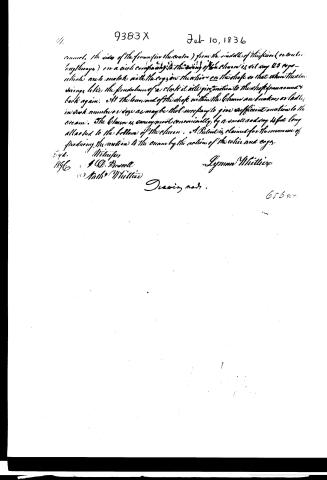
Page 3.
9383X Feb 10, 1836
connect the sides of the frame (in the centre) from the middle of the fixed (or centre long things) on a circle corresponding to the winding of the column is set any 25 eggs which are to match with the eggs on the other end of the shaft so that when the windings let the pendulum of a clock it will give motion to the shaft of the column & back again. At the lower end of the shaft within the column are hooks or latches in such number or size as maybe thought necessary to give sufficient motion to the cream. The column is carried most conveniently by a small rod or stay of iron long attached to the bottom of the column. A Patent is claimed for the manner of producing the motion to the cream by the action of the coils and eggs.
Lyman Whittier
Drawing not. 656
Published accounts: journal notice
Notice in the monthly list of patents, with remarks
Journal of the Franklin Institute, new ser., vol. 18 (1836), p. 189 · View the page
35. For a Churn; Lyman Whittier, Vienna, Kennebec county, Maine, February 10.
Remarks. A churn, in the ordinary form of the vertical kind, is so hung as to swing backwards and forwards like a pendulum, there being a suitable frame to sustain it. A vertical shaft passes through the top, and runs in a pivot at the bottom of the churn; wings, or dashers, being attached to it to agitate the cream. A small cog wheel, or pinion, surrounds the vertical shaft, above the lid of the churn, and the teeth of this wheel take into teeth on a piece of timber, forming a rack, and attached to the frame, which, when the churn is swung, causes the shaft to revolve; the swinging may be effected by means of a rod, or other contrivance, attached to it for that purpose.
About this record
- Patentee
- DATAMP
- Date
- the Name and Date index of patents, DATAMP, USPTO records
- Invention
- DATAMP
- Listed in
- the Name and Date index of patents, DATAMP, USPTO records, Jim Shaw's X-patent list, the Journal of the Franklin Institute, Burke's List of Patents (1847)
- Burke's 1847 Patent Office list gives the same patent.