

Drawings and documents
National Archives restored drawings: drawing
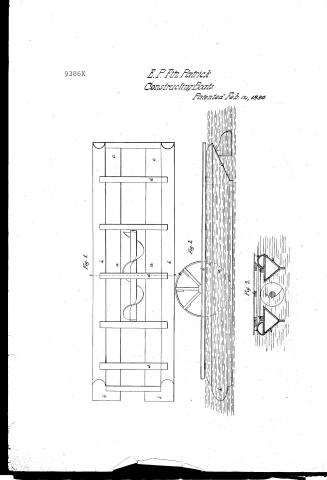
Edward P. Fitz Patrick's Patent Drawing for a Method of Constructing Boats

National Archives, Restored Patent Drawings (Record Group 241) · Full-size scan at the National Archives · Catalog record
Show the text on the drawing Hide (93 words)
Words on the drawing as machine-read by the National Archives; not checked. Useful mainly for searching.
Ldward Print Intrich / Pah, Feb. 12.1936 / Form, / gatenter Stel. 12.18 / Voe. 27. 14.173. / constructing leats / Sist / stig. 2. / 14th / References. / aa the triangular submersed boats / f. bow. / Incont office has 1841 / c sterm. d.d.dd. pillars. / l platform / Area made th direction if th Commition / f. servw.dg whell mopeller / of Patent in conformity with act aft: march 1813 / h.h. semicylinds. / sty with i a Stopaire without dig. 2. with a dedecies. Ts hesin afterd through lutter line a.t. / Company of belint.
USPTO scan
The patent as scanned by the USPTO
-
 Page 1
-
 Page 2
-
 Page 3


U.S. Patent and Trademark Office · Google Patents
Show the transcription Hide (730 words)
Machine transcription (LightOnOCR) of the pages as scanned by the USPTO, most of them the handwritten copies made when the records were restored after the 1836 fire. Not checked; it can misread handwriting, so compare it with the scan.
Page 1.
9386X
E.P. Fitz Patrick
Constructing Boats.
Patented Feb. 12, 1836.
Fig. 1.
Fig. 2.
Fig. 3.
Page 2.
9386X
Feb. 12, 1836
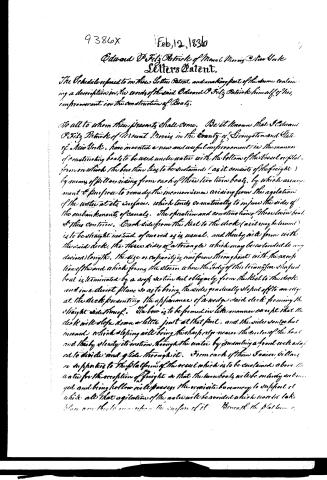
Edward D. Fitz Patrick of Mount Morris, New York
Letters Patent.
The Schedule referred to in these Letters Patent, and making part of the same, containing a description in the words of the said Edward D. Fitz Patrick himself of his improvement in the construction of Boats.
To all to whom these presents shall come. Be it known that I Edward D. Fitz Patrick of Mount Morris in the County of Livingston and State of New York, have invented a new and useful improvement in the manner of constructing boats to be used under water with the bottom of the vessel or platform on which the burden lies to be sustained (as it consists of the freight) by means of pillars rising from each of three twin boats, by which arrangement & purpose to remedy the inconveniences arising from the agitation of the water at its surface, which tends so materially to injure the sides of the embankments of canals. The operation and construction of these twin boats is thus contrived. Each side from the keel to the deck (as it may be termed) is to be straight instead of curved as is usual, and thereby with the side deck, the three sides of a triangle (which may be extended to any desired length). The size or capacity is uniform throughout with the exception of the end which forms the stern where the body of this triangular shaped boat is terminated by a cross section cut obliquely from the keel to the deck and in a direct plane so as to bring the sides gradually sloped off to an edge at the deck presenting the appearance of a wedge said deck forming the straight side thereof. The bow is to be formed in like manner except that the deck will slope down a little just at that point, and the sides will be inward which sloping will bring the sharp edge near the end of the boat and thereby steady its motion through the water by presenting a front well adapted to divide and glide through it. From each of these three pillars or supports to the platform of the vessel which is to be sustained above the water for the reception of freight so that the twin boats will be entirely submerged and being hollow will possess the requisite buoyancy to support it while all the agitation of the water will be avoided which would take place were the boat to run upon the surface of it. Beneath the platform
Page 3.
1. 9386X Feb 12, 1836
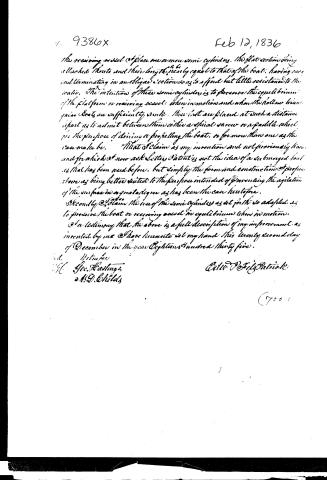
The receiving vessel I place one or more semi cylinders, the flat section being attached thereto and their length nearly equal to that of the boat, having ends and terminating in an oblique section so as to afford but little resistance to the water. The intention of these semi cylinders is to preserve the equilibrium of the platform or receiving vessel when in motion and when the hollow transparent boats are sufficiently sunk. These last are placed at such a distance apart as to admit between them either a spiral screw or a paddle wheel for the purpose of driving or propelling the boat, or for more than one as the case may be. That I claim as my invention and not previously known and for which I now ask Letters Patent is not the idea of a submerged boat as that has been used before, but simply the form and construction of propellers above as being better suited to the purpose intended of producing the agitation of the surface in a greater degree as has been the case heretofore.
Secondly, I claim the use of the semi cylinders as set forth so adapted as to preserve the boat or receiving vessel in equilibrium when in motion.
In testimony that the above is a full description of my improvement as invented by me I have hereunto set my hand this twenty second day of December in the year Eighteen hundred thirty five.
Wilmington
Geo. Hastings
A. D. Childs
Ellis V. Fisk Patrick
(700)
Published accounts: journal notice
Notice in the monthly list of patents, with remarks
Journal of the Franklin Institute, new ser., vol. 18 (1836), p. 191 · View the page
44. For Constructing Boats to be used under water; Edward P. Fitzpatrick, Mount Morris, Livingston county, New York, February 12.
Remarks. These boats are to be constructed with a triangular cross section, one angle forming the lower point, or keel; the stem and stern are to be sloped : from the lower angle to the upper side, but they are to be, otherwise, perfectly straight. These boats are to be connected together, and to be entirely submersed; of course they must be air-tight. Pillars from them are to support a platform above the water, upon which the load is to be placed. Upon the lower side of this platform there are to be semi-cylindrical hollow trunks. "The intention of these semi-cylinders is to preserve the equilibrium of the platform, or receiving vessel, when in motion, and when the hollow triangular boats are sufficiently sunk." The propelling is to be effected by means of a paddle wheel, or of a spiral screw, placed between the boats. The claim is to "the form and construction, as being better suited to the purpose intended, of preventing the agitation of the surface in so great a degree as has been the case heretofore." Those who have been in the habit of using Nicholson's Hydrometer, will not need to be told of the difficulty, we might say impossibility, of regulating the load of such a boat; but independently of this the whole plan is open to numerous valid objections, and proceeds upon the false assumption that the water may be agitated just below the surface, whilst it remains comparatively tranquil there.
About this record
- Patentee
- DATAMP
- Date
- the Name and Date index of patents, DATAMP, USPTO records
- Invention
- DATAMP
- Listed in
- the Name and Date index of patents, DATAMP, USPTO records, Jim Shaw's X-patent list, the Journal of the Franklin Institute, Burke's List of Patents (1847)
- Burke's 1847 Patent Office list gives the same patent.