

Drawings and documents
National Archives restored drawings: drawing
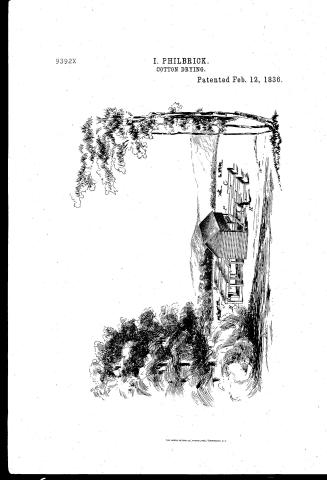
J. Philbrick's Patent Drawing for a Method of Cotton Drying


National Archives, Restored Patent Drawings (Record Group 241) · Full-size scan at the National Archives · Catalog record
Show the text on the drawing Hide (33 words)
Words on the drawing as machine-read by the National Archives; not checked. Useful mainly for searching.
Sheet 1. 34, / DRIERS. / and / Houses & Kilns, / x 5 / 9392-X / 9392 - x / Cotton Drying / Patented February 12th 1836 / O.
Sheet 2. 9392.
USPTO scan
The patent as scanned by the USPTO
-
 Page 1
-
 Page 2
-
 Page 3


U.S. Patent and Trademark Office · Google Patents
Show the transcription Hide (752 words)
Machine transcription (LightOnOCR) of the pages as scanned by the USPTO, most of them the handwritten copies made when the records were restored after the 1836 fire. Not checked; it can misread handwriting, so compare it with the scan.
Page 1.
9392X
I. PHILBRICK.
COTTON DRYING.
Patented Feb. 12, 1836.
THE NORRIS PETERS CO., PHOTO-LITHO., WASHINGTON, D.C.
Page 2.
9392x
Feb 12, 1836
John Philbrick Wilkinson Mississippi
Letters Patent
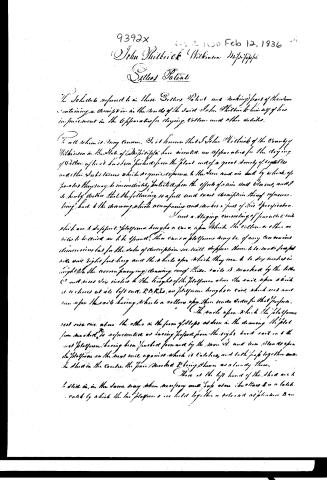
The Selectors of the United States have issued Letters Patent and making part of them containing a description in the words of the said John Philbrick Wilkinson of his improvement in the apparatus for drying cotton and other articles.
To all whom it may concern, Be it known that I John Philbrick of the County of Wilkinson in the State of Mississippi have invented an apparatus for the drying of Cotton which has been picked from the plant out of a great variety of vegetables and other substances which are quite exposed to the sun and air and by which of course they may be immediately protected from the effects of rain and storms, and I hereby declare that the following is a full and exact description thereof reference being had to the drawing which accompanies and makes a part of this specification.
I have a drying consisting of parallel rails which are 8 feet long, platforms brought on each upon which the cotton or other articles to be dried are to be spread. These rails or platforms may be of any convenient dimensions but for the sake of description we will suppose them to be made 6 feet wide and 8 feet long and the 4 holes upon which they are to be supported in the accompanying drawing, each of these rails is marked by the letter C and since six inches to the height of the platforms above the rails upon which it is placed at its left end, B.B.B.B. on platforms brought on each side and one upon the rails having wheels a roller upon them under which for that purpose.
The rails upon which the platforms rest rise one above the other in the form of steps as seen in the drawing the platform from marked is represented as having passed from the right hand rail on to the next platform having been pushed forward by the man W. and then placed upon the platform on the next rail against which it catches, and both pass together over the others in the course the pair marked B being shown as already there.
These at the top hand of the shed are to slide in, in the same way when necessary and stop above the others & so a latch catch by which the two platforms are held together a release at platform B on
Page 3.
9392x
Feb 12, 1836
movable steps for conveniently reaching, changing and discharging the platforms. Although the only of such platforms are responsible as to the danger in each state of the ship, the number to be used is limited only by the convenience with which they may be managed and this is the case also with this invention.
The mode of managing them also will advantageously be noted when the principles upon which they operate will remain unchanged. Thus for example, the ship may be raised to cross the highest platform and be then protected as to gather all the cargo platforms under it in its progress the platforms may be in a single row or there may be two or three rows in width for being shown in the drawing. The platforms may be run under the ship by hand or by means of a winch with a winch rope and rope or otherwise. Having thus fully explained the general construction and use of my said apparatus, I wish it to be distinctly understood that I do not intend by the example given to limit myself thereto but I say the same in any way I may think proper, whilst the subject and as allowed by analogous means. What I claim as my invention is the construction of a sort of a ship's ship's steps and having upon them two platforms upon which while to be closed may be exposed to the sun and air and which may in a few seconds be provided upon each other under a sheet to protect them from the weather when necessary in the manner as upon the principles herein set forth.
1. Silas
2. W. Lewis
3. H. H. Mansell
Silas Phillips
(Entered 13 February 1836)
768 Words
Drawing
Published accounts: journal notice
Notice in the monthly list of patents
Journal of the Franklin Institute, new ser., vol. 18 (1836), p. 193 · View the page
51. For Apparatus for Drying Cotton after it has been picked, &c.; John Philbrick, Wilkinson county, Mississippi, February 12.
About this record
- Patentee
- DATAMP
- Date
- the Name and Date index of patents, DATAMP, USPTO records
- Invention
- DATAMP
- Listed in
- the Name and Date index of patents, DATAMP, USPTO records, Jim Shaw's X-patent list, the Journal of the Franklin Institute, Burke's List of Patents (1847)
- Burke's 1847 Patent Office list gives the same patent.