

Drawings and documents
National Archives restored drawings: drawing
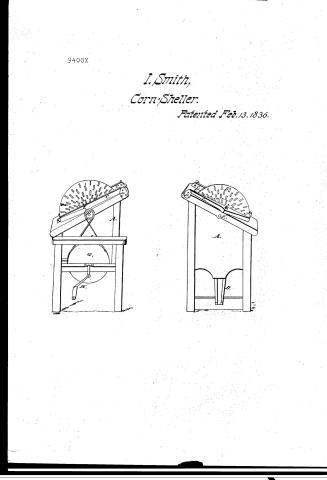
Ira Smith's Patent Drawing for a Corn Sheller

National Archives, Restored Patent Drawings (Record Group 241) · Full-size scan at the National Archives · Catalog record
Show the text on the drawing Hide (38 words)
Words on the drawing as machine-read by the National Archives; not checked. Useful mainly for searching.
130. THRASHING. / Corn Shellers. / ch's / Disk Action. / usa B o / 12- / 9.400.= / 9400 / IRA SMITH'S / CORN SHELLER. / Putented 13th 201836 / U/D / To / OF
USPTO scan
The patent as scanned by the USPTO
-
 Page 1
-
 Page 2


U.S. Patent and Trademark Office · Google Patents
Show the transcription Hide (372 words)
Machine transcription (LightOnOCR) of the pages as scanned by the USPTO, most of them the handwritten copies made when the records were restored after the 1836 fire. Not checked; it can misread handwriting, so compare it with the scan.
Page 1.
9400X
I. Smith,
Corn Sheller.
Patented Feb. 13, 1836.

Page 2.
9400X
Feb. 15. 1856
26.
Ira Smith's Corn Shelling
Letters Patent
The Schedule referred to in these Letters Patent and making part of the same containing a description in the words of the said Ira Smith himself of his improvement on the machine for shelling corn.
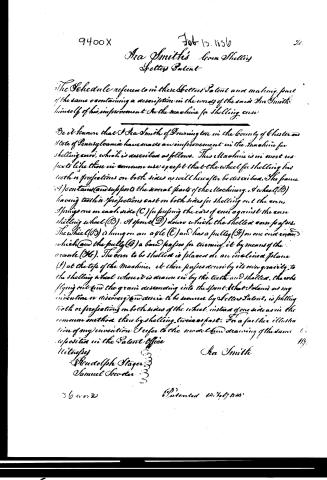
Be it known that I Ira Smith of Downingtown in the County of Chester and State of Pennsylvania have made an improvement in the machine for shelling corn, which is described as follows. This machine is in most respects like those in common use except that the wheel for shelling has teeth or projections on both sides as will hereafter be described. The frame (A) contains and supports the several parts of the machinery. A wheel (B) having teeth or projections cast on both sides for shelling out the corn, Springs one on each side (C) for pressing the ears of corn against the corn shelling wheel (B). A spout (D) down which the shelled corn passes. The wheel (B) is hung on an axle (E) and has a pulley (F) on one end round which and the pulley (G) a band passes for turning it by means of the crank (H). The corn to be shelled is placed on an inclined plane (I) at the top of the machine, it then passes across by its own gravity to the shelling wheel where it is drawn on by the teeth and shelled, the cobs flying out and the grain descending into the spout. What I claim as my invention or discovery and desire to be secured by Letters Patent, is putting teeth or projections on both sides of the wheel, instead of one side as in the common method, thus by shelling twice as fast. For a further illustration of my invention I refer to the model and drawing of the same deposited in the Patent Office.
Witnesses
Rudolph Stager
Samuel Swoyer
Ira Smith
36 words
Patented 15th July 1856
Published accounts: journal notice
Notice in the monthly list of patents, with remarks
Journal of the Franklin Institute, new ser., vol. 18 (1836), p. 193 · View the page
17 54. For a Machine for Shelling Corn; Ira Smith, Downingtown, Chester county, Pennsylvania, February 13.
Remarks. This machine does its work by means of a vertical revolving plate, constructed in the well known way of making such plates. The supposed novelty will appear from the claim, which is to "putting teeth or projections on both sides of the wheel, instead of on one side, as in the common method, thereby shelling twice as fast." It so happens, however, that this contrivance is old, having been patented some years since, and subsequently re-invented more than once. 55. For a Machine for making Screws; William Keone, Monroe, Orange county, New York. This machine is for cutting the threads upon wood screws; it is contrived with considerable ingenuity, and possesses much originality; it appears likely to operate well, and should it do so, and make screws with sufficient speed, it will be of great value; from want of the latter property, several such machines, in other respects very perfect, have been abandoned. The dies in this machine consist of two cast-steel wheels, about an inch and a half in diameter, fixed so as to revolve on axes, with their edges nearly in contact; upon these edges the female screw is cut. They are so constructed as to be borne up towards each other, whilst the screw is being cut, and they, and the apparatus to which they are attached, are contained within a can, or vessel, filled with oil and water. A hollow vertical shaft passes through the bottom of the vessel, and through this shaft the requisite revolving motion is communicated. The contrivances to effect this, and the other requisite objects, are too complex for verbal description. The claim is "to the combination and arrangement of the several parts of the machine for making screws, particularly the mode of giving the dies a simultaneous horizontal and vertical movement in oil and water, whilst cutting the screw." We do not think the former part of this claim sufficiently guarded, as the combination and arrangement may be much varied, whilst the result will be the same, and the means substantially similar.
About this record
- Patentee
- DATAMP
- Date
- the Name and Date index of patents, DATAMP, USPTO records
- Invention
- DATAMP
- Listed in
- the Name and Date index of patents, DATAMP, USPTO records, Jim Shaw's X-patent list, the Journal of the Franklin Institute, Burke's List of Patents (1847)
- Burke's 1847 Patent Office list gives the same patent.