

Drawings and documents
National Archives restored drawings: drawing
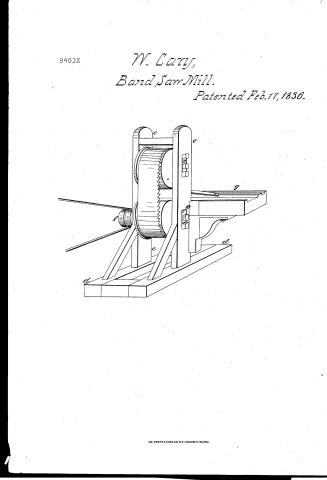
W. Cary's Patent Drawing for a Belt Saw

National Archives, Restored Patent Drawings (Record Group 241) · Full-size scan at the National Archives · Catalog record
Show the text on the drawing Hide (91 words)
Words on the drawing as machine-read by the National Archives; not checked. Useful mainly for searching.
food / z4g. / WOOD SAWING / Band Saw Machines / I43. WOOD SAWING: / Ood 25. nage549 / #1- / Band Saw Machines. / UV. CARLY / Satented Felt1y" 1836 / 9.403. x / Belt Saw / DIVIO TOIN. / 9403 / a. Band saw / b. wheels of wood or hou / C Pasts / d. sills / e. Botes smrdges / I. f Platform Whirland to Belt receive material / Strickland De' / Patent office sep 30 1843 / Made under the direction of the commission / of Patient m comformity with act of March 1837 / Coramysonor of Palend
USPTO scan
The patent as scanned by the USPTO
-
 Page 1
-
 Page 2
-
 Page 3


U.S. Patent and Trademark Office · Google Patents
Show the transcription Hide (636 words)
Machine transcription (LightOnOCR) of the pages as scanned by the USPTO, most of them the handwritten copies made when the records were restored after the 1836 fire. Not checked; it can misread handwriting, so compare it with the scan.
Page 1.
9403X
W. Cary,
Band Saw Mill.
Patented Feb. 17, 1836.
![Diagram of a band saw mill with labeled parts: c, d, f, g]
A.M. PHOTO-LITHO. CO. N.Y. (OSBORNE'S PROCESS)
Page 2.
2/17/1836 9403X
Feb. 17, 1836. Av. 12 5119
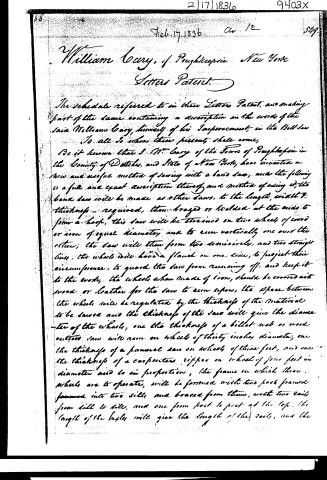
William Carey, of Poughkeepsie New York
Letters Patent.
The schedule referred to in these Letters Patent, and making part of the same containing a description in the words of the said William Carey, himself of his Improvement, in the Belt Saw
To all to whom these presents shall come,
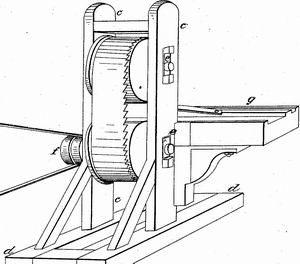
Be it known that I Wm Carey of the Town of Poughkeepsie in the County of Dutchess, and State of New York, have invented a new and useful method of sawing with a band saw, and the following is a full and exact description thereof and method of using it, the band saw will be made as other saws, to the length, width & thickness required, then brazed or welded at the ends to form a loop, this saw will be trained on two wheels of wood or iron of equal diameter, and to run vertically one over the other, the saw will then form two semicircles, and two straight lines, the wheels will have a flanch on one side, to project their circumference, to guard the saw from running off, and keep it to the work, the wheels when made of iron, should be covered with wood or leather for the saw to run upon, the space between the wheels will be regulated by the thickness of the material to be sawed and the thickness of the saw will give the diameter of the wheels, one the thickness of a billet web or wood cutter saw will run on wheels of thirty inches diameter, one the thickness of a panel saw on wheels of three feet, and one the thickness of a carpenters ripper on wheels of four feet in diameter and so in proportion, the frame in which these wheels are to operate, will be formed with two post frames formed into two sills and braced from them, with two rails from sill to sill, and one from post to post at the top, the length of the lags will give the length of the rails, and the
Page 3.
2/17/1836 9403X
550
now the axles will be as long as the wheel diameter, the legs of the lower axle will be fixed in the post, and the axle raised up and with levers the upper box to be moved up and down in the post by levers to strain the saw, and balance it that it may not keep too hard against the plank nor run off on the other side, a wheel to be fixed on the lower axle on which to apply the power to drive the machine with a loose wheel to receive the belt when cast off, there will be a platform fixed between the wheels, on which to lay the material to be sawed, supported from the posts, from this platform will be a transverse to turn on a center with which to saw circles, and a guide to shift by which to saw in a straight line to any width or thickness, and irregular shapes may be guided by the hand.
What I claim as my own invention and not previously known in the above described machine, is the band saw running on two wheels, and the arrangement of the machine in which it is to operate. In witness whereof I have hereunto set my hand
Witnesses
J. Raymond
Lewis W. Sisson
William Cary
576 no.
A. H. H. 1836
Published accounts: journal notice
Notice in the monthly list of patents, with remarks
Journal of the Franklin Institute, new ser., vol. 18 (1836), p. 248 · View the page
With Remarks and Exemplifications by the Editor. (CONTINUED FROM p. 195.) 59. For Sawing with a Band Saw; William Carey, Poughkeepsie, Dutchess county, New York, February 17.
Remarks. The patentee claims as his invention, "the band saw running on two wheels, and the arrangement of the machine in which it is to operate." For the validity of which claim, see our remarks upon the patent of Benj. Barker, p. 112 of the present volume; every remark respecting which applies fully to the present patent.
DATAMP: illustration
Illustrations from DATAMP

DATAMP (Directory of American Tool and Machinery Patents), via the Internet Archive · Archived DATAMP page
About this record
- Patentee
- DATAMP
- Date
- the Name and Date index of patents, DATAMP, USPTO records
- Invention
- DATAMP
- Listed in
- the Name and Date index of patents, DATAMP, USPTO records, Jim Shaw's X-patent list, the Journal of the Franklin Institute, Burke's List of Patents (1847)
- The Franklin Institute's journal spells the name differently.
- Burke's 1847 Patent Office list gives the same patent.